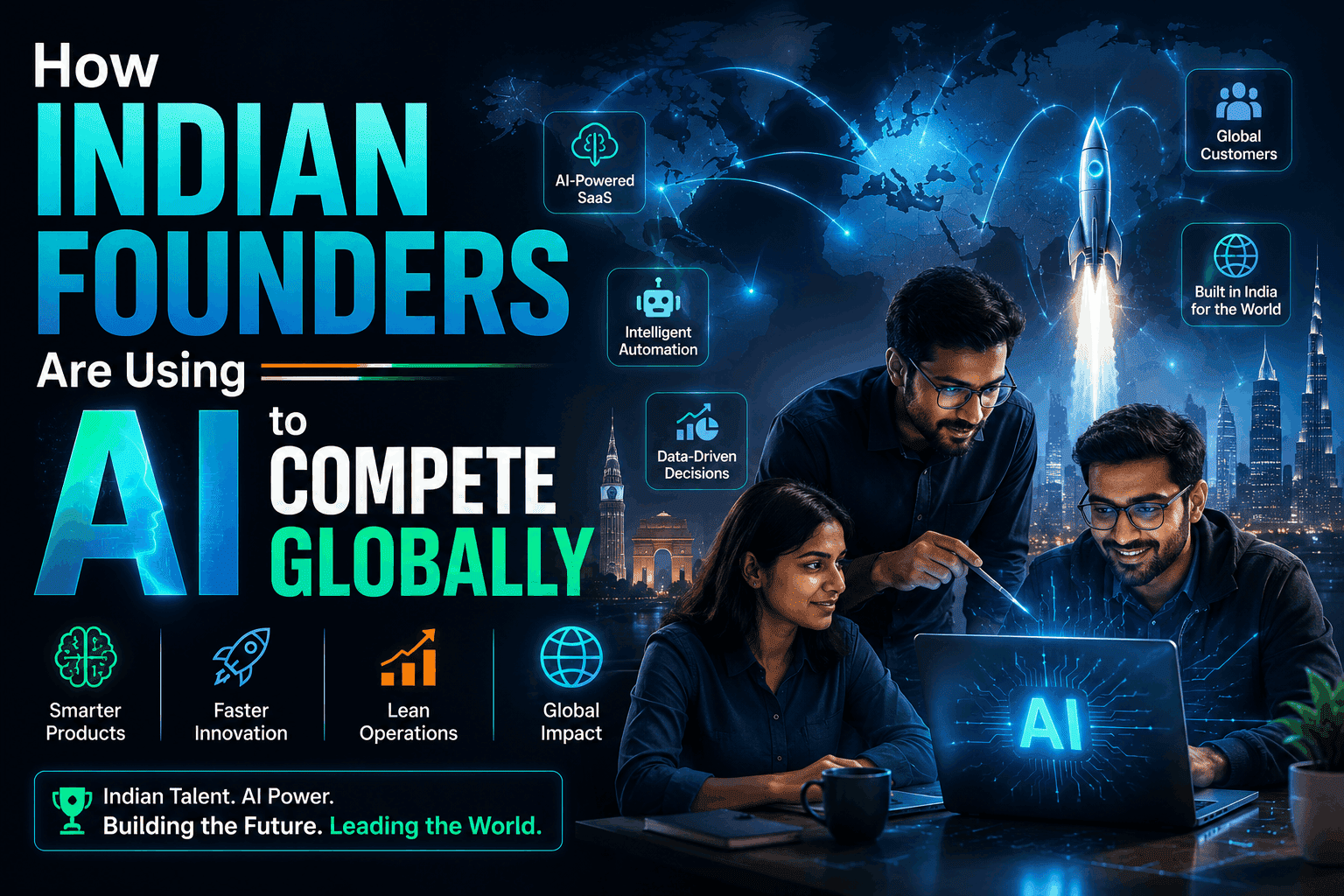
Indian founders are using AI to close the gap with well-funded Western competitors not by copying them, but by doing things that weren’t possible before AI existed. They are building leaner teams, shipping faster, and reaching global customers without needing global offices. The playbook is new, and it is being written right now.
The Setup Nobody Talks About
Here is a number worth sitting with: India produces roughly 1.5 million engineering graduates every year. It has one of the largest pools of English-speaking tech talent on the planet. And yet, for decades, Indian startups were seen as service businesses, not product companies. The default assumption, both inside India and outside was that the really interesting product innovation happened elsewhere.
That assumption is breaking.
Not because India suddenly changed. But because AI changed the economics of building a global software product. The advantages that used to belong exclusively to well-capitalized Silicon Valley startups large teams, expensive enterprise sales, multilingual support, sophisticated marketing are no longer exclusively theirs.
Indian founders figured this out early. And quietly, they started using it.
What “Competing Globally” Actually Means for an Indian Startup
Before getting into the how, it helps to be specific about what global competition means in practice.
It does not mean having an office in San Francisco. It means closing deals with customers in Germany, Australia, and the UAE without leaving Bangalore. It means your product is reviewed alongside Salesforce and HubSpot, not after them. It means your support ticket response time is the same whether the customer is in Mumbai or Munich.
For most Indian startups five years ago, this was structurally difficult. The cost of hiring a multilingual support team was prohibitive. Building and iterating on product fast enough to keep pace with funded US competitors was hard. The sales cycle for enterprise customers abroad required a physical presence that most early-stage Indian startups could not afford.
AI did not solve all of these problems. But it made enough of them tractable that a new generation of founders is treating global as their first market, not their fifth.
7 Ways Indian Founders Are Actually Using AI
1. Building AI-Native Products, Not AI-Decorated Ones
The clearest advantage Indian founders have right now is timing. Many of them started building after foundation models became genuinely capable which means they designed their products around AI from day one, rather than retrofitting it.
Sarvam AI, founded by Vivek Raghavan and Pratyush Kumar, is building language models specifically for Indian languages not as a side feature, but as the core product. Their focus is on the 1.4 billion people whose first language is not English. That is not a niche. That is a market that most global AI companies have treated as an afterthought.
Bhavish Aggarwal’s Krutrim, India’s first unicorn AI company, is building AI infrastructure with a specific thesis: that India needs its own AI stack, not a dependency on models trained primarily on Western data. Whether or not that thesis plays out exactly as planned, the ambition is different from what Indian founders were building five years ago.
The pattern is consistent. The most interesting Indian AI startups are not layering AI onto an existing SaaS product to add a chatbot. They are asking: what does this category look like if you build it assuming AI exists?
2. Compressing Team Size Without Compressing Ambition
One of the more striking things happening in Indian startup circles right now is the conversation about team size. Founders who would have previously needed a team of 50 to build and ship a product are doing it with 12. Not because they are cutting corners, but because AI handles chunks of the work that previously required headcount.
“We shipped our first version in six weeks with a four-person team,” said Arjun Malhotra, co-founder of a Pune-based B2B SaaS startup serving mid-market retailers in the US and UK. “Three engineers and one designer. The AI wrote a significant portion of the boilerplate, the documentation, and the first draft of our customer-facing help content. We were in market before companies that started at the same time as us and raised three times what we raised.”
This compression matters for global competition because it changes the funding math. An Indian startup with a lower burn rate can reach the same milestone as a US competitor with a fraction of the capital which means they can stay independent longer, raise on better terms, or simply reach profitability faster.
3. Multilingual Customer Support Without a Multilingual Team
Enterprise sales to global customers historically required local support. A European customer dealing with a billing issue at 10 PM their time did not want to wait until morning in India. That gap used to cost deals.
AI-powered support has changed this more than almost anything else. Companies like Yellow.ai and Haptik – both Indian-founded – built conversational AI platforms that now power customer support for companies across 30+ countries. But what is more interesting is that smaller Indian startups are now using tools like these (or building their own lightweight versions) to offer 24/7, multilingual support without a single overseas hire.
Rohan Verma, founder of a Delhi-based logistics SaaS company with customers in Southeast Asia, described it plainly: “Our support AI handles queries in Bahasa Indonesia, Tagalog, and Thai. My team speaks none of those languages. Before AI, that market was simply closed to us. Now it is not.”
4. Closing the Sales Intelligence Gap
One of the more underappreciated barriers for Indian startups going global has been sales intelligence. Enterprise sales in the US or Europe runs on context – knowing a company’s recent funding, their executive changes, their stated strategic priorities, their existing tech stack. Historically, US-based sales teams had this context by proximity. Indian sales teams had to work harder to get it.
AI has substantially compressed that gap. Founders describe using AI tools to research prospects in depth, generate highly personalized outreach, analyze competitor positioning, and prepare for calls with context that previously would have required a dedicated sales researcher.
“The quality of our discovery calls went up sharply when we started using AI for pre-call research,” said Priya Nair, who runs sales at a Chennai-based cybersecurity startup. “We walk into calls knowing things about the prospect’s business that they are surprised we know. It changes the dynamic.”
5. Speed-to-Market as a Competitive Weapon
Freshworks, now a publicly listed company on NASDAQ, proved the thesis early: an Indian-founded SaaS company could compete directly with Zendesk and Salesforce on product quality, not just price. What Freshworks did by building a large team over years, a new wave of Indian startups is attempting to do faster, with smaller teams, using AI as a force multiplier.
The gap between “idea” and “in market” has collapsed for technical founders who know how to work with AI tools well. This matters globally because the standard playbook for large enterprise software companies – slow, deliberate product cycles – is increasingly vulnerable to faster-moving competitors.
Darwinbox, the Hyderabad-based HR tech platform now used by companies like Mahindra, Tokopedia, and Dalmia Bharat, has been explicit about using AI to accelerate its product roadmap. Their AI features – predictive attrition, intelligent performance reviews, automated payroll anomaly detection – ship at a pace that larger incumbent HR platforms have found difficult to match.
6. Using India’s Data Diversity as a Product Advantage
There is something counterintuitive happening in AI that Indian founders are well-positioned to exploit. The most capable AI systems in the world were trained predominantly on English-language internet data. That means they perform better in English and worse in other languages and contexts.
India, with 22 official languages and a population that spans enormous economic and cultural diversity, generates data that most Western AI companies do not have clean access to. Founders who understand this are building products that work better in Indian and emerging market contexts than anything built in San Francisco can match.
SigTuple, a Bangalore-based medical AI company, trained its diagnostic models on blood sample data from Indian patients. The result is a system that outperforms imported AI diagnostics in Indian clinical settings because it was built on data that actually reflects the population it serves. They are now expanding into Southeast Asia and the Middle East markets with similar data profiles not despite their Indian focus, but because of it.
7. Redefining What “Affordable” Means at Global Quality
Indian founders have always competed on cost. What is different now is that “affordable” no longer implies a quality tradeoff in software. AI has raised the baseline quality of what a lean team can produce.
An Indian startup with 15 engineers using AI effectively can produce software that competes on features with a US startup with 60 engineers. That used to be impossible. It is not anymore.
The downstream effect is that the “India = budget option” positioning that previously constrained Indian SaaS companies in global markets is weakening. Customers are choosing Indian products not because they are cheaper, but because they are good and happen to come with better pricing.
Data Snapshot: Indian AI Startups in 2026
| Metric | Figure |
|---|---|
| Indian AI startups (active, 2026) | 3,000+ |
| AI-related startup funding in India (2025) | $2.1 billion |
| Indian AI unicorns | 6 (as of Q1 2026) |
| % of Indian SaaS startups with AI features | ~67% |
| Indian AI startups with customers in 10+ countries | ~400 |
Sources: NASSCOM AI Report 2025, Inc42 State of Indian Startup Ecosystem 2026
What Indian Founders Are Still Getting Wrong
This would be an incomplete picture without the friction.
The AI advantage is real, but it is not automatic. Several Indian founders interviewed for this piece mentioned the same set of failure modes.
Over-relying on AI-generated content for sales and marketing. Outreach that sounds like it was written by a machine – because it was – gets ignored faster than ever. Buyers are trained to spot it. The founders winning globally use AI for research and structure, but insist on human voice in customer-facing communication.
Building for India first, global later. This sounds like caution. It often leads to a product that does not travel. The founders with the strongest global traction designed for a global customer from day one, even if their first 10 customers were Indian.
Underinvesting in trust signals. An Indian startup selling to an enterprise in Germany faces a trust deficit that a US startup does not. AI can help with the product, but it cannot substitute for case studies, references, and visible proof of reliability. Founders who skip this step lose deals they should win.
The Honest Assessment
India’s AI moment is real. It is not hype.
But it is also not inevitable. The founders who are winning globally are not winning because they are Indian and they use AI. They are winning because they are obsessive about their customers, technically sharp, and genuinely building things the world needs and they are using AI to move faster than the previous generation of Indian founders could.
The structural advantages – large talent pool, cost efficiency, data diversity, strong diaspora networks – were always there. AI is not what created the opportunity. It is what made the opportunity executable.
“People keep asking me what our AI strategy is,” said one founder who builds accounting software for small businesses across Africa and Southeast Asia, and who asked not to be named. “I always tell them: the same as our product strategy. Make something that actually works for the person using it. AI just helps us do that faster.”
That is probably the most accurate summary of where the best Indian founders are right now. Not racing to add AI features. Using AI to build things that actually work, for people the global tech industry has largely ignored.
The results are starting to show.
Key Takeaways
- Indian founders are using AI to compress team sizes, accelerate product development, and offer multilingual support without overseas offices.
- AI-native Indian startups built around AI from day one rather than retrofitting it, are the ones with the strongest global competitive position.
- India’s data diversity (22+ languages, large underserved populations) is a structural advantage in AI product development that most Western companies have not exploited.
- The “India = budget software” positioning in global markets is weakening as AI raises the baseline quality of what lean Indian teams can produce.
- Indian AI startup funding reached $2.1 billion in 2025, with 3,000+ active AI startups and 6 unicorns as of Q1 2026.
- The founders winning globally are not winning because of AI alone, they are winning because they design for global customers from day one and use AI to move faster.
Frequently Asked Questions
Which Indian startups are using AI to compete globally?
Several Indian startups are building globally competitive AI products, including Sarvam AI (Indian-language models), Krutrim (AI infrastructure), Yellow.ai (conversational AI), Darwinbox (AI-powered HR tech), Freshworks (customer experience AI), and SigTuple (medical AI). Many smaller, early-stage Indian startups are also using AI tools to reach global customers without large teams or overseas offices.
How does AI help Indian startups compete with US companies?
AI helps Indian startups compress team sizes, ship product faster, offer 24/7 multilingual customer support, improve sales intelligence for global markets, and reach price-performance benchmarks that previously required far more capital. The net effect is that a small Indian team can compete on product quality, not just price, with larger Western competitors.
What is India’s advantage in AI?
India has a large pool of English-speaking technical talent, significant data diversity across languages and economic contexts, cost-efficient operations, and a growing ecosystem of AI-focused investors and accelerators. Indian founders who build for underserved markets in Southeast Asia, the Middle East, and Africa also have a data and cultural context advantage over Western AI companies targeting those regions.
Are Indian AI startups profitable?
Many Indian AI startups, particularly those in the SaaS and B2B space, have been more capital-efficient than their US counterparts and have reached profitability at smaller revenue scales. However, deep tech AI companies building foundation models or AI infrastructure (like Krutrim or Sarvam AI) require significant capital and are not yet profitable.
What challenges do Indian AI startups face globally?
The main challenges include building trust with international enterprise buyers, avoiding over-reliance on AI-generated sales and marketing that feels generic, and designing products for global customers from the start rather than retrofitting them. Brand recognition and sales distribution in markets like North America and Europe also remain harder to build for Indian startups than for locally headquartered competitors.
Entrepreneur Bus covers startup stories, founder journeys, and the ideas shaping the global innovation economy. Have a story to share? Submit it here.
What do you feel about this post?

Like

Love

Happy

Haha

Sad