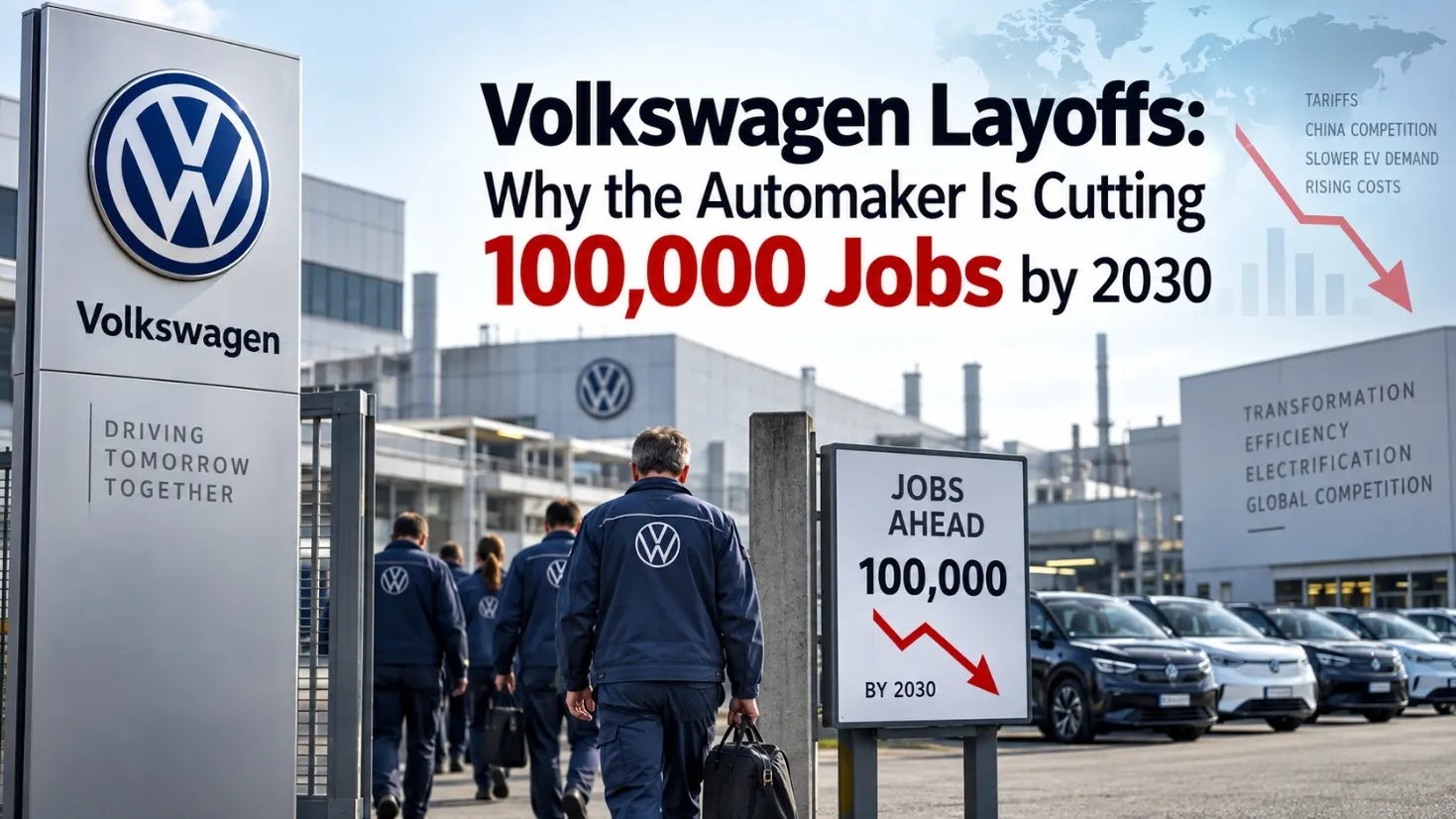
Volkswagen is cutting 100,000 jobs by the end of the decade, one of the largest workforce reductions in automotive history. The move builds on 50,000 job cuts already agreed with unions in late 2024, pushing the total reduction to around 15% of the company’s global staff of roughly 660,000 people. Volkswagen Group – the parent of VW, Audi, and Porsche – is also reconsidering the future of four German plants as part of a broader plan to cut costs, restructure its business, and compete with rising Chinese rivals.
Here’s a breakdown of what’s happening, why it’s happening now, and what it means for Volkswagen’s workforce and the wider auto industry.
Key Facts at a Glance
- Total planned job cuts: 100,000 (roughly 15% of Volkswagen’s global workforce)
- Additional cuts announced: 50,000 new positions, on top of 50,000 already agreed to in 2024
- Plants under review: Hanover, Zwickau, and Emden (Volkswagen), plus Audi’s Neckarsulm site
- Jobs at those four sites: More than 45,000
- Global VW Group workforce: Around 657,000–667,000 employees, with roughly 43% based in Germany
- Timeline: Cuts to be carried out by 2030; exact regional breakdown not yet disclosed
- Key pressures: US tariffs, falling China sales, slowing EV demand, rising competition from Chinese automakers like BYD
Why Is Volkswagen Cutting 100,000 Jobs?
Volkswagen’s restructuring is being driven by a mix of financial strain and competitive pressure that has built up over several years rather than a single event.
Falling profits: In the first quarter of 2026, Volkswagen’s net profit dropped by roughly 28% year-over-year to about €1.56 billion, while revenue slipped around 2% to €75.7 billion.
US tariffs: Group CFO Arno Antlitz has put the annual cost of US tariffs on Volkswagen at approximately €4 billion.
Losing ground in China: China is Volkswagen’s largest single market, but first-quarter sales there reportedly fell around 20% as domestic manufacturers, particularly BYD, continue gaining share.
Slower EV demand: Despite Volkswagen being one of Europe’s leading EV producers, demand for electric models has grown more slowly than the company planned for, leading to repeated production pauses at EV-focused plants like Zwickau.
Together, these pressures pushed Volkswagen’s leadership to move well beyond its original 2024 restructuring plan.
Which Volkswagen Plants Could Close?
Volkswagen has said it cannot guarantee the long-term future of four major German manufacturing sites:
- Hanover – a long-standing Volkswagen commercial vehicle plant
- Zwickau – recently converted into a dedicated EV production site for multiple VW Group brands, but hit by weak EV demand and repeated output pauses
- Emden – another core Volkswagen manufacturing site in northern Germany
- Neckarsulm – Audi’s plant, one of the brand’s key production hubs
Combined, these four sites employ more than 45,000 workers. If any of them close, it would reportedly be the first time Volkswagen has fully shut a plant on German soil in the company’s history – a symbolically significant step for a brand closely tied to German industrial identity, and one that local officials warn could hollow out entire surrounding communities that depend on the plants and their supplier networks.
How Volkswagen’s Unions Are Responding
The scale of the plan has triggered a sharp standoff between Volkswagen’s management and its workforce representatives.
Under a 2024 agreement, unions accepted 50,000 job cuts on the condition that Volkswagen wouldn’t pursue further layoffs or plant closures before 2030. Doubling that number is seen by labor representatives as a breach of that understanding. IG Metall, Germany’s largest metalworkers’ union, along with Volkswagen’s General Works Council, has publicly pledged to resist the plan by every means available.
Tension was also fueled by how the news broke: reports of the 100,000-job figure circulated publicly before management formally briefed employees internally, which unions have criticized as a breakdown in transparency.
What Else Is Changing at Volkswagen?
The layoffs are part of a much larger restructuring effort, not a standalone cost-cutting measure:
- Corporate restructuring: Volkswagen plans to split its core VW brand and parts/components operations into separate legal entities, potentially setting up future stock market listings for individual brands or divisions.
- Fewer subsidiaries: The group intends to reduce its number of companies and holdings by roughly a third to simplify decision-making.
- Investment cuts: Planned five-year investment has reportedly been trimmed by around 15%, to a bit over €130 billion.
- R&D spending: Despite the cuts, Volkswagen says it will still commit a “three-digit billion” sum toward research and development to strengthen future competitiveness.
- Geographic shift: The company is placing more emphasis on North America and Global South markets for exports, alongside efforts to shore up its position in China.
- Precedent: Volkswagen has already closed one major European site – its Audi Brussels (Forest) plant – in February 2025, ending 76 years of production there and cutting around 3,000 jobs.
How This Compares to Other Automaker Layoffs
Volkswagen’s own leadership has called this the biggest overhaul in its 89-year history. For context, General Motors cut about 50,000 jobs during its 2009 bankruptcy – half the scale of what Volkswagen is now planning. The restructuring reflects a broader shift across the global auto industry, where legacy manufacturers are being squeezed simultaneously by trade tariffs, a slower-than-expected EV transition, and fast-growing Chinese competitors expanding into international markets.
What Happens Next
Volkswagen has not yet confirmed a detailed timeline or regional breakdown for the job cuts, and formal negotiations with unions are expected to continue. Given the strength of union pushback and the employment guarantees currently in place through 2030, the final scope, timing, and plant-closure decisions could still shift before implementation begins.
Frequently Asked Questions
How many jobs is Volkswagen cutting?
Volkswagen plans to cut 100,000 jobs in total – 50,000 already agreed to in 2024, plus 50,000 additional positions announced more recently.
Which Volkswagen plants might close?
Four German plants are under review: Volkswagen’s sites in Hanover, Zwickau, and Emden, and Audi’s plant in Neckarsulm. Together they employ more than 45,000 people.
Why is Volkswagen laying off so many workers?
The cuts stem from falling profits, roughly €4 billion a year in US tariff costs, a sharp sales decline in China, and slower-than-expected demand for electric vehicles.
When will the Volkswagen layoffs happen?
Volkswagen says the cuts will be carried out by 2030, but it hasn’t specified an exact timeline or how the reductions will be spread across regions.
Is this the biggest layoff in Volkswagen’s history?
Yes. Company leadership has described it as the largest workforce restructuring in Volkswagen’s 89-year history, roughly double the scale of General Motors’ 50,000 job cuts during its 2009 bankruptcy.
How are Volkswagen’s unions reacting?
IG Metall and Volkswagen’s General Works Council have vowed to resist the plan, arguing it breaks a 2024 agreement that was meant to protect jobs and plants through 2030.
What do you feel about this post?

Like

Love

Happy

Haha

Sad