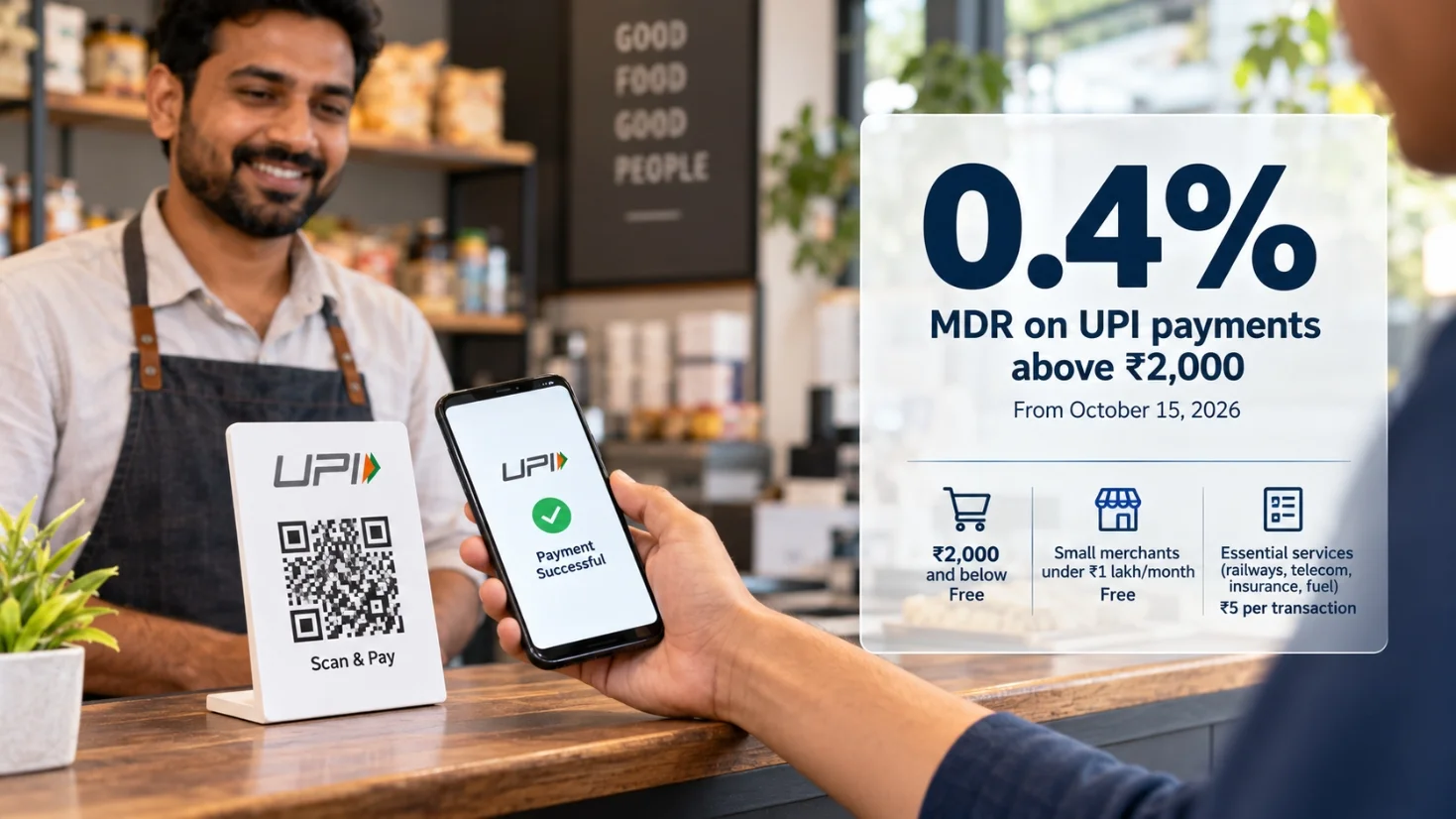
From October 15, 2026, NPCI is charging a 0.4% Merchant Discount Rate (MDR) on UPI payments above ₹2,000 made to merchants. Customers don’t pay anything extra – the fee comes out of the merchant’s side, split between banks, payment apps, and NPCI. Payments up to ₹2,000, all person-to-person transfers, and small shops collecting under ₹1 lakh a month via UPI QR stay completely free.
If you run a shop, a café, a service business, or an online store that takes UPI, that last sentence about the ₹1 lakh threshold is the one to read twice. It decides whether this rule touches you at all.
What Actually Changed on September 15, 2026
NPCI released a circular and an accompanying FAQ document on September 15, reintroducing MDR on UPI person-to-merchant (P2M) transactions after a six-year gap. Zero-MDR on UPI and RuPay debit cards has been government policy since January 2020 – a decision that helped UPI grow from a novelty into the payment rail behind roughly 24.5 billion transactions a month.
That zero-MDR model was never free to run. Someone had to pay for servers, fraud monitoring, and customer support, and for six years that someone was the government, through an annual incentive scheme. NPCI’s own estimate puts the yearly cost of running UPI at close to ₹20,000 crore. The new MDR is the ecosystem’s attempt to fund itself instead of waiting on a budget line every year.
What Is UPI MDR, in Plain Terms
Merchant Discount Rate is the cut a payment network takes for processing a transaction. When you swipe a credit card, the merchant doesn’t get the full amount – a slice goes to the bank, the network, and the payment processor. That’s MDR, and it’s existed on cards for decades. UPI simply never had one, because the government waived it to push adoption.
It’s not a tax. Nobody collects it into a government account. It gets split among the acquiring bank, the payment service provider, and NPCI (which takes a 0.02% switching fee out of the total), and the money is meant to fund infrastructure, fraud prevention, and the next round of features.
The 0.4% Rule, in Rupees
Here’s what the charge looks like on real transaction amounts:
| Transaction amount | MDR (0.4%) | What the merchant actually pays |
| ₹2,000 or below | 0% | ₹0 |
| ₹3,000 | 0.4% | ₹12 |
| ₹10,000 | 0.4% | ₹40 |
| ₹50,000 | 0.4% | ₹200 |
| ₹75,000 | 0.4% (capped) | ₹300 |
| ₹1,00,000 | Would be ₹400, capped instead | ₹300 |
That cap matters more than it looks. Without it, a ₹5 lakh UPI payment would cost ₹2,000 in MDR. With it, the ceiling stays at ₹300 no matter how large the transaction gets, once you cross ₹75,000.
A handful of sectors – railways, telecom, insurance, and fuel – get a flat ₹5 MDR per transaction above ₹2,000 instead of the percentage rate, to keep essential-service payments predictable.
The P2PM Exemption: The Part Most Small Business Owners Will Miss
This is the section that actually decides whether the new rule costs you anything.
NPCI has created a category called P2PM – Person-to-Person-Merchant – for small vendors who take UPI payments straight into a personal or basic current account through a QR code. If your monthly UPI collections stay under ₹1 lakh, you sit in P2PM, and P2PM pays zero MDR. Full stop. It doesn’t matter if one customer pays you ₹8,000 in a single transaction – a single payment above ₹2,000 does not, by itself, move you out of the exempt category.
What does move you out is volume, not a single transaction size. If your UPI collections cross ₹1 lakh a month for three consecutive months, banks and payment providers reclassify you into the standard P2M category, and from that point, transactions above ₹2,000 attract the 0.4% MDR.
A worked example, straight from how NPCI has framed the transition: a shopkeeper collects ₹90,000 in month one, ₹1.05 lakh in month two, ₹1.1 lakh in month three. That’s two months above the threshold, not three in a row starting from month one – so the account stays P2PM for now. Cross ₹1 lakh for three straight months and the switch happens.
Two more things worth knowing if you’re running a small shop:
- You don’t need GST registration to qualify for P2PM zero-MDR. Eligibility is based on your monthly collection amount, not your tax status.
- Your existing QR code and soundbox keep working exactly as they do now. There’s no hardware change, no re-registration, no new sticker to put up.
Will This Push Prices Up for Customers?
No – and NPCI has been explicit that merchants are not allowed to pass the MDR on as a surcharge. Consumers pay the posted price. UPI apps also can’t add a platform fee of their own on top. In practice, a merchant absorbing 0.4% on a ₹10,000 sale is losing ₹40 in margin, not adding ₹40 to your bill. Whether that pressure eventually shows up in prices indirectly is a separate question – but there’s no line-item MDR charge appearing on your payment screen.
What to Actually Do If You Run a Small Business
This is the part the news coverage skips, so here it is straight:
- Check your last three months of UPI inflow. If you’re consistently under ₹1 lakh a month, you’re in P2PM and this changes nothing for you before October 15.
- If you’re close to or above ₹1 lakh a month, talk to your payment provider now, not after the reclassification notice arrives. Ask them directly whether your account is currently tagged P2M or P2PM – this isn’t always visible from the merchant app dashboard.
- If you’re already firmly P2M (larger stores, restaurants, most e-commerce sellers), build the 0.4% into your margin math the same way you’d account for a payment gateway fee. It’s smaller than card MDR, but it’s not zero anymore.
- Don’t try to structure transactions to dodge the rule – splitting a ₹3,000 bill into two ₹1,500 UPI requests to stay under the threshold. Payment providers reconcile against your total monthly collection, not per-transaction amounts, so it won’t work and it complicates your own bookkeeping for nothing.
- Watch for the small-merchant fund. NPCI has said a separate support framework for small merchants will be finalised with the RBI within three months. That’s a signal, not a rule yet – worth checking back on in Q1 2027.
UPI MDR vs. Card MDR: How It Actually Compares
| Payment method | Typical MDR | Cap on high-value transactions |
| Credit card | 1.5%–2.5% | Usually none, or a high internal cap |
| Debit card | Up to 0.9% | ₹1,000 per transaction (RBI rule) |
| UPI (from Oct 15, 2026) | 0.4% | ₹300 per transaction |
Even after this change, UPI stays the cheapest way to accept digital payments in India by a wide margin. A ₹50,000 sale costs a merchant somewhere between ₹750 and ₹1,250 on credit card, up to ₹450 on debit card, and ₹200 on UPI. That comparison is probably why NPCI feels comfortable introducing the charge now – it’s still landing well below every other rail, not above it.
Timeline: What Happens When
- September 15, 2026 – NPCI issues the circular and FAQ.
- October 15, 2026 – 0.4% MDR takes effect on eligible P2M UPI transactions above ₹2,000.
- Within 3 months of the circular – RBI and NPCI to finalise a support framework for small merchants.
- Ongoing – Banks and payment providers begin monitoring P2PM accounts against the ₹1-lakh-for-three-months threshold.
Frequently Asked Questions
Does UPI MDR apply to me if I use PhonePe or Google Pay to send money to friends?
No. Person-to-person (P2P) transfers stay completely free regardless of amount. MDR only applies to person-to-merchant (P2M) payments – money going to a registered business account.
I run a small kirana store and take one big UPI payment of ₹15,000 a month from a wholesaler. Do I pay MDR?
Not automatically. A single large transaction doesn’t move you out of the P2PM exempt category. What matters is your total monthly UPI collection across three consecutive months. If your overall monthly total stays under ₹1 lakh, you remain exempt.
Can a shop legally add the MDR charge to my bill as a customer?
No. NPCI’s framework explicitly states merchants cannot pass MDR on to consumers as a separate charge. You should only ever pay the listed price.
What happens if I cross ₹1 lakh a month just once and then drop back down?
Nothing changes immediately. Reclassification from P2PM to P2M only happens after collections stay above ₹1 lakh for three consecutive months, not after a single high month.
Is the 0.4% MDR the final rate, or could it change?
NPCI has said the operational details, sector-specific caps, and fee distribution will be finalised by the UPI and Services Steering Committee, so some specifics could still be adjusted before or after October 15. The 0.4% headline rate and the ₹300 cap are what’s confirmed as of this writing.
The Bottom Line
Zero-MDR UPI had a good six-year run, but it was never meant to be permanent – it was a subsidy to build habit, and the habit is built. For most small shop owners, this change costs nothing, because most day-to-day UPI collections either fall under ₹2,000 per transaction or under ₹1 lakh a month in total. If you’re a growing business sitting right around that ₹1 lakh line, this is the month to find out exactly which category your account falls into – before the reclassification notice does it for you.
What do you feel about this post?

Like

Love

Happy

Haha

Sad