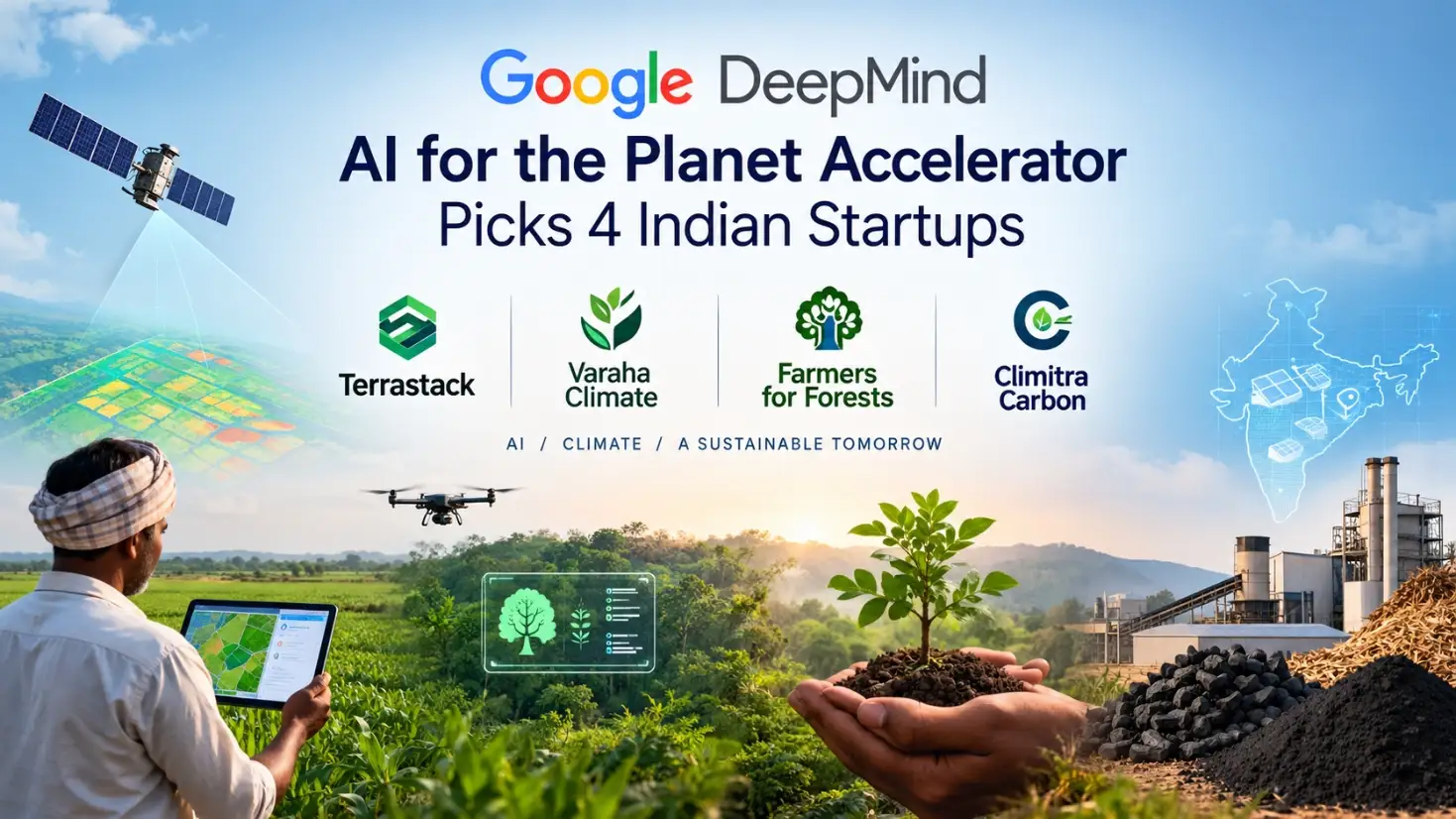
Four Indian startups just landed a seat at Google DeepMind’s table. Terrastack, Varaha Climate, Farmers for Forests, and Climitra Carbon are joining the inaugural cohort of the Google DeepMind Accelerator: AI for the Planet (APAC) – a climate-focused program that hands selected teams frontier AI models, technical support, and three months of Google engineering time.
That’s the headline. The more interesting question, if you run a climate-tech or agritech startup in India, is what this actually opens up.
Key Takeaways
- Google announced the selections on September 14, 2026, naming Terrastack, Varaha Climate, Farmers for Forests, and Climitra Carbon as the four Indian participants.
- They join a cohort of 16 organisations from across Asia-Pacific – a mix of startups, nonprofits, and research teams.
- The program runs three months: it opened with a bootcamp in Singapore from September 7–11, and wraps with a Demo Day in December 2026.
- Alongside the accelerator, Google confirmed a 150 MW solar deal with ReNew Power in Rajasthan and a rooftop-solar AI mapping project covering 300 million Indian buildings.
What Happened
Google DeepMind opened applications for its first “AI for the Planet” cohort earlier this year, targeting organisations using AI to tackle climate and biodiversity problems across the Asia-Pacific region. On September 14, Google confirmed the final list: 16 organisations total, four of them Indian.
The Indian founders in question have already been building for years – this isn’t a first-time-founder accelerator. Terrastack layers satellite imagery with agronomic data to give farmers plot-level land intelligence, essentially telling a smallholder what’s actually happening on their specific patch of land rather than a district-wide average. Varaha Climate does something adjacent but distinct: it uses remote sensing to verify regenerative agriculture practices, which is the unglamorous but essential work behind letting small farmers actually sell carbon credits instead of just talking about them.
Farmers for Forests takes a different route – a payments-for-ecosystem-services model that pays farmers and communities to convert degraded land into biodiverse forest, tracked using AI-powered drones. And Climitra Carbon is working on converting waste biomass into bio-coal and biochar, positioning its output as a direct swap for fossil coal in steelmaking while locking carbon away permanently.
Four startups, four different bets on the same underlying problem: climate data in India is patchy, hard to verify, and expensive to collect at scale.
Why It Matters for Indian Climate-Tech Founders
Here’s the part most coverage of this news skipped: what a three-month sprint with Google’s AI stack is actually worth to a startup at this stage.
For companies like Terrastack and Varaha Climate, the bottleneck usually isn’t the business model – it’s compute and model access. Running satellite image analysis or remote-sensing verification at national scale takes serious infrastructure, and that’s exactly the constraint Google is offering to lift for free during the program. Free frontier-model access for three months can compress a roadmap that would otherwise take a funding round to execute.
There’s also a credibility dividend that outlasts the program itself. A “Google DeepMind cohort” line on a pitch deck reads differently to an investor than “we’re building climate AI” on its own. Expect these four names to show up in seed and Series A conversations over the next two quarters, and expect other India-based climate startups to start positioning themselves for the second cohort, whenever Google opens it.
What to Expect Next
The cohort’s real test is the December 2026 Demo Day, where each organisation presents what it built with the extra AI access. Watch for two things: whether any of the four announce new partnerships with state agriculture departments or carbon registries, and whether Google turns this pilot into an annual program rather than a one-off.
Separately, Google’s broader India clean-energy push – the ReNew Power solar deal and the rooftop-mapping API – signals the company sees India as more than an accelerator market. It’s treating the country as a testbed for AI-driven climate infrastructure at scale, and the accelerator looks like the R&D layer feeding that larger bet.
Frequently Asked Questions
Which Indian startups were selected for Google DeepMind’s AI for the Planet accelerator?
Four Indian startups made the cohort: Terrastack (satellite-based land intelligence for farmers), Varaha Climate (AI-verified regenerative agriculture and carbon credits), Farmers for Forests (AI-tracked agroforestry and biodiversity restoration), and Climitra Carbon (biomass-to-biochar carbon removal).
What do participating startups get from the program?
Selected organisations get three months of access to Google’s AI stack, including frontier models, plus dedicated technical support and mentorship from Google DeepMind’s team, ending with a Demo Day in December 2026.
How many organisations are in the accelerator’s first cohort?
Sixteen organisations from across the Asia-Pacific region – a mix of startups, nonprofits, and research groups – make up the inaugural AI for the Planet cohort, with the four Indian startups among them.
Is this connected to Google’s other climate investments in India?
Yes. Google announced the accelerator selections alongside a 150 MW solar power agreement with ReNew Power in Rajasthan and an AI-powered rooftop-solar mapping initiative covering roughly 300 million buildings in India, part of a broader clean-energy push in the country.
What do you feel about this post?

Like

Love

Happy

Haha

Sad