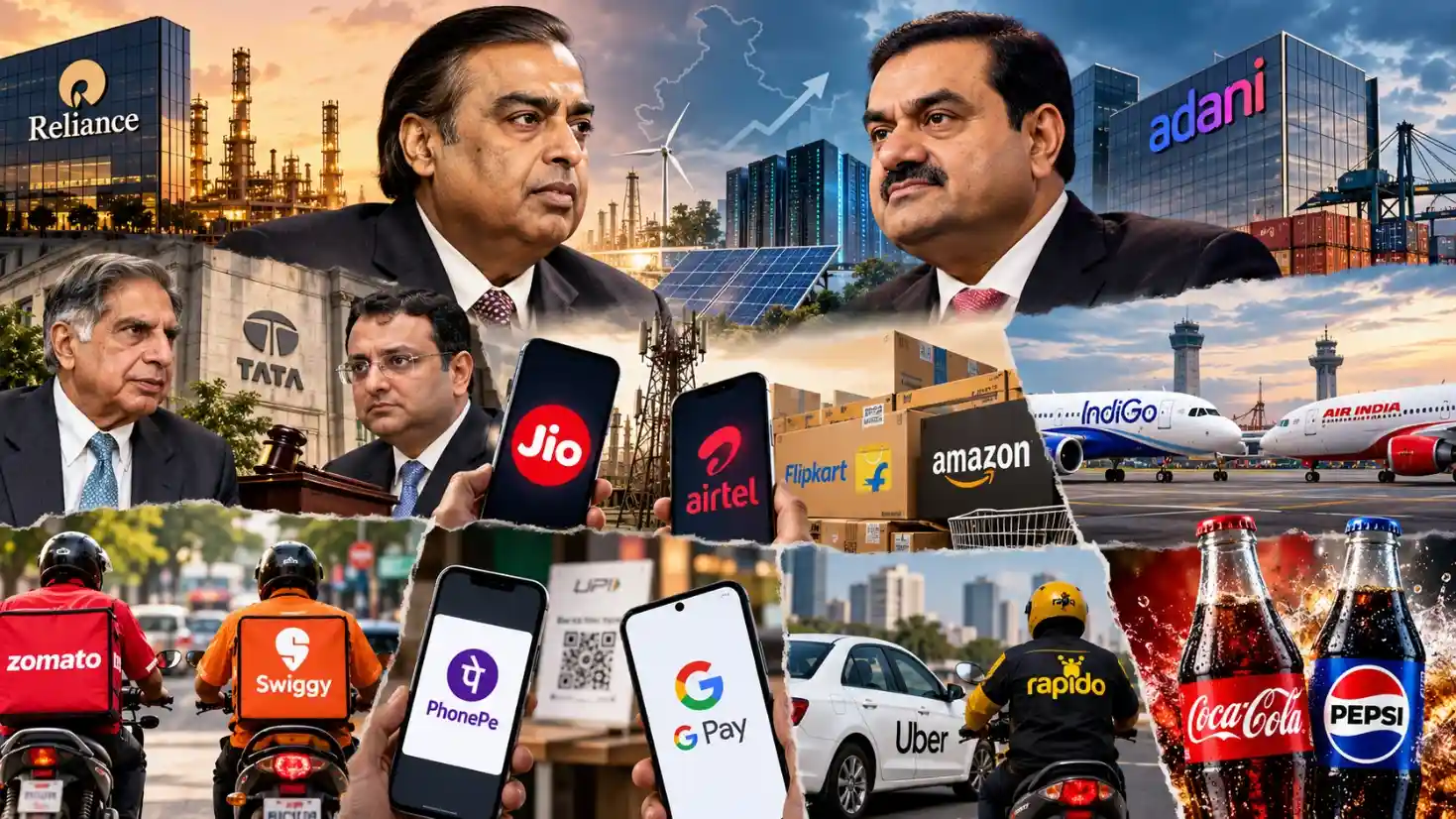
The biggest business rivalries in India don’t all look like fights. Some play out in courtrooms. Some play out in app stores. One gets scored every month in a TRAI report.
What they share is money and customers. These contests decide what you pay for a phone plan, a flight, a grocery order or a UPI transfer, and in one case who controls a group with more than $100 billion in annual revenue. We picked ten, ranked them by what’s at stake and pulled the latest numbers we could verify. Where a figure is an estimate, we say so.
What Are the Biggest Business Rivalries in India?
The biggest business rivalries in India are Mukesh Ambani vs Gautam Adani, Tata Sons vs the Mistry family, Jio vs Airtel, Flipkart vs Amazon, IndiGo vs Air India, Eternal vs Swiggy, PhonePe vs Google Pay, Mukesh vs Anil Ambani, Uber vs Rapido, and Coca-Cola vs Pepsi. We ranked them by money at stake and customers affected.
Here’s the quick view before the detail:
| # | Rivalry | Arena | Latest edge |
| 1 | Ambani vs Adani | Green energy, petrochemicals, data centres | No clear winner; overlap grows every year |
| 2 | Tata Sons vs Mistry family | Control of Tata Sons | Tata Trusts hold about 66%, Mistry family about 18.4% |
| 3 | Jio vs Airtel | Mobile and broadband | Jio 39.31%, Airtel 38.01% of subscribers (Aug 2026) |
| 4 | Flipkart vs Amazon | E-commerce | Flipkart ahead on GMV share |
| 5 | IndiGo vs Air India | Domestic aviation | IndiGo 67.4%, Air India Group 24% (Jul 2026) |
| 6 | Eternal vs Swiggy | Food delivery, quick commerce | Eternal’s Blinkit well ahead of Instamart |
| 7 | PhonePe vs Google Pay | UPI payments | PhonePe about 46%, Google Pay about 33% (May 2026) |
| 8 | Mukesh vs Anil Ambani | Family split | Mukesh, by a wide margin |
| 9 | Uber vs Rapido | Ride-hailing | Uber in cabs, Rapido in total rides |
| 10 | Coca-Cola vs Pepsi | Soft drinks | Long stalemate; no verified current split |
How We Ranked These Rivalries
We looked at four things: the money at stake, the number of customers affected, how openly the two sides fight, and whether the contest is still live in 2026. That last filter is why this list has Uber vs Rapido instead of the old Ola vs Uber. The ranking is our judgment, so expect arguments.
1. Mukesh Ambani vs Gautam Adani
Two Gujarati billionaires. Two sprawling groups. And for years, an unspoken agreement to stay out of each other’s way.
Reliance Industries, led by Mukesh Ambani, grew from oil refining and petrochemicals into telecom and retail. The Adani Group, led by Gautam Adani, built its name on ports, coal, power and airports. Those lanes barely touched until green energy opened a big shared one. In 2021 Ambani announced a $10 billion clean-energy push, and Quartz reported that Adani Green Energy’s share price fell after the news. Adani, meanwhile, set up a petrochemicals business that same year, the field Ambani’s father Dhirubhai started in. Data centres and the 2022 5G airwave auction added more overlap.
Then came an odd twist. In March 2024 Reliance agreed to take a 26% stake in an Adani Power project in Madhya Pradesh as part of a captive-power deal, the first time the two had worked together on anything. Rivals one quarter, customer and supplier the next.
Our read: this is less a street fight than two giants bumping elbows as they both get bigger. When they do collide, buyers tend to gain. Analysts expected Ambani’s solar entry to push tariffs lower.
Who’s ahead: Neither. The two have swapped the title of Asia’s richest person more than once, which tells you how close they run.
2. Tata Sons vs the Mistry Family
This is the one with the longest legal paper trail and, as of this month, an unfinished ending.
Cyrus Mistry became chairman of Tata Sons in 2012. In October 2016 the board removed him, in a move led by Ratan Tata, and what followed was widely called India’s biggest corporate battle. The Supreme Court upheld Tata Sons’ decision on March 26, 2021. Cyrus Mistry died in a car accident in September 2022.
The fight didn’t die with him. The Mistry family’s Shapoorji Pallonji (SP) Group still owns about 18.4% of Tata Sons, while Tata Trusts own about 66%. SP Group carries heavy debt, its Tata Sons stake is pledged with lenders, and the shares can’t be sold freely. In September 2026, after an RBI order dated September 11, Shapoor Mistry publicly backed taking Tata Sons public. Noel Tata, chairman of Tata Trusts, said the order didn’t make listing the only route, and the Trusts are weighing alternatives. At the September 17 board meeting, he presented an SP Group proposal to monetise part of its stake and raise ₹25,000 crore without a listing.
The family tree makes it stranger. Noel Tata’s wife, Aloo Mistry, is Shapoor Mistry’s sister. That hasn’t stopped the two sides from disagreeing in public.
Who’s ahead: Tata Trusts hold the votes. The Mistrys hold the pressure.
3. Jio vs Airtel
Before Reliance Jio launched in September 2016, mobile data in India was expensive. Jio came in with free offers and very cheap plans, and the whole market had to respond. Airtel is the rival that stayed standing at scale.
The latest TRAI numbers (August 2026) show how tight it is. Jio has 508.43 million wireless subscribers and a 39.31% share. Airtel has 491.60 million and 38.01%. Vodafone Idea sits at about 15.4%. In August Airtel added fewer subscribers than Jio (2.11 million against 2.40 million), but it out-added Jio in May and June.
Money tells a different story. In the June 2026 quarter Airtel’s mobile ARPU was ₹264, against ₹215.6 for Jio. Circle by circle, Jio ranked second in 11 of India’s 22 telecom circles as of July 2026, behind Airtel in 10 and Vodafone Idea in Kerala. Airtel’s lead is biggest in Delhi and Karnataka.
There’s a new twist this week. The Jio Platforms IPO opened for subscription on October 21 and closes on October 23, 2026, with listing tentatively set for October 28. Reports describe it as the largest IPO India has seen. Once it lists, public investors can compare Jio and Airtel side by side on the exchanges every day.
Who’s ahead: Jio on subscribers, Airtel on revenue per user. Which one matters depends on whether you’re a customer or an investor.
4. Flipkart vs Amazon
Amazon entered India in 2013 and walked into a market that Flipkart, founded in Bengaluru in 2007, already led. Walmart bought a majority of Flipkart in 2018, and the contest turned into Walmart vs Amazon with India as the battleground. Both have spent heavily on discounts, delivery and festive-season marketing, and each has long claimed to be the bigger one during sale season.
Where do they stand in 2026? ICICI Securities research puts Flipkart at 50 to 60% of India’s e-commerce GMV and Amazon at 25 to 30%, with Meesho near 10%. The same research has Amazon ahead in metros, about 45% against Flipkart’s 35%. Flipkart together with Myntra holds about 35% of monthly active users in 2026, and its quick-commerce service, Flipkart Minutes, has crossed 1 million daily orders.
Our read: Amazon plays the big-city shopper, Flipkart plays breadth. The bigger threat to both is Meesho’s low-price model and quick commerce nibbling at small-ticket orders. ICICI notes neither can copy Meesho’s positioning without hurting its own brand.
Who’s ahead: Flipkart on volume and users. Amazon in the biggest cities.
5. IndiGo vs Air India
Jet Airways once led Indian skies, holding 32.3% of the market in 2006. That’s the year Rahul Bhatia and Rakesh Gangwal founded IndiGo. Jet is gone. IndiGo isn’t, and in January 2022 the Tata Group took Air India back from the government.
The DGCA numbers for June 2026 show IndiGo at a record 66.3% share. Air India Group fell to 23.9%, down from 27.1% a year earlier, after it cut capacity amid aircraft shortages. Air India said it would restore flights from September. In July, IndiGo held 67.4% (80.82 lakh passengers) against 24% (28.75 lakh) for Air India Group. Akasa Air reached a record 6.4% in June, while SpiceJet dropped to 1.6% in July.
IndiGo has its own mess to explain. In December 2025 it cancelled 5,689 domestic flights, and the government told Parliament that about 364,933 passengers were affected between December 3 and 5. In March 2026 the same reply said IndiGo and Air India together hold 91% of the domestic market, and one MP called it effectively a duopoly.
When one side wins this easily, the real question shifts. What happens to fares and service if it gets any more lopsided?
Who’s ahead: IndiGo, by more than 43 percentage points.
6. Eternal vs Swiggy
Zomato (now part of Eternal) and Swiggy spent a decade fighting over your dinner order. Quick commerce moved the target to your groceries, delivered in minutes.
Here are the FY26 order counts from Zepto’s updated draft prospectus, as reported by Apparel Resources: Blinkit (Eternal) 916.6 million, Zepto 640.2 million, Instamart (Swiggy) 412.2 million. Instamart’s share of orders among the three fell to 20.9% from 34.3% in FY24.
The profit gap is wider. In Q4 FY26, per an INDmoney analysis, Blinkit posted an adjusted EBITDA of ₹37 crore while Instamart lost ₹858 crore. On food delivery the same analysis found Swiggy growing faster and Eternal running the better business. Swiggy has raised fresh funds and Zepto has filed an updated draft prospectus, so there’s money for a long fight.
Who’s ahead: Eternal, clearly in quick commerce. Food delivery is closer.
7. PhonePe vs Google Pay
UPI is the world’s largest real-time payments system, and two apps run most of it. NPCI data for May 2026 shows PhonePe near 46.2%, Google Pay near 32.7% and Paytm at 7.9%. PhonePe and Google Pay together slipped to 79%, the first time below 80%. They were at 86% in May 2024. Smaller apps are gaining: BHIM reached 1%, while Navi and super.money together took 5.5%.
The regulator is the third player here. NPCI’s 30% market-share cap for any single app is due to take effect on December 31, 2026, after earlier delays. PhonePe, backed by Walmart, sits at close to half of all UPI volume. In September 2026 UPI handled 24.07 billion transactions worth ₹29.37 lakh crore. Paytm, once a front-runner, slid after the RBI restricted its payments bank in 2024.
Our read: if NPCI enforces the cap, the leader would have to shed users, which rarely happens in business. Given the earlier delays, we wouldn’t bet on it.
Who’s ahead: PhonePe, about 13 points clear of Google Pay.
8. Mukesh Ambani vs Anil Ambani
Dhirubhai Ambani died in 2002 and the sons fell out over who got what. In 2005, with their mother Kokilaben brokering, Reliance split in two. Mukesh kept oil refining and petrochemicals. Anil took power, telecom, financial services and entertainment. A non-compete arrangement kept the brothers out of each other’s industries for years.
What followed is the sharpest before-and-after in Indian business. Mukesh launched Jio in 2016 and built India’s largest mobile network. Anil’s Reliance Communications collapsed under debt and entered insolvency proceedings in 2019. That same year Anil publicly thanked his brother and sister-in-law for helping him clear dues to Ericsson and avoid jail.
The cases kept piling up in 2026. The Enforcement Directorate has been investigating alleged bank fraud at Reliance Communications and other group companies, and in February 2026 it attached his Mumbai house, Abode, valued at ₹3,716 crore. In June 2026 the NCLT’s Mumbai bench admitted an SBI plea to begin personal insolvency proceedings against him. These are allegations and proceedings, not final findings.
Our read: it’s the clearest Indian case for settling who owns and controls what before the founder is gone.
Who’s ahead: Mukesh, by a wide margin.
9. Uber vs Rapido (With Ola Fading)
For years this slot belonged to Ola vs Uber. Not anymore. Industry estimates from February 2026 put Uber at about 45% of four-wheeler ride-hailing, Ola at 25 to 30% (down from more than 40% in FY24) and Rapido, which entered cabs only in late 2023, above 20%. Across all ride types Rapido has reportedly passed Uber, with about 50% of rides against Uber’s 40%, and it holds more than 65% of bike and three-wheeler rides. Uber CEO Dara Khosrowshahi has said Rapido, not Ola, is now Uber’s main rival in India.
Uber has answered with money. It put ₹2,921 crore (about $330 million) into its Indian arm, even as Uber India’s net ride-hailing revenue fell 89% to ₹88 crore in FY25 because of heavy incentive payouts. Rapido is reportedly preparing a public listing.
Our read: Rapido won by starting where Uber wasn’t, with bike taxis, then autos, then cabs. A new rival rarely shows up where you’re looking.
Who’s ahead: Uber in cabs, Rapido in total rides. Treat every figure here as an estimate.
10. Coca-Cola vs Pepsi in India
Coca-Cola left India in 1977. Pepsi arrived in 1989 and had four years of the market to itself. When Coca-Cola came back in 1993, it bought Parle’s soft drink brands, including Thums Up, and the cola war started for real.
It was loud. Bottling deals became a flashpoint and advertising became a weapon. At the 1996 cricket World Cup, Coca-Cola was the official sponsor, and Pepsi answered with an ambush campaign built on the idea that there was nothing official about it.
Both now run large local operations through Hindustan Coca-Cola Beverages and PepsiCo India. A newer wrinkle: Reliance relaunched Campa Cola in 2023, which drags Mukesh Ambani’s group into a fight with two global brands. We couldn’t verify a current market-share split, so we’re not quoting one.
Who’s ahead: No verified figure, so call it a long stalemate.
Which Is the Biggest Business Rivalry in India Right Now?
Jio vs Airtel is the most closely watched rivalry right now. Jio’s IPO is open as of October 22, 2026, and the two sit about 1.3 percentage points apart on mobile subscribers. The Tata Sons listing fight is a close second.
For day-to-day impact on ordinary people, Jio vs Airtel and IndiGo vs Air India matter most, because both decide prices for services millions use every week.
What Founders Can Learn from India’s Biggest Business Rivalries
Four lessons stand out.
Deep pockets decide price wars: Jio launched on free data and the rest of the market had to respond. Uber had to put ₹2,921 crore into its India arm to hold ground against Rapido. If you can’t outspend, pick a fight where spending doesn’t decide the winner.
The threat comes from the side: Ola and Uber watched each other. Rapido grew through bike taxis, where it now reportedly holds more than 65%, and only then moved into cabs. Your real rival may not be on your competitor slide yet. Our list of founders who pivoted after failure shows how often the next big thing starts as a side door.
Market share without profit is a trap: Blinkit made money in a quarter where Instamart lost ₹858 crore. Order counts alone don’t tell you who’s winning.
Write down who decides what: The Ambani split and the Tata-Mistry fight both involved huge stakes and unclear control. Settling governance early is cheaper than settling it in court. For more on how founders think about this, see these 15 Indian business books every aspiring entrepreneur should read. And if you’re wondering where startup money flows between cities, read why Mumbai overtook Bengaluru as India’s top startup funding hub.
FAQs About Business Rivalries in India
What is the biggest business rivalry in India?
Mukesh Ambani vs Gautam Adani is the best known, because their groups now overlap in green energy, petrochemicals, data centres and spectrum. By day-to-day customer impact, Jio vs Airtel is bigger: together they hold about 77% of India’s mobile market, with Jio at 39.31% and Airtel at 38.01% in August 2026.
Are Ambani and Adani rivals?
Yes, but not in every market. Reliance and the Adani Group competed little for years, then collided in green energy, petrochemicals and data centres. They have also cooperated: in 2024 Reliance took a 26% stake in an Adani Power project in Madhya Pradesh under a captive-power deal.
Who is ahead, Jio or Airtel?
Jio has more subscribers: 508.43 million and a 39.31% share in August 2026, against 491.60 million and 38.01% for Airtel, per TRAI data. Airtel earns more per user, with mobile ARPU of ₹264 versus ₹215.6 for Jio in the June 2026 quarter.
Who is winning, Flipkart or Amazon?
Flipkart leads by volume. ICICI Securities research puts it at 50 to 60% of India’s e-commerce GMV, against 25 to 30% for Amazon. Amazon is stronger in metro cities, with roughly 45% there versus Flipkart’s 35%. Both face pressure from Meesho and quick commerce.
What is the biggest family feud in Indian business?
The Ambani brothers’ split is the best known. After Dhirubhai Ambani died in 2002, Mukesh and Anil divided the Reliance empire in 2005. Mukesh’s businesses went on to lead telecom and retail, while Anil’s group faces insolvency proceedings and investigations in 2026. Those are allegations and ongoing cases, not final findings.
Is Tata Sons going public?
Not yet. As of late September 2026, the SP Group backs a listing while Tata Trusts, which own about 66%, are exploring alternatives, so the question is unresolved. Check recent reports for any update after that.
What Happens Next
Rivalries move faster than articles. In FY24 Ola still held more than 40% of Indian cab rides, and now the story is Rapido. We’ll keep updating these numbers as TRAI, DGCA and NPCI publish new data. For more breakdowns like this, browse our Case Study section.
What do you feel about this post?

Like

Love

Happy

Haha

Sad