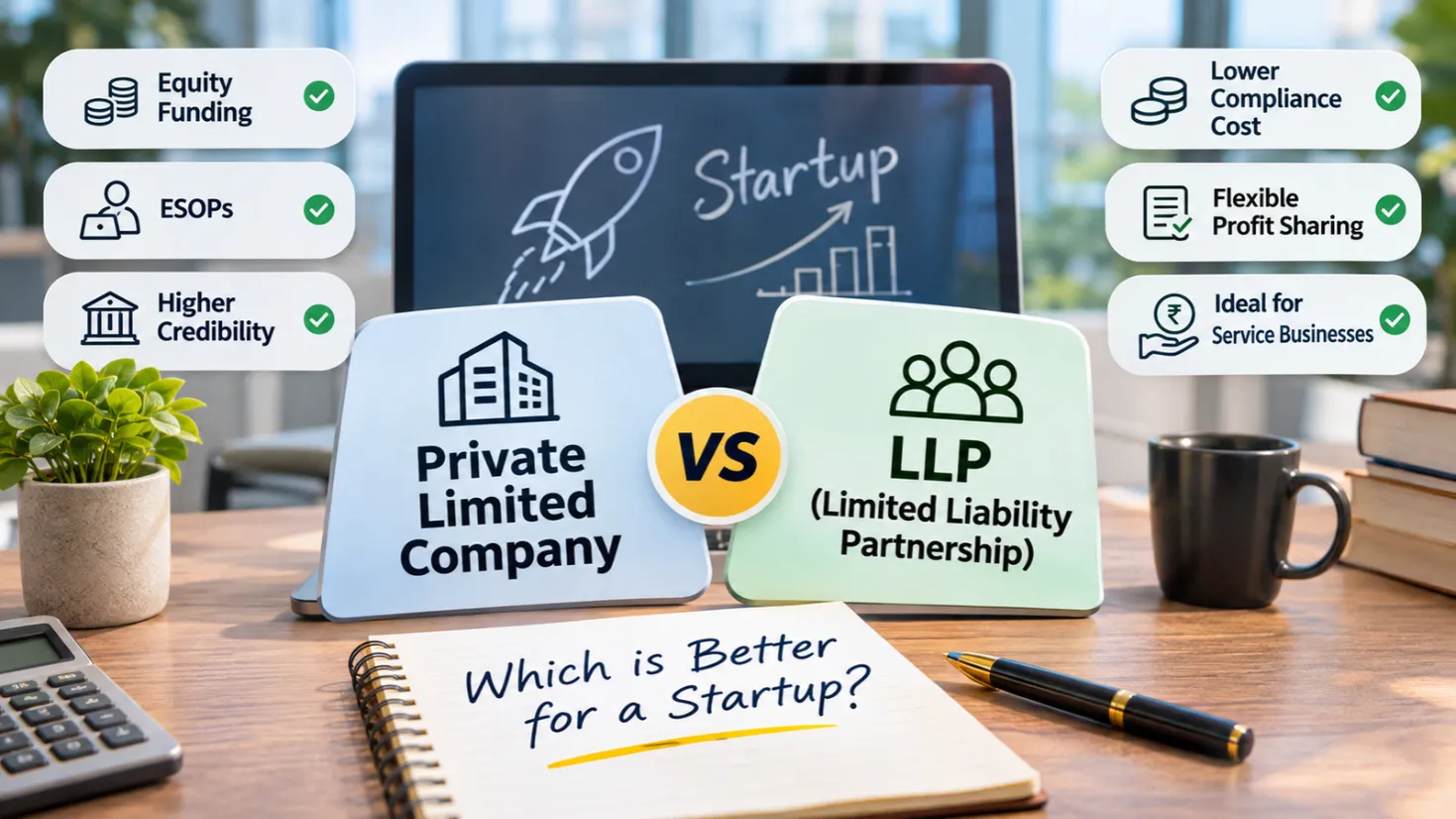
Private limited vs LLP is the first real decision most Indian founders make, usually a day before they pay someone to register the business. Both structures give you limited liability and a separate legal identity. Both qualify for DPIIT startup recognition. They split on the question that shapes most startups: will you raise equity money or give employees ESOPs?
This guide compares the two on funding, tax, compliance and cost, using figures current as of November 2026.
Private Limited vs LLP: Quick Answer
For most startups, a Private Limited company is better, because it can issue equity shares, grant ESOPs and take venture capital without friction. An LLP suits service businesses and professional firms that expect to stay bootstrapped, want lower compliance costs, and don’t plan to raise equity funding.
Choose a Private Limited company if:
- You plan to raise money from angels, VCs or accelerators
- You want to give ESOPs to early hires
- You expect a foreign investor or foreign co-founder
- You want the most credibility with banks and large customers
Choose an LLP if:
- You run a service or professional business and will fund it yourself
- You want lower annual compliance cost and no mandatory audit while you’re small
- You want partners to split profit differently from how they split capital
- You expect to pay out most of the profit rather than reinvest it
Private Limited vs LLP at a Glance
| Factor | Private Limited Company | LLP |
| Governing law | Companies Act, 2013 | LLP Act, 2008 |
| Ownership | Shares | Partner contributions and LLP agreement |
| Minimum people | 2 directors, 2 shareholders | 2 partners (2 designated partners) |
| Equity funding from VCs and angels | Yes | Not practical |
| ESOPs | Yes | No |
| Income tax | 22% (Section 115BAA, with deductions given up) or 25%, plus surcharge and cess | 30%, plus surcharge and cess |
| Tax on payouts | Dividends taxed again in the shareholder’s hands | Partners’ profit share not taxed again |
| Statutory audit | Every year | Only if turnover is above ₹40 lakh or contribution is above ₹25 lakh |
| Main annual filings | AOC-4, MGT-7, AGM | Form 8, Form 11 |
| Typical annual compliance fees | ₹18,000 to ₹40,000 | ₹8,000 to ₹18,000 |
| Foreign investment | Automatic route in most sectors | Only where 100% FDI is automatic and no performance conditions apply |
| DPIIT recognition and 80-IAC | Eligible | Eligible |
| Credibility with banks and large clients | Higher | Good, sometimes needs explaining |
The fee ranges are what filing firms commonly quote. Treat them as rough guides, not a rate card.
What Is a Private Limited Company?
A Private Limited company is a separate legal entity registered under the Companies Act, 2013, with ownership divided into shares. It needs at least two directors and two shareholders, and at least one director must be an Indian resident. Shareholders’ liability is limited to the unpaid value of their shares.
What Is an LLP?
A Limited Liability Partnership is registered under the LLP Act, 2008. It’s a body corporate with its own legal identity, run through an LLP agreement between partners. You need at least two partners, with two acting as designated partners, and one designated partner must be an Indian resident. Each partner’s liability is limited to their agreed contribution, although a partner stays personally liable for their own fraud or wrongful acts.
Private Limited vs LLP: Head-to-Head Comparison
1. Fundraising and ESOPs: Private Limited wins
Angels, VCs and accelerators invest by buying shares or convertible instruments. An LLP has no shares, so a standard equity round doesn’t fit. ESOPs hit the same wall, because there’s nothing to grant. Founders who start as an LLP and then attract investor interest usually convert before the first priced round, which eats time in the exact weeks you’d rather spend closing the deal.
If equity funding is even a possibility, start as a company.
2. Taxation: depends on whether you keep or distribute profit
An LLP pays a flat 30% on profit, plus a 12% surcharge once income crosses ₹1 crore and 4% cess. That’s about 31.2% below ₹1 crore and 34.94% above it. A Private Limited company pays 25% by default (30% if turnover crosses ₹400 crore), or it can opt for 22% under Section 115BAA by giving up most deductions. After surcharge and cess, the 22% option lands near 25.17%. The Income-tax Act, 2025, in force since 1 April 2026, carries these headline rates over.
The catch shows up when you take money out. A company’s dividend is taxed again in the shareholder’s hands at their slab rate. An LLP’s profit share isn’t taxed again in the partners’ hands. For a founder in the top slab who withdraws every rupee, the company route can approach 48% combined. For founders who reinvest profit, which is most startups in the early years, the company’s lower rate wins.
LLPs have one more lever. Remuneration and interest paid to working partners is deductible within statutory limits, which can pull the effective rate well below the headline 30%.
Verdict: reinvesting startups do better as a company. Partner-run businesses that distribute most profit often do better as an LLP.
3. Compliance and running cost: LLP wins
Every Private Limited company needs a statutory audit each year, however small it is. An LLP needs one only if turnover crosses ₹40 lakh or partner contribution crosses ₹25 lakh. Watch the second test. A one-time capital infusion can trigger the audit even when sales are tiny.
An LLP usually files Form 8 (accounts and solvency) by 30 October and Form 11 (annual return) by 30 May. A Private Limited company holds an AGM, appoints an auditor, and files AOC-4 (financials) and MGT-7 (annual return) with the ROC, along with board meeting records. Both file income tax returns, and both need GST filings if registered.
The gap is real but it’s not huge. You’re looking at a few tens of thousands of rupees a year, not lakhs.
4. Foreign investment: Private Limited wins
A Private Limited company can take foreign investment under the automatic route in most sectors. An LLP can too, but only in sectors where 100% FDI is allowed automatically and no FDI-linked performance conditions apply. If your sector carries such a condition, the LLP route closes. IT and software services pass the test, so a services LLP with a foreign partner is workable. A product startup chasing an overseas fund is a different story.
5. Credibility with banks, enterprise clients and tenders: Private Limited wins, slightly
Banks, procurement teams and some tenders treat a company as the default structure. An LLP is legally solid and widely accepted, but you’ll occasionally explain what it is. It’s a perception gap more than a legal one, and it matters most when you sell to large corporates.
6. Ownership flexibility: LLP wins
Profit sharing in an LLP follows the LLP agreement, not capital. A partner who puts in ₹2 lakh and brings in all the clients can be given 50% of profit. In a company, economics follow shareholding, and anything else needs preference shares or a shareholders’ agreement. Write the LLP agreement carefully. Where it’s silent, default rules in the LLP Act fill the gap, including equal profit sharing.
7. Startup India and DPIIT benefits: a tie
Both structures qualify. Under notification G.S.R. 108(E) of 4 February 2026, DPIIT recognition lasts up to 10 years from incorporation with turnover capped at ₹200 crore in any year. A new Deep Tech category gets 20 years and ₹300 crore.
The Section 80-IAC tax holiday (100% deduction for three consecutive years within the first ten) is open to Private Limited companies and LLPs incorporated before 1 April 2030. It needs a separate Inter-Ministerial Board certificate, so recognition alone doesn’t deliver it. One more thing for companies: the 22% route requires giving up most deductions, so it generally doesn’t stack with the holiday. Ask your CA to model both.
Which Should You Choose? Common Startup Scenarios
- Two friends starting a design or consulting studio, no outside money planned: LLP.
- SaaS or app startup aiming for a seed round: Private Limited.
- D2C brand expecting angel money and ESOPs: Private Limited.
- CAs, lawyers or agency partners splitting profit: LLP.
- A foreign co-founder or foreign angel: Private Limited.
- Side project, funding unclear: LLP is cheaper to start. Budget for a conversion later if investors show up.
Can You Convert an LLP to a Private Limited Company Later?
Yes. An LLP can register as a company under the Companies Act by filing Form URC-1 along with the incorporation forms, and its assets and liabilities vest in the company. It isn’t a wind-up and restart. The cost is the cleanup afterwards: new MOA and AOA, plus updates to bank accounts, GST, trademarks and contracts. If you expect to raise money within the next 12 months, skip the detour and incorporate as a Private Limited company.
What Changed in 2026
- DPIIT definition revised (4 February 2026): turnover ceiling doubled to ₹200 crore, with a new Deep Tech category and cooperatives added.
- Income-tax Act, 2025 (from 1 April 2026): headline rates for companies and LLPs carry over, but section numbers changed. Old agreements citing the 1961 Act need updating.
- Corporate Laws (Amendment) Bill, 2026: introduced in the Lok Sabha on 23 March 2026, with the Joint Parliamentary Committee report presented on 3 August 2026. As of 2 November 2026 it hadn’t passed, so the current Companies Act and LLP Act rules still apply. Check again before you file.
Common Mistakes Founders Make
- Picking an LLP for cheap compliance, then needing funding: Conversion works, but it lands at the worst time.
- Picking a Private Limited company for status while running a tiny services business: You pay for an audit you didn’t need.
- Assuming an LLP never needs an audit: Turnover above ₹40 lakh or contribution above ₹25 lakh triggers one.
- Skipping the founders’ agreement: An LLP agreement or shareholders’ agreement is where equity, exits and decision rights get settled.
FAQs: Private Limited vs LLP
Is an LLP or a Private Limited company better for a startup?
A Private Limited company is better for startups that plan to raise equity funding, issue ESOPs or take foreign investment. An LLP is better for bootstrapped service businesses and professional partnerships that want lower compliance cost and flexible profit sharing. If anyone may ever invest in your business, choose a Private Limited company.
Can an LLP raise venture capital funding?
Not in practice. VCs and angels invest through equity shares or convertible instruments, and an LLP can’t issue shares. Foreign investment is possible only in sectors with automatic 100% FDI and no performance conditions. Most LLPs that attract investors convert into Private Limited companies first.
Is an LLP cheaper than a Private Limited company?
Usually, yes. An LLP needs a statutory audit only above ₹40 lakh turnover or ₹25 lakh contribution, while a Private Limited company needs one every year. Filing firms commonly quote around ₹8,000 to ₹18,000 a year for an LLP and ₹18,000 to ₹40,000 for a company.
Which pays less tax, a Private Limited company or an LLP?
A company pays 22% or 25% against an LLP’s 30%, before surcharge and cess. But a company’s dividends are taxed again in shareholders’ hands, while an LLP’s profit share isn’t. Reinvested profit favours the company. Fully distributed profit often favours the LLP.
Can an LLP get DPIIT startup recognition?
Yes. DPIIT recognises Private Limited companies, LLPs, partnership firms and cooperatives that are within 10 years of incorporation and under ₹200 crore turnover. The 80-IAC tax holiday is open to companies and LLPs incorporated before 1 April 2030, and needs separate approval.
Can I convert my LLP into a Private Limited company later?
Yes. File Form URC-1 with the incorporation forms and the LLP’s assets and liabilities vest in the new company. Conversion is common before a funding round. It takes paperwork and fees, so choose a company from the start if funding is likely.
Final Recommendation
Building a product, expecting to raise money, or planning to hand out ESOPs? Register a Private Limited company. Running a services business or professional partnership that will fund itself? An LLP costs less to run and gives partners more room on profit sharing.
Still stuck? Ask one question: will anyone ever invest in, or buy shares of, this business? If yes, go with a Private Limited company.
Ready to register? Our guide on how to register a company in India covers the cost, documents and SPICe+ process step by step.
What do you feel about this post?

Like

Love

Happy

Haha

Sad