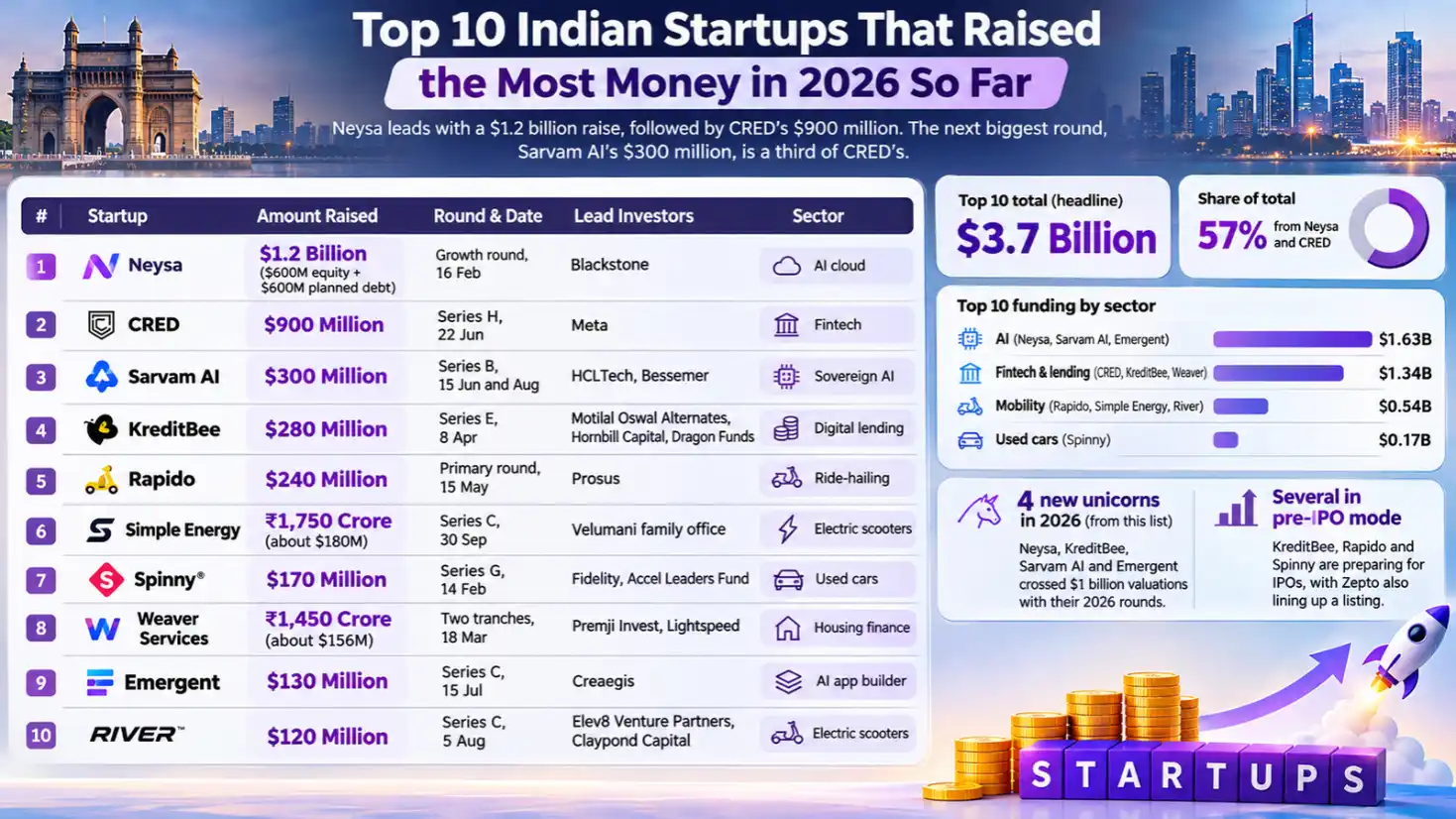
Neysa leads the list of Indian startups that raised the most money in 2026, and the drop-off after the top two is steep. The Mumbai-based AI cloud company announced a $1.2 billion capital raise in February. CRED followed in June with $900 million from Meta. The next biggest round, Sarvam AI’s $300 million Series B, was a third of CRED’s.
This list ranks the ten largest rounds announced between 1 January and 21 November 2026. Each entry gives the investors, the valuation where one was reported, and a fine-print note, because several headline numbers include debt, secondary share sales or money that arrived in separate tranches.
Which Indian startup raised the most money in 2026?
Neysa raised the most money of any Indian startup in 2026 so far, announcing a $1.2 billion capital raise in February, half equity from a Blackstone-led group and half planned debt. CRED followed with a 900millionSeriesHledbyMetainJune.SarvamAI(300 million), KreditBee (280million)andRapido(240 million) complete the top five.
The top 10 Indian startups that raised the most money in 2026
| # | Startup | Amount | Round and date | Lead investors | Sector |
| 1 | Neysa | 1.2B(600M equity + $600M planned debt) | Growth round, 16 Feb | Blackstone | AI cloud |
| 2 | CRED | $900M | Series H, 22 Jun | Meta | Fintech |
| 3 | Sarvam AI | $300M | Series B, 15 Jun and Aug | HCLTech, Bessemer | Sovereign AI |
| 4 | KreditBee | $280M | Series E, 8 Apr | Motilal Oswal Alternates, Hornbill Capital, Dragon Funds | Digital lending |
| 5 | Rapido | $240M | Primary round, 15 May | Prosus | Ride-hailing |
| 6 | Simple Energy | ₹1,750 crore (about $180M) | Series C, 30 Sep | Velumani family office | Electric scooters |
| 7 | Spinny | $170M | Series G, 14 Feb | Fidelity, Accel Leaders Fund | Used cars |
| 8 | Weaver Services | ₹1,450 crore (about $156M) | Two tranches, 18 Mar | Premji Invest, Lightspeed | Housing finance |
| 9 | Emergent | $130M | Series C, 15 Jul | Creaegis | AI app builder |
| 10 | River Mobility | $120M | Series C, 5 Aug | Elev8 Venture Partners, Claypond Capital | Electric scooters |
Rupee rounds use the dollar figure the cited outlets reported. Sarvam AI’s $300 million was announced in two closes, June and August. Data as of 21 November 2026.
How we ranked them
We ranked each company by its single largest announced round between 1 January and 21 November 2026. Tranches of the same round were added together. Every entry was checked against a company or investor statement or at least one major outlet: TechCrunch, Business Standard, Inc42, Entrackr or YourStory.
We counted companies based in India or run from it. We left out subsidiaries of listed groups, rounds that were mostly debt restructuring, and rounds where part of the money hadn’t closed. The exclusions, with reasons, are further down.
One warning first. Funding trackers don’t agree with each other, so any top 10 depends on where its author draws the line. If you want month-by-month totals instead, see our Indian startup funding by month in 2026 tracker.
1. Neysa: $1.2 billion
Neysa runs GPU-based cloud infrastructure for AI workloads out of Mumbai. On 16 February, Blackstone-affiliated funds and co-investors including Teachers’ Venture Growth, TVS Capital, 360 ONE Asset and Nexus Venture Partners agreed to put in up to $600 million of equity, which gives Blackstone a majority stake. Neysa said it planned to add another $600 million in debt, and that is how the total reached $1.2 billion. Inc42, citing ET, reported a $1.4 billion enterprise valuation. Entrackr counted Neysa as the second Indian unicorn of 2026, after Juspay. The money is meant to take its fleet past 20,000 GPUs.
Fine print: half the headline is debt Neysa still had to raise. Counted by equity alone, the figure is $600 million, which would still sit second behind CRED’s $900 million.
2. CRED: $900 million
CRED, the Bengaluru fintech that began with credit card bill payments, announced a ₹8,550 crore (about $900 million) Series H on 22 June, led by Meta. The round values it at $4.5 billion post-money (₹43,239 crore) and makes Meta a minority shareholder. A leadership change came with it: founder Kunal Shah stepped back as CEO and joined Meta to run WhatsApp globally, and Miten Sampat took over as interim CEO.
Fine print: the round mixes new shares with shares bought from existing holders, and the reports we reviewed didn’t give the split. The cash going into CRED itself is lower than $900 million.
3. Sarvam AI: $300 million
Sarvam, a Bengaluru company building sovereign AI models for India, announced the first close of its Series B on 15 June: $234 million at a $1.5 billion post-money valuation. HCLTech led with $150 million for a stake of about 10.46%, alongside Bessemer Venture Partners, Khosla Ventures and Peak XV Partners. In August, Sarvam added about $74 million from Nvidia, Activate, Glade Brook Capital and Gaja Capital, completing the planned $300 million. Inc42 called it India’s 130th unicorn.
Fine print: two closes, two months apart. Read only the June headline and you’ll see $234 million.
4. KreditBee: $280 million
KreditBee, a Bengaluru digital lender, raised a $280 million Series E on 8 April at a $1.5 billion post-money valuation. Motilal Oswal Alternates, Hornbill Capital and MUFG-backed Dragon Funds led. The company reports more than 18 million unique loan customers, over 60 million loans disbursed and about $1.5 billion in assets under management as of March 2026. Its co-founder described the round as the last private raise before a planned IPO.
Fine print: $220 million is fresh capital. The other $60 million is secondary, meaning existing shareholders sold part of their stakes.
5. Rapido: $240 million
Rapido, the Bengaluru bike-taxi and ride-hailing platform, announced a $240 million primary round on 15 May. Prosus led, with WestBridge Capital and Accel, at a $3 billion post-money valuation. The money is aimed at smaller cities; Rapido reports operating in about 400 cities with more than 9 million driver partners. Medianama reported that the company has indicated plans to prepare for an IPO by the end of 2026.
Fine print: the $240 million sits inside a larger $730 million primary-and-secondary financing. Separately, Prosus and Accel bought Swiggy’s roughly 12% stake in a deal valued near $270 million. We ranked Rapido on the $240 million of new primary equity only.
6. Simple Energy: ₹1,750 crore (about $180 million)
Simple Energy, a Bengaluru electric two-wheeler maker, closed a ₹1,750 crore Series C on 30 September, all equity, led by the family office of Dr Arokiaswamy Velumani. Entrepreneur India called it the third-largest round by an Indian electric two-wheeler company. It follows a ₹250 crore Series B in June that mixed debt and equity. The company says the new money will pay for a factory, higher production and a bigger service network.
Fine print: co-founder Shreshth Mishra told YourStory the round would also help clear past delivery delays and working-capital gaps. Dollar conversions vary by outlet; Inc42 and DealStreetAsia used about $180 million.
7. Spinny: $170 million
Spinny, the used-car marketplace, reportedly closed a $170 million Series G around 14 February, co-led by Fidelity Investments and Accel Leaders Fund. Inc42 put the valuation near $1.5 billion, a small drop from the $1.7 billion after its 2025 round. The Competition Commission approved Fidelity’s stake of roughly 6.63%.
Fine print: only about $90 million is primary capital. The rest is secondary sales by early investors. Reports in mid-2026 also said Spinny had begun IPO preparation, targeting a listing in early 2027.
8. Weaver Services: ₹1,450 crore (about $156 million)
Weaver Services, a Mumbai housing-finance platform that lends to self-employed borrowers in smaller cities, raised ₹1,450 crore in two tranches announced on 18 March. Premji Invest and Lightspeed co-led the ₹950 crore tranche, which was Lightspeed’s first investment in affordable housing finance, with Gaja Capital also taking part. The money funds Weaver’s purchase of a 75.01% controlling stake in Centrum Housing Finance. That business will merge with its existing People Home Finance unit to form a lender with assets above ₹2,000 crore and 140 branches.
Fine print: a large part of this round is acquisition money, not growth capital for the existing business.
9. Emergent: $130 million
Emergent lets people build web and mobile apps by describing them in plain English. It raised a $130 million Series C on 15 July at a $1.5 billion valuation, five times what it was worth earlier in the year. Creaegis led, with MNI Ventures-Claypond Capital and Sentinel Global as co-leads. CEO Mukund Jha, who previously co-founded Dunzo, told TechCrunch the company had reached a $120 million annualized revenue run rate and more than 200,000 paying customers. It works from San Francisco and Bengaluru.
Fine print: the revenue figures come from the company, and a five-fold valuation jump inside months is worth reading with some care.
10. River Mobility: $120 million
River, a Bengaluru electric scooter maker, announced a $120 million Series C on 5 August, made up of equity and venture debt. Elev8 Venture Partners and Claypond Capital co-led. Indian institutions joined for the first time alongside existing backers Yamaha Motor and Al-Futtaim. CEO Aravind Mani said revenue grew 330% in the year to March 2026 on sales of the Indie scooter, and the company plans a new factory.
Fine print: reports didn’t split the equity and debt, so the equity cheque is smaller than $120 million.
Who didn’t make the list, and why
If you’ve seen other trackers, you’ll notice names missing here. Each omission was deliberate.
- Navi: The only round we could confirm from the company and major outlets was $100 million from Prosus in August, its first institutional raise. Some trackers show larger figures from earlier reports that we couldn’t confirm.
- Udaan: It announced a $160 million structured financing, but reports break it into roughly $50 to 60 million of fresh equity, about $45 million of BlackRock private credit, and a debt-to-equity conversion.
- Brahma AI: It announced $150 million on 23 September, but it’s a unit of listed Prime Focus, and reports citing the parent’s filing described $150 million as the target, with Multiples’ $100 million still awaiting approvals.
- iD Fresh: Apax’s stake was undisclosed (reports range from ₹1,300 to ₹1,500 crore) and was bought partly from existing shareholders.
- Spiro: It raised $215 million in June and has an Indian founder, but it was announced from Dubai, operates in Africa, and its own parent group invested.
- Zepto: Its 100 million) pre-IPO, below this list’s cutoff.
- US-headquartered companies with Indian-origin founders: Wispr Flow, Emerald AI and SiMa.ai appear in some Indian trackers. They aren’t India-based startups, so we left them out.
- Nxtra Data: One tracker lists a raise of about $710 million, but it’s the data-centre arm of Bharti Airtel, not a startup.
What the 2026 list tells us
The ten rounds add up to about $3.7 billion in headline amounts. Neysa and CRED account for $2.1 billion of that, or 57%. Funding in 2026 has been concentrated in a few large bets.
By sector, AI took about $1.63 billion (Neysa, Sarvam AI, Emergent), fintech and lending about $1.34 billion (CRED, KreditBee, Weaver), electric and ride-hailing mobility about $540 million (Rapido, Simple Energy, River), and used cars $170 million (Spinny). For more on the AI side, see Indian AI startup funding in 2026.
Four of the ten crossed a $1 billion valuation on these rounds: Neysa, KreditBee, Sarvam AI and Emergent. Entrepreneur India counted Emergent as India’s seventh new unicorn of 2026 in July. Our list of new Indian unicorns of 2026 has the full set.
Several are now in pre-IPO mode. KreditBee called its Series E its last private round before listing, Rapido has talked of preparing an IPO by the end of 2026, and Spinny has reportedly begun work on one. Zepto, which missed this list, paused its IPO in July and raised pre-IPO money instead. We track these in upcoming startup IPOs in India.
Why funding totals differ between trackers
| Source | Period | Total reported |
| Inc42 | H1 2026 | $5.2 billion, down 9% year on year |
| YourStory | H1 2026 | $6.9 billion in VC funding |
| Business Standard | H1 2026 | $7.2 billion in tech startup funding, up 12% |
| Inc42 | Q3 2026 | $2.2 billion, up 5% |
| Entrackr | Q3 2026 | $2.9 billion |
| DealStreetAsia | Q3 2026 | $3.86 billion, up 25.3% |
Each tracker draws its own line on what counts as a startup, whether debt and secondary sales are included, and which date it uses for a round. The same year can read as growth in one report and a dip in another. When you quote a total, name the tracker.
Frequently asked questions
How much did the top 10 Indian startups raise in 2026?
The ten largest rounds announced between January and 21 November 2026 add up to about 3.7billioninheadlineamounts.Neysa(1.2 billion) and CRED ($900 million) account for roughly 57% of that. Headline figures include some debt and secondary share sales, so the cash reaching the companies is lower.
Which Indian startups became unicorns in 2026 through these rounds?
Four companies on this list crossed a $1 billion valuation with their 2026 rounds: Neysa (February), KreditBee (April), Sarvam AI (June) and Emergent (July). CRED, Spinny and Rapido already held unicorn status before their rounds.
Which sector raised the most among the top 10?
AI leads with about $1.63 billion across Neysa, Sarvam AI and Emergent, ahead of fintech and lending at about $1.34 billion (CRED, KreditBee, Weaver Services). Mobility follows with about $540 million. This covers only the ten largest rounds, not total sector funding, which trackers measure differently.
Is Zepto among the top Indian startups by funding raised in 2026?
No. Zepto’s $450 million round at a 7 billion valuation was in October 2025. In 2026 it reportedly raised about ₹1,000 crore (100 million) in a pre-IPO round at roughly a $4.5 billion valuation, below this list’s $120 million cutoff, and postponed its IPO.
Did Indian startup funding grow in 2026?
It depends on the tracker. Inc42 reported H1 2026 funding down 9% year on year at $5.2 billion, and Q3 up 5% at $2.2 billion. A Business Standard report put H1 tech startup funding at $7.2 billion, up 12%. Differences in what each tracker counts are the usual reason.
What do you feel about this post?

Like

Love

Happy

Haha

Sad