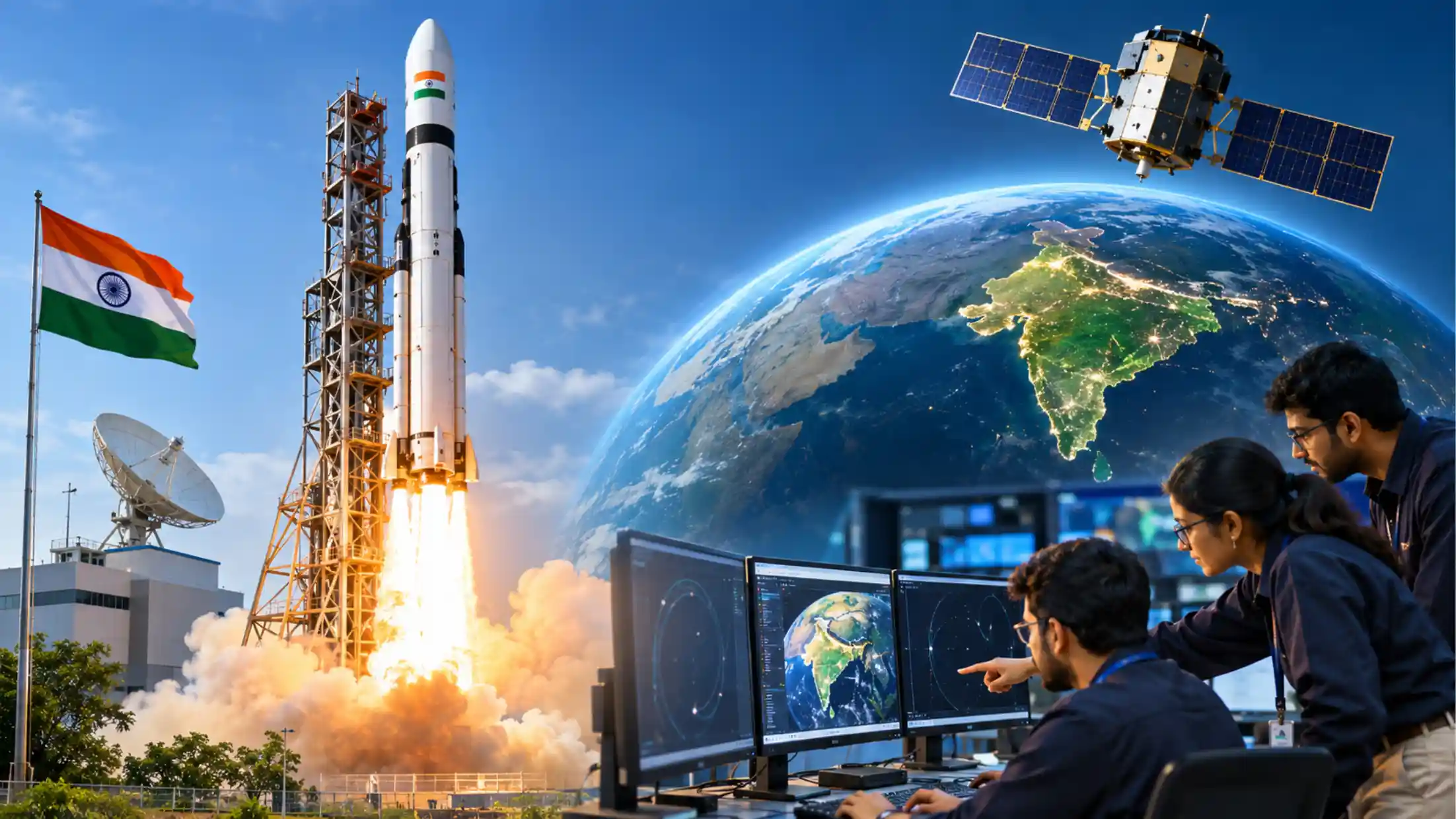
India space tech startups stopped being a side story on 18 July 2026. That morning, Skyroot Aerospace’s Vikram-1 lifted off from Sriharikota and reached orbit on its first attempt. India became the third country with a privately built orbital rocket, after the United States and China.
One launch doesn’t make an industry. But it changes who gets taken seriously.
What Is India’s Space Tech Boom?
India’s space tech boom is the rise of private companies building rockets, satellites and space data products after the government opened the sector in 2020. Hundreds of startups now operate in India, Skyroot has reached orbit, Pixxel raised $100 million in September 2026, and the government is targeting a $44 billion space economy by 2033.
The numbers worth knowing:
- $8.4 billion to $44 billion: India’s projected space economy growth, 2022 to 2033, according to IN-SPACe. That includes about $11 billion in exports.
- 2 to 3%: India’s current share of the global space economy. The target is roughly 8%.
- ₹1,000 crore: the government-backed venture fund for space startups, managed by SIDBI Venture Capital.
- $1.1 billion: Skyroot’s valuation after its May 2026 round, which made it India’s first space unicorn.
Why Is India’s Space Sector Booming Now?
Policy came first, then money, then hardware.
India created IN-SPACe in 2020 as a single window for private companies that need ISRO’s facilities and approvals. The Indian Space Policy 2023 spelled out what private firms may do. In 2024 the government loosened foreign investment rules, with reported limits of 100% in ground segment services, 74% in satellite manufacturing and 49% in launch vehicles. Then the ₹1,000 crore venture fund, approved by the Union Cabinet in October 2024, gave early-stage founders a domestic cheque to chase.
ISRO’s decades of work also left something no startup could buy: a deep bench of engineers and a working launch site. Skyroot flew from ISRO’s own Sriharikota pad. Private companies aren’t replacing that base. They’re building on it.
Which Indian Startups Are Building Rockets?
Skyroot Aerospace
Skyroot, based in Hyderabad, flew the suborbital Vikram-S in November 2022, the first privately built Indian rocket to leave the ground. It took almost four years to go from that test to orbit.
Vikram-1 is a four-stage vehicle, about 22 metres tall, that can carry roughly 350 kg to low Earth orbit. On its debut it reached about 450 km at a 60-degree inclination and released payloads from Grahaa Space, Cosmoserve and DCubed, plus Skyroot’s own SCOPE satellite. It’s also the first company to reach orbit on a first attempt, which seldom happens in rocketry.
Two months before launch, Skyroot raised about $60 million at a $1.1 billion valuation. Investors were betting on a rocket that hadn’t flown yet. The bet paid off. Hardware for a second Vikram-1 mission has already reached Sriharikota, and that’s the real test now. Launch cadence is what turns a milestone into revenue.
Agnikul Cosmos
Agnikul is the other name you’ll hear. The Chennai-based company is known for 3D-printed engines and reusable-launch ambitions. But as of October 2026, public launch records show no orbital flight from Agnikul, and its stated schedule has slipped from early 2026. That’s normal for launch companies. It’s also why Skyroot has a lead right now.
Which Indian Startups Are Building Satellites?
Rockets get the headlines. Satellites and the data they produce are where most of the revenue sits. IN-SPACe’s own projections put the bulk of the 2033 market, about $32 billion of $44 billion, in downstream services like imagery, analytics and communications.
Pixxel builds hyperspectral Earth-observation satellites, which see hundreds of colour bands instead of the few a normal camera captures. That lets them spot crop stress, mineral deposits or gas leaks from orbit. In September 2026 it raised $100 million in a Series C led by Temasek and Seraphim, taking reported total funding to about $195 million. It also runs an Earth intelligence platform called Aurora, which sells answers instead of raw images.
Digantara focuses on orbital safety, tracking objects in space so satellites can avoid collisions. Dhruva Space builds satellite platforms and infrastructure. GalaxEye operates Earth-observation satellites commercially.
India Space Tech Startups at a Glance
| Startup | Segment | Where it stands in 2026 |
| Skyroot Aerospace | Launch vehicles | Reached orbit with Vikram-1 (18 July); valued at $1.1B |
| Agnikul Cosmos | Launch vehicles | No orbital attempt yet; known for 3D-printed engines |
| Pixxel | Earth observation | $100M Series C (September); hyperspectral satellites |
| Digantara | Space situational awareness | Tracks orbital objects for safety and intelligence |
| Dhruva Space | Satellite platforms | Builds satellites and supporting infrastructure |
| GalaxEye | Earth observation | Operates commercial imaging satellites |
How Much Money Is Flowing Into Indian Space Startups?
Private investment in the sector crossed $600 million over five years, according to an April 2026 industry summary. That’s small next to American numbers. It’s also growing fast, and 2026 alone has produced two rounds of $60 million and $100 million.
The government’s venture fund will release capital over five years. Cheques run ₹10–30 crore for growth-stage companies and ₹30–60 crore for later-stage ones. The aim is to back at least 40 startups. IN-SPACe has estimated that the full $44 billion goal needs about $22 billion in investment, from both government and private sources.
What Could Slow the Boom Down?
Three things worry me more than the headlines suggest.
Cadence: Skyroot has one successful flight. Customers want a rocket that flies on schedule, again and again. Until Vikram-1 does that, it’s a proven concept and not yet a business.
Customers: India’s private launch demand is still thin. Skyroot’s pitch is a dedicated small-satellite ride when you don’t want to wait for a rideshare. That’s a real niche, but it needs a steady stream of buyers.
Concentration: Most of the money and attention has gone to a handful of names. Hundreds of other startups, including the ones building propulsion, sensors and ground systems, are far less visible and far harder to fund.
What Does This Mean for Founders and Investors?
If you’re building, look downstream. Launching rockets takes huge capital and years. Turning satellite data into something a farmer, insurer or city planner pays for takes less of both, and that’s where IN-SPACe expects the most growth.
If you’re investing, watch Skyroot’s second launch more closely than its first. The first proved the engineering. The second shows whether it can be repeated.
Frequently Asked Questions
Which Indian startup launched the first private rocket into orbit?
Skyroot Aerospace did. Its Vikram-1 rocket reached low Earth orbit on 18 July 2026 from Sriharikota, making it India’s first privately built orbital launch vehicle.
How many space startups are there in India?
Counts vary by source. Industry summaries in 2026 range from more than 300 commercial space organisations to over 400 space startups, depending on how they’re defined. India ranks among the top countries by number of space companies.
What is IN-SPACe?
IN-SPACe (Indian National Space Promotion and Authorisation Centre) is the government agency, set up in 2020 under the Department of Space, that authorises and supports private space activity and gives companies access to ISRO facilities.
Can foreign investors fund Indian space startups?
Yes. Published figures show up to 100% FDI in ground segment and support services, 74% in satellite manufacturing and 49% in launch vehicles. Rules and approval routes change, so check the current DPIIT policy before investing.
Has Agnikul launched a rocket to orbit?
Not yet. Public launch records show no Agnikul orbital flight through October 2026.
Which are the biggest private space companies in India?
Skyroot Aerospace, Pixxel, Agnikul Cosmos, Dhruva Space, Digantara and GalaxEye are among the most widely cited, covering launch, Earth observation, satellite platforms and orbital safety.
What do you feel about this post?

Like

Love

Happy

Haha

Sad