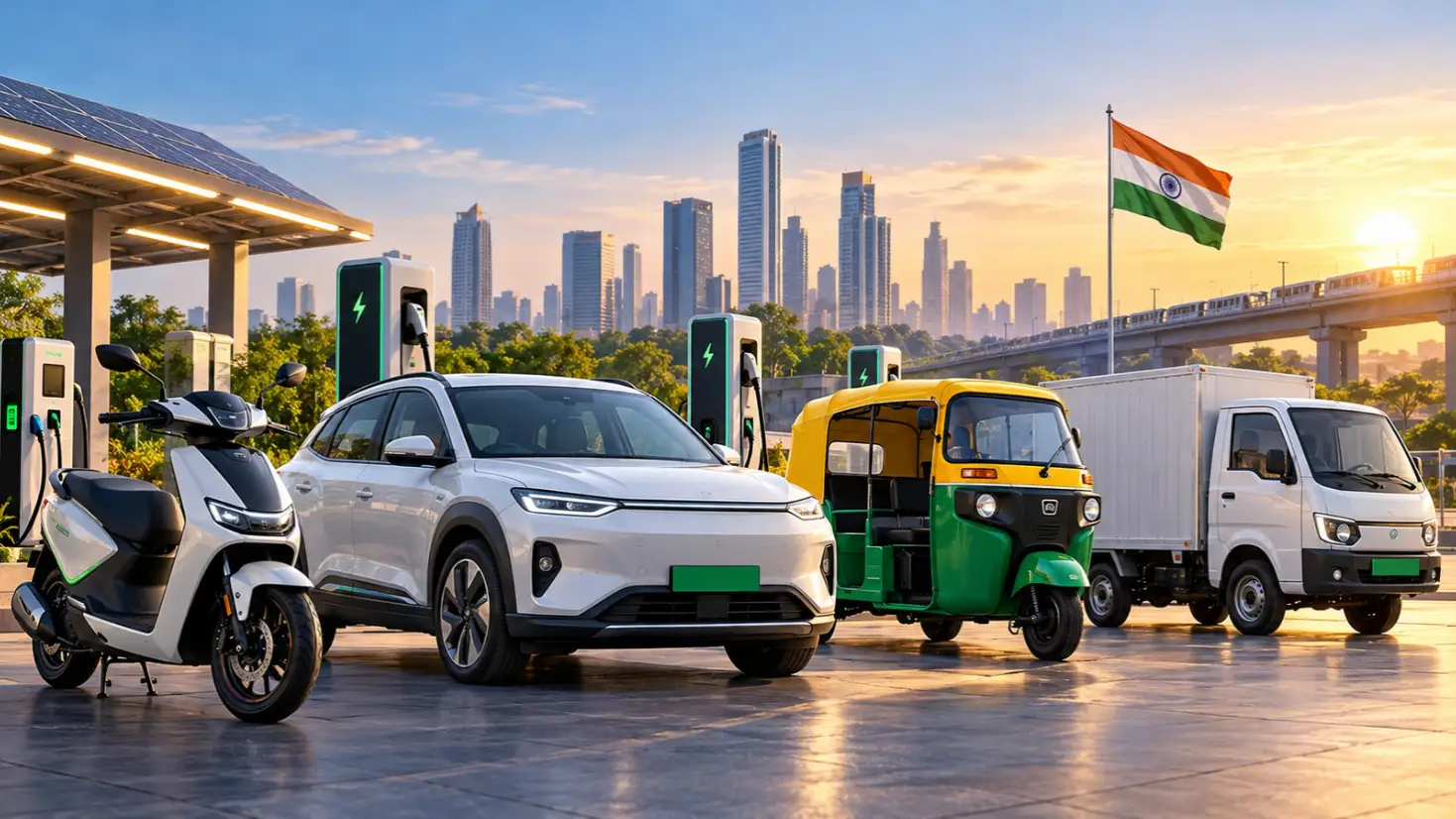
India’s EV industry is growing fast but unevenly. Electric two-wheelers hit 11.6% of all two-wheeler sales in September 2026, and electric three-wheelers already hold over 55% of passenger autos. Cars sit near 8%. TVS, Bajaj, Ather and Tata lead the market, while startups compete in batteries, swapping and commercial fleets.
The India EV industry looks very different from what it did two years ago. Ola Electric once owned the headlines. Now legacy names like TVS Motor and Bajaj Auto lead electric two-wheeler sales, a central subsidy has ended, and fuel prices keep pushing buyers toward plugs. If you’re a founder, investor or operator, the question is no longer whether Indians will buy EVs. It’s which parts of the chain will actually make money.
This guide covers the numbers, the players, the startups worth watching, and the gaps where new companies can still win.
Key takeaways
- Electric two-wheelers sold 1,401,861 units in FY26, up 21.8% on FY25 (Vahan data, via Business Standard).
- EV penetration in September 2026: 11.6% in two-wheelers, about 8% in cars, 55.5% in passenger three-wheelers (Aug 2026), 31.4% in cargo three-wheelers (Aug 2026).
- India had over 9.19 million registered EVs by Q2 2026 (Mercom India).
- The PM E-DRIVE subsidy for electric two-wheelers closed on 31 July 2026. Three-wheeler support runs to March 2028.
- Startup funding is concentrating: $1.4 billion in 2025, up 27%, across fewer deals (Tracxn).
How big is the India EV industry in 2026?
Big enough to be a mainstream auto category, small enough that most vehicles sold are still petrol. India recorded 3,33,571 EV registrations in September 2026, up from 3,02,746 in August, per Vahan dashboard data compiled by EVreporter. Q1 2026 alone had 696,769 EV sales, a 35.5% jump year on year (Mercom India).
Penetration varies wildly by vehicle type:
| Segment | EV share of new sales | Month |
| Two-wheelers | 11.6% | Sep 2026 |
| Passenger three-wheelers (L5) | 55.5% | Aug 2026 |
| Cargo three-wheelers (L5) | 31.4% | Aug 2026 |
| Passenger cars | 7.9% | Jul 2026 |
Source: Vahan dashboard via EVreporter. Figures are pan-India registrations and exclude low-speed e-2Ws.
Two-wheelers do the heavy lifting. They made up nearly 63% of EV sales in Q2 2026, with 524,910 units. Electric cars took 10.1% of EV volume that quarter (84,952 units).
One more thing worth a look. After the two-wheeler subsidy ended on 31 July, penetration dipped from 11.2% in July to 10.7% in August. Then it climbed to 11.6% in September. A short dip, then a recovery. That suggests demand now rests on running costs and fuel prices more than on a ₹5,000 discount.
Who are the biggest EV players in India?
The leaderboard depends on the vehicle type. Here’s how it breaks down.
Electric two-wheelers
Incumbents have taken over. From January to May 2026, TVS Motor held 26.3% of electric two-wheeler registrations and Bajaj Auto 22.5% (EVreporter, Vahan). Ather Energy sold 239,124 units in FY26, an 82% rise that took it to about 17% share (Autocar Professional). Hero MotoCorp and Ola Electric follow. In Q1 2026, TVS sold 116,290 units, Bajaj 97,616, Ather 78,858, Hero 47,442 and Ola 21,626 (Mercom India).
Ola’s slide is the story here. It once dominated; by July 2026 it registered 14,102 units against Ather’s 30,317 (EVreporter).
Honda, Yamaha and Suzuki have also entered the e-2W field, though Honda’s EV share of its own sales was still about 0.2% in August 2026.
Electric cars
Tata Motors leads with over 41% of the electric four-wheeler market in July 2026, followed by Mahindra and JSW MG Motor (EVreporter). EVs made up 25.9% of Tata’s passenger vehicle sales in September 2026 and 13.6% of Mahindra’s. JSW MG sells mostly EVs, at around 80% of its volume.
Most large rivals barely play. Hyundai (1.7%), Kia (2.7%) and Toyota Kirloskar (0.7%) had low EV shares in the latest data, and Skoda-Volkswagen, Honda Cars, Renault and Nissan reported none. In luxury, BMW India reached a 25.5% EV share in September, ahead of Mercedes-Benz at 7.1%. Vietnam’s VinFast has entered India with an all-electric line-up.
Three-wheelers and commercial vehicles
This is where EVs are closest to winning outright. Over half of passenger L5 autos are electric. In electric goods carriers, Tata Motors held over 43% share in June 2026, with Euler Motors and Mahindra Last Mile Mobility behind it.
Which EV startups are shaping the market?
India has more than 200 e-2W makers on record (222 in FY26, up from 180 in FY24, per Autocar Professional). Most are tiny. A handful matter.
Ather Energy: Premium scooters and strong software. Now listed, and it passed 200,000 annual sales for the first time in FY26.
Ola Electric: Scale-first scooters and a vertically integrated bet on cells. Listed too, but losing share to rivals with bigger dealer networks. It and Ather were India’s only EV unicorns as of Inc42’s 2025 report.
Ultraviolette: Performance electric motorcycles. It raised $85 million in September 2026 from Yali Capital, TDK Ventures and Walden International’s Lip-Bu Tan, started exporting to Europe in April 2026, and launched a battery-as-a-service plan with green NBFC Ecofy in March.
Euler Motors: Electric cargo three-wheelers. It raised a $75 million Series D in 2025 and has leaned on venture debt before.
Battery Smart: Battery swapping for two- and three-wheelers. It raised a $29 million Series B.
EKA Mobility and Blue Energy Motors: Commercial EV makers that raised $57 million (Series A) and $30 million (Series A) respectively in 2025.
Other names worth tracking: River, Simple Energy, Altigreen, Exponent Energy and Log9 on the hardware and battery side, and Statiq and Bolt.Earth in charging.
What’s driving EV adoption in India?
Three forces stack up.
Price: A sharp GST cut in September 2025 narrowed the sticker gap between petrol and electric two-wheelers, per Autocar Professional.
Fuel costs: The ongoing Iran oil crisis has pushed ICE-to-EV fence-sitters to commit, according to the same report. Rising fuel prices and Middle East tensions also show up in coverage of the subsidy extension.
Delivery economics: Last-mile fleets run scooters and three-wheelers all day. Per-kilometre running cost matters more to them than to a weekend rider.
Policy helped early, and now it’s thinning out. The PM E-DRIVE scheme has a ₹10,900 crore outlay and runs to 31 March 2028. But the e-2W demand incentive (₹2,500 per kWh, capped at ₹5,000 per vehicle after being halved) ended on 31 July 2026. The L5 three-wheeler subsidy had already closed in December 2025 after hitting its target. Support continues for e-rickshaws and e-carts to March 2028, for electric ambulances, and for public charging stations. State incentives still apply, so check your state’s EV policy.
Where are the opportunities in India’s EV industry?
We’d rank them like this, from most open to most crowded. These are our reading of the data above, not guarantees.
1. Battery swapping and battery-as-a-service: Selling the vehicle without the battery cuts upfront cost, and Ultraviolette and Battery Smart are both building on that idea. Swapping fits fleets and delivery riders best, since they can’t wait for a charge.
2. Commercial and last-mile fleets: Cargo three-wheelers sit at about 31% EV share and passenger three-wheelers above 55%. Tata leads goods carriers, but Euler and Mahindra Last Mile show the field isn’t closed. Fleet financing, telematics and maintenance services are open around it.
3. Charging infrastructure: Public charger funding under PM E-DRIVE continues to 2028. Fast charging for cars is thinner than for two-wheelers.
4. Cells, packs and recycling: India imports most lithium, cobalt and nickel. Anyone who reduces that dependence, through cell manufacturing or recycling, has a policy tailwind.
5. Exports: Ultraviolette’s European shipments show Indian EV makers can sell abroad. It’s early, but it’s a route past a home market where incumbents are strong.
6. Passenger cars: The headroom is huge: about 8% penetration, with most major carmakers still near zero. But Tata and Mahindra have the lead, so a new entrant needs a sharp angle.
What are the risks and challenges?
Funding is narrowing. Tracxn counted 65 deals in 2025 (year to date at report time) against 135 in 2024, even as total dollars rose. Investors are backing fewer, more mature companies. If you’re an early-stage founder, expect harder questions on unit economics.
Subsidy withdrawal is a test, not a verdict. September’s recovery is a good sign, but one month isn’t a trend.
Incumbents are catching up fast. TVS and Bajaj have dealer networks and service reach that most startups don’t. Ola’s market share drop is a warning about what happens when scale meets distribution.
Supply chain exposure remains. Heavy reliance on imported battery minerals leaves costs tied to global prices.
FAQs about the India EV industry
How big is the EV market in India?
India had over 9.19 million registered EVs by Q2 2026. Monthly registrations were 3,33,571 in September 2026. Electric two-wheelers account for about 63% of sales.
Which company leads India’s electric two-wheeler market?
TVS Motor led with 26.3% share from January to May 2026, followed by Bajaj Auto (22.5%). Ather Energy ranks third by recent monthly data.
Which company sells the most electric cars in India?
Tata Motors, with over 41% of the e-4W market in July 2026. Mahindra and JSW MG Motor come next.
Is the EV subsidy still available in India?
The PM E-DRIVE subsidy for electric two-wheelers ended on 31 July 2026. Incentives for e-rickshaws and e-carts run until 31 March 2028, and state-level policies may still apply.
What are the best EV startups in India?
Ather Energy, Ola Electric, Ultraviolette, Euler Motors and Battery Smart are the best known. They cover scooters, motorcycles, cargo vehicles and swapping.
What are the biggest opportunities in India’s EV industry?
Battery swapping, commercial fleets, charging, battery cells and recycling, and exports. Passenger cars have the most headroom but a strong leader.
The bottom line
India’s EV industry has moved from subsidy-driven to price- and fuel-driven. Two- and three-wheelers are already mainstream. Cars are early. The money for startups probably sits around the vehicles: batteries, swapping, fleet services and charging. Data in this article comes from Vahan-based reports and is current to October 2026. Update it monthly as new registrations land.
What do you feel about this post?

Like

Love

Happy

Haha

Sad