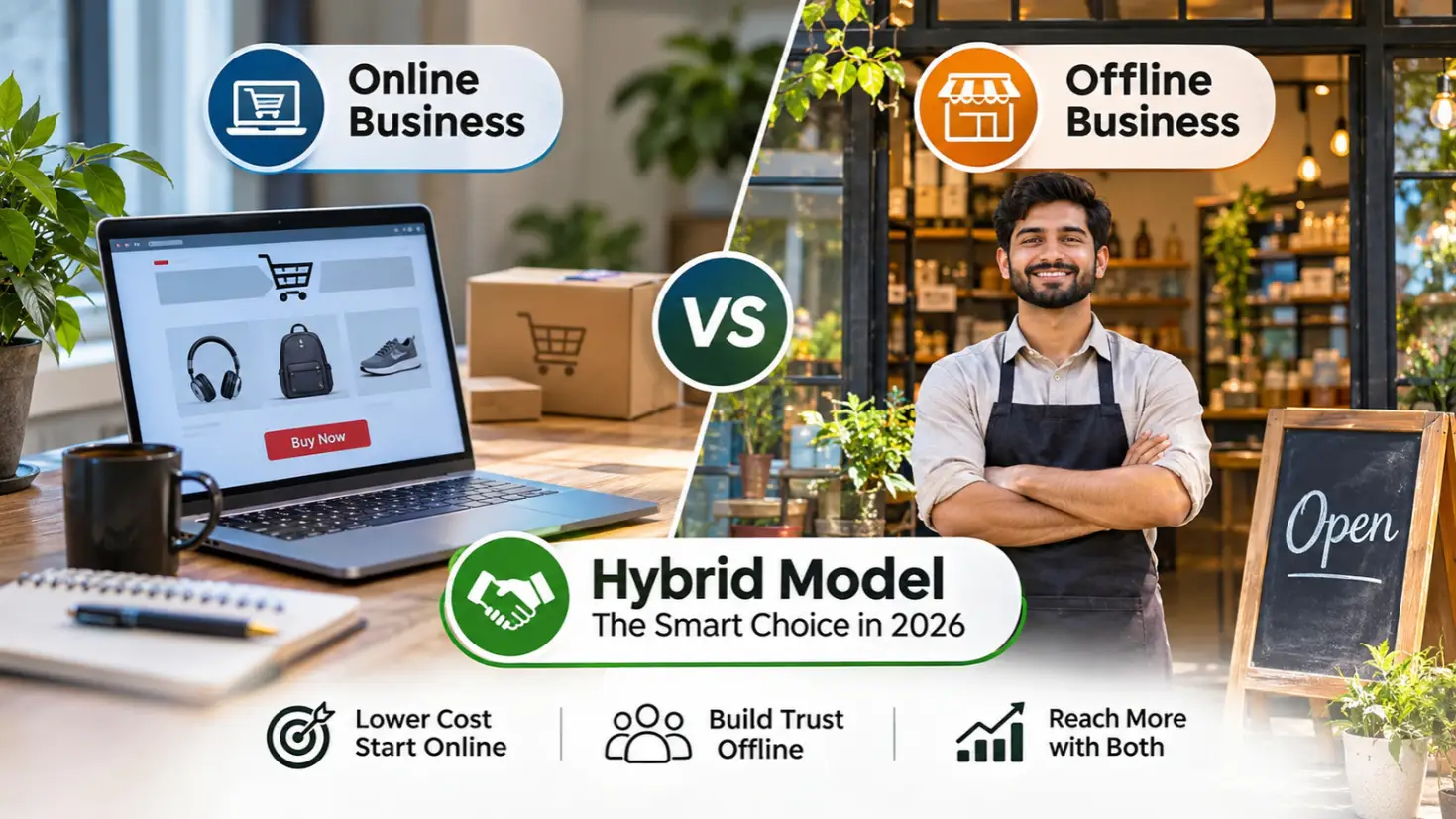
Neither wins outright. The online vs offline business question has a different answer depending on your money, your product and your customer. An online business costs less to start and has no geographic limit. An offline business wins on trust and local demand. For most new founders in 2026, the smartest move is a hybrid: serve customers in person, find them online.
Here’s the number that should reset your thinking. The U.S. Census Bureau reports that e-commerce reached $340.2 billion in Q2 2026, up 12.2% from a year earlier and 17.1% of total U.S. retail sales. Online is growing fast. But roughly 83 cents of every retail dollar still moved through other channels. Both models are alive, so the real question is which one fits you.
What Is the Difference Between an Online and Offline Business?
An online business sells products or services that customers find, order and pay for through the internet. Think online stores, freelancing, courses, software, affiliate sites and dropshipping.
An offline business serves customers through a physical location or face-to-face contact. Shops, salons, restaurants, clinics, workshops and coaching centres all fit here.
The line is blurrier than it used to be. A restaurant that takes orders through a delivery app is partly online. A freelancer who meets clients for coffee is partly offline. A more useful split is this: where does the customer buy, and where is the product or service delivered?
Which Is Better: Online or Offline Business?
For most beginners in 2026, an online business is the better starting point because it needs less capital and has no location limit. An offline business is better when customers need to see, touch or trust you in person. Most strong businesses end up using both.
If you have little money and flexible time, start online. If your product depends on touch, trust or same-day service (a bakery, a repair shop, a clinic), start offline. And if you can’t decide, pick the channel your first ten customers already use. Start there.
Online vs Offline Business: Side-by-Side Comparison
| Factor | Online Business | Offline Business |
| Startup cost | Low. A website, tools and some ad budget | Higher. Rent, fit-out, stock, staff |
| Market reach | National or global | Mostly local |
| Operating hours | 24/7, often automated | Fixed opening hours |
| Customer trust | Built slowly through reviews and content | Built fast through face-to-face contact |
| Competition | Heavy. You compete with everyone | Lighter. Mostly nearby rivals |
| Scaling | Fast and cheap once systems work | Slow. Each new site is a new investment |
| Risk | Platform and algorithm changes | Lease, footfall and location |
| Best for | Digital products, services, niche goods | Food, health, repair, personal services |
Pros and Cons of an Online Business
Pros
- Low startup cost. You can test an idea with a small budget before committing.
- Reach beyond your city. One product page can serve customers in many regions.
- Always open. Orders, payments and support can run while you sleep.
- Easy to measure. Analytics show where visitors come from and where they drop off.
Cons
- Crowded markets. Low barriers mean everyone else starts online too.
- Slower trust. Strangers can’t see you, so reviews and proof carry the weight.
- Platform dependence. A search update or an ad-cost jump can hit sales overnight.
- Logistics. Shipping, returns and delivery delays eat time and margin on physical goods.
Pros and Cons of an Offline Business
Pros
- Instant trust. People buy faster from someone they can see and talk to.
- Local advantage. A good location and word of mouth are hard for a distant competitor to copy.
- Real experience. Customers can try, taste or test before paying.
- Immediate sales. No waiting for traffic to build.
Cons
- High fixed costs. Rent, utilities and salaries arrive whether you sell or not.
- Limited reach. Your market is the people who can walk or drive to you.
- Fixed hours. When the shutter is down, sales stop.
- Hard to scale. A second branch means a second round of capital and management.
Which Is More Profitable: Online or Offline?
Neither, by default. Profit depends on your margin and your costs, not your channel.
Online businesses can earn high margins on digital products because there’s no stock to hold. But ad spend and platform fees can swallow that margin. Offline businesses carry rent and staff, yet walk-in customers often convert at a higher rate than anonymous web traffic.
So skip the debate and run a break-even check. The formula is simple: fixed monthly costs divided by profit per sale. As an illustration, if your fixed costs are 60,000 a month and you earn 300 profit per sale, you need 200 sales a month just to break even. Do that sum for both models before you spend anything. The model with the lower break-even number is usually the safer first move.
Is Online or Offline Business Better for Beginners?
Online usually is, but with a catch. Easy to start doesn’t mean easy to win. The low barrier that lets you launch in a weekend lets thousands of others do the same, so a vague store selling “everything” gets lost. Online beginners need a clear niche, a specific audience and the patience to build trust without a shopfront.
Offline beginners face the opposite problem. Starting is expensive and slow, but once you have a loyal local base, competitors can’t easily pull it away.
How to Choose: Four Questions to Ask Yourself
- How much can you afford to lose? If the answer is “very little,” online lets you test cheaply.
- Does your customer need to touch, try or meet you? If yes, you need some offline presence.
- Do you already have an audience or skill people search for online? If yes, online gets you moving faster.
- Where do your customers actually look first? Ask ten of them. Don’t guess.
Why the Hybrid Model Wins in 2026
Shoppers don’t care about your business model. They care about friction. Many research online, compare prices, then walk into a store to buy. Others see a product in person and reorder online later.
A hybrid business meets them on both sides. Some examples:
- A salon takes bookings through WhatsApp or Instagram and delivers the service in person.
- A coaching centre finds students through YouTube and teaches in a classroom.
- A local bakery sells from its counter and takes custom cake orders online.
- A repair shop ranks on Google Maps and collects payment through a digital link.
You don’t need a complicated setup. A claimed Google Business Profile, a simple website, an easy way to message you and digital payments cover most of it. Each piece is cheap and each one removes a reason for a customer to walk away.
Common Mistakes When Choosing Between Online and Offline
- Copying a trend: A model that works for someone else’s product may not fit yours.
- Ignoring fixed costs: A shop lease is a monthly commitment, and many founders underestimate it.
- Expecting instant traffic online: Ranking, followers and reviews take months, not days.
- Treating the choice as permanent: You can start in one channel and add the other once it pays for itself.
FAQs: Online vs Offline Business
Which is more profitable, online or offline business?
Neither is always more profitable. Online businesses often have lower costs and wider reach, while offline businesses can convert more walk-in customers. Calculate your break-even point for each model before you decide.
Is online business better than offline business in 2026?
Online is better for low-budget starts and digital products. Offline is better for businesses that rely on in-person trust or same-day service. For most founders, combining both works best.
Which business has a lower startup cost: online or offline?
Online businesses usually cost less to start because they skip rent, fit-out and large stock purchases. Costs still add up through tools, ads and delivery, so budget for them early.
Can I run an online and offline business together?
Yes, and it’s now common. Take orders or bookings online, then deliver in person. This hybrid model gives you wider reach and the trust of a physical presence.
Is offline business dying?
No. According to the U.S. Census Bureau, e-commerce made up 17.1% of U.S. retail sales in Q2 2026, which means the large majority of retail sales still happened elsewhere. Online share is rising, but offline remains the bigger channel.
The Bottom Line
The online vs offline business choice isn’t a permanent label. It’s a starting point. Pick the channel where your first customers already are, prove that it makes money, then add the other. Founders who treat the two as partners tend to build the sturdiest businesses.
What do you feel about this post?

Like

Love

Happy

Haha

Sad