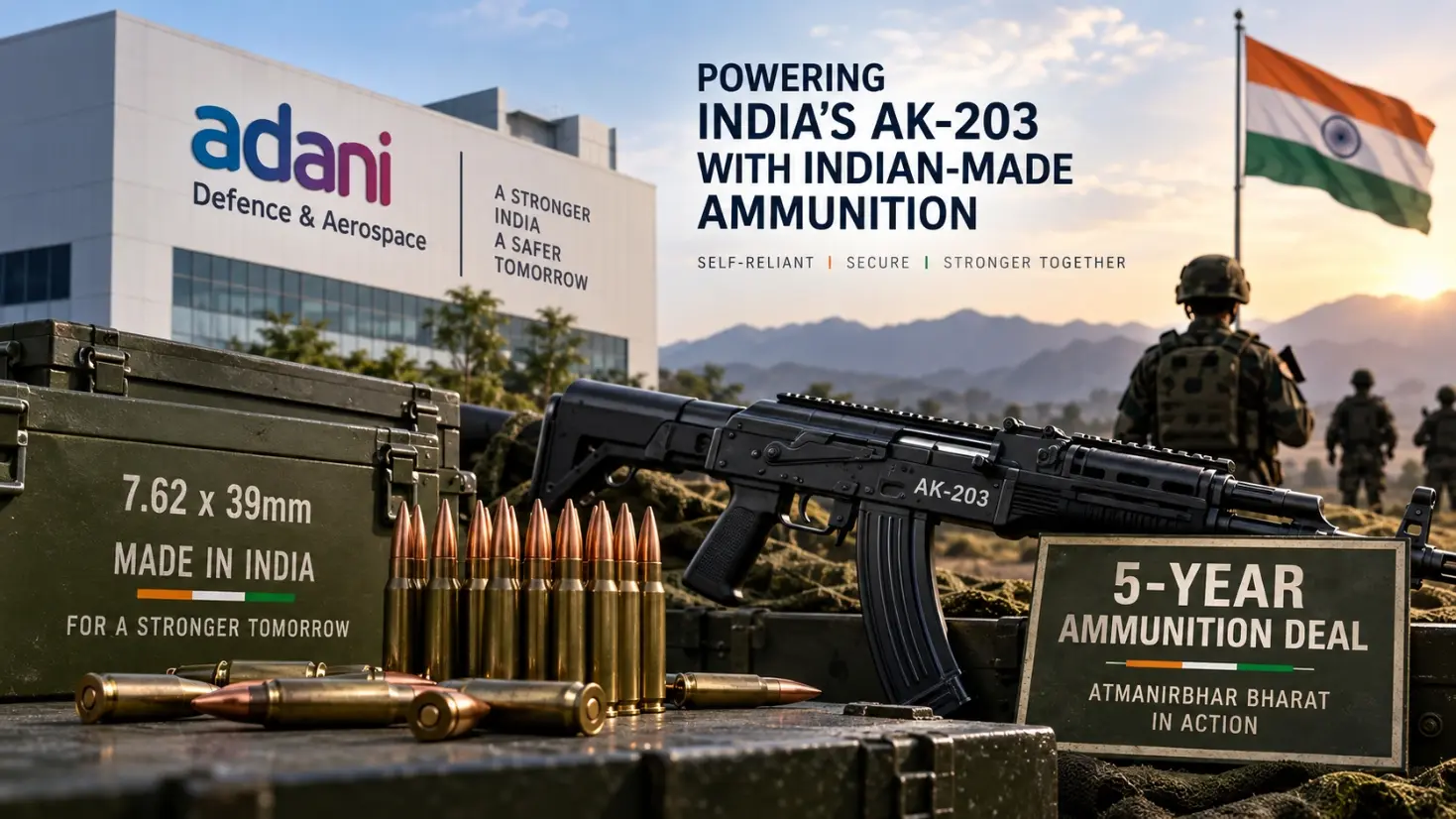
Adani Defence just picked up a contract that closes a gap nobody outside the defence-procurement world was really talking about: who makes the bullets once you’ve made the gun.
Key Takeaways
- Adani Defence & Aerospace has signed a five-year deal with Indo-Russian Rifles Pvt Ltd (IRRPL) to supply Made-in-India 7.62x39mm ammunition for AK-203 assault rifles.
- The ammunition will come from Adani’s small-calibre plant in Kanpur, Uttar Pradesh.
- IRRPL is the India-Russia joint venture already building the AK-203 at its Korwa factory in Amethi, under a December 2021 government contract for over 6 lakh rifles.
- The deal fills a supply-chain gap: India could build the rifle at scale, but the ammunition for it was still leaning on external sourcing.
- It’s another data point in Adani’s push into India’s defence-manufacturing sector, alongside its existing drone and loitering-munition supply to the armed forces.
What Happened
Adani Defence & Aerospace and Indo-Russian Rifles Pvt Ltd signed a five-year arrangement on September 7, 2026, for the supply of Indian-made 7.62x39mm ammunition for the AK-203 assault rifle. The company will run this out of its small-calibre ammunition facility near Kanpur.
That’s the whole announcement, really. No rupee figure has been disclosed, and neither company has released a breakdown of rounds per year. What we do know is which programme this plugs into.
IRRPL is the joint venture behind the AK-203 in India – Russia’s Kalashnikov Concern and Rosoboronexport on one side, India’s Advanced Weapons and Equipment India Ltd and Munitions India Ltd on the other. It was set up in 2019 under an intergovernmental agreement, and its factory sits in Korwa, in Amethi district. The Indian government locked in a contract with IRRPL back in December 2021 for 6,01,427 AK-203 rifles, replacing the ageing INSAS as the Army’s standard-issue weapon.
So the rifle side of the equation was already moving. This deal is Adani stepping in on the ammunition side of the same programme.
Why It Matters
Here’s the thing about “Made in India” defence deals – the headline number is rarely the interesting part. What matters is where in the supply chain the localisation actually happens.
India has gotten reasonably good at final assembly of imported weapon designs. Ammunition is a different story. A rifle programme can hit its production targets and still depend on ammunition sourced or part-sourced from outside the country, which means the whole system’s readiness is only as strong as that external link. Pairing a domestically built rifle with domestically built ammunition removes that dependency for one of the Army’s core small arms.
For Adani, this is a continuation, not a pivot. The group has already supplied drones and loitering munitions to the Indian armed forces – some of which reportedly saw use during Operation Sindoor – and has been hiring veterans into its defence unit to build out that expertise. Adding ammunition for a half-a-million-plus rifle programme gives it a long, government-anchored revenue line. This kind doesn’t depend on winning the next headline contract every year.
There’s a broader signal here too, for anyone watching India’s defence-manufacturing sector as a business opportunity rather than a policy story. When a large private conglomerate builds out ammunition capacity at scale – not just for one rifle model but as a category – it usually means the component and raw-material supply chain around it (brass, propellant, precision tooling) gets a demand bump as well. That’s where the smaller opportunities tend to sit.
What to Expect Next
Neither company has said whether this is exclusive to the AK-203 programme or a template for other small-arms ammunition Adani might supply down the line. Given Adani has already talked about wanting a meaningfully larger share of India’s ammunition demand overall, it wouldn’t be a surprise if this contract gets read as the first of several, not a one-off.
Watch for two things: whether IRRPL or the Ministry of Defence puts a number on annual round volumes, and whether Adani’s Kanpur facility gets scaled up to serve this alongside its existing export orders to Europe and other Asian markets.
Background: How the AK-203 Programme Got Here
The AK-203 was picked in 2018 to replace the INSAS rifle, which had a reputation for jamming and magazine issues, especially at high altitude. The formal intergovernmental agreement between India and Russia was signed in February 2019, and the joint venture – IRRPL – was floated the same year to manufacture the rifle at Korwa.
The commercial contract took a while to close. Price negotiations dragged for years before the Rs 5,000-crore-plus deal was finally signed in December 2021, covering technology transfer and local production of over 6 lakh rifles over roughly a decade. Production has been ramping since, with IRRPL reporting batches of rifles delivered to the Ministry of Defence along the way.
What’s been missing from that story until now is the ammunition side – and that’s the piece this new Adani contract fills in.
FAQs
What is the Adani Defence AK-203 ammunition deal?
It’s a five-year contract between Adani Defence & Aerospace and Indo-Russian Rifles Pvt Ltd for Adani to supply Made-in-India 7.62x39mm ammunition for AK-203 assault rifles, produced at Adani’s plant near Kanpur.
Who is Indo-Russian Rifles Pvt Ltd (IRRPL)?
IRRPL is the India-Russia joint venture manufacturing AK-203 assault rifles at Korwa in Amethi, Uttar Pradesh. Its partners include Russia’s Kalashnikov Concern and Rosoboronexport, and India’s Advanced Weapons and Equipment India Ltd and Munitions India Ltd.
Where does Adani Defence make the AK-203 ammunition?
At its small-calibre ammunition manufacturing facility located near Kanpur, Uttar Pradesh.
How many AK-203 rifles is India manufacturing?
Under the December 2021 contract, IRRPL is producing 6,01,427 AK-203 rifles for the Indian Armed Forces at its Korwa factory.
What do you feel about this post?

Like

Love

Happy

Haha

Sad