Ford invested heavily in Indian manufacturing, but much of that capacity was built with global export markets in mind rather than the price-and-mileage priorities of the average Indian car buyer. Its models struggled to compete with more fuel-efficient, lower-maintenance-cost options from Maruti Suzuki, Hyundai, and Tata Motors. Ford ended vehicle manufacturing and sales in India in 2021 after two decades and reported billions in losses.
The lesson: Manufacturing presence isn’t the same as product-market fit. Building for export, not for the local buyer, left Ford exposed when domestic demand didn’t materialize.
3. General Motors: Never Cracking the Value Segment
General Motors entered India in 1996 and struggled for two decades to build a car lineup that matched what price-sensitive Indian buyers wanted. Its models were seen as overpriced relative to comparable Maruti Suzuki and Hyundai options, and its dealer and service network never reached the scale of local competitors. GM stopped selling cars in India in 2017, continuing only limited manufacturing for export.
The lesson: In a hyper-competitive, price-led segment, a brand that’s positioned as “a bit better but a lot more expensive” loses to a brand that’s “good enough and cheaper.”
4. Uber Eats: Underestimating Zomato and Swiggy’s Head Start
Uber Eats launched in India in 2017 with global brand recognition and Uber’s ride-hailing user base to lean on. But Zomato and Swiggy already had years of local restaurant relationships, hyperlocal delivery networks, and deep discounting strategies in place. Uber Eats couldn’t close the gap on order volume or delivery density, and sold its India business to Zomato in 2020.
The lesson: Global scale doesn’t offset a late entry into a market where local players already own the supply side (restaurant partnerships) and delivery infrastructure.
5. eBay India: Losing the Marketplace War to Local Players
eBay entered India early (2004, via the acquisition of Baazee.com) but never adapted its auction-style, cross-border model to how Indian consumers actually wanted to shop online – cash on delivery, fast local delivery, and mobile-first browsing. Flipkart and later Amazon India out-executed eBay on logistics and trust-building. eBay eventually folded its India operations into a stake in Flipkart in 2017, exiting as an independent player.
The lesson: A global platform model doesn’t automatically fit a market with different payment habits, trust levels, and logistics realities.
6. Home Depot: Getting the Regulatory Timing Wrong
Home Depot explored entering India’s home-improvement retail space for years but never actually opened a consumer-facing store. Restrictive foreign direct investment rules on multi-brand retail at the time made it difficult to set up the big-box format Home Depot relies on elsewhere. After years of sourcing operations without a retail launch, it wound down its India presence around 2015.
The lesson: Some markets require patience with regulation, not persistence with the original format. Waiting for rules to change without a fallback plan can mean years of sunk cost with nothing to show for it.
7. Metro Cash & Carry: A Format Few Indian Businesses Needed
Metro’s wholesale cash-and-carry model worked well in Europe, where it served small retailers and restaurants at scale. In India, most small retailers preferred existing local wholesale networks and informal credit relationships that Metro’s cash-only, membership-based model didn’t replicate. After two decades of modest growth, Metro sold its India business to Reliance Retail in 2022.
The lesson: A B2B format built around a different retail ecosystem needs more than translation – it needs to plug into how local supply chains and small businesses already operate.
8. Kellogg’s: Misreading the Indian Breakfast Habit
When Kellogg’s launched cornflakes in India in 1994, it assumed consumers would simply swap out traditional breakfasts for cereal with cold milk. Instead, many Indian households poured hot milk over the cereal – a common habit for other breakfast items – which made it soggy almost instantly. Combined with a price point far above traditional breakfast staples, early sales badly missed expectations. Kellogg’s spent years reworking its products and messaging before finding real traction.
The lesson: Even a simple product needs testing against actual local habits, not assumptions carried over from other markets.
9. Tesco: Boxed In by Foreign Retail Restrictions
Tesco wanted a full-scale retail presence in India but FDI restrictions on multi-brand retail limited it to a wholesale joint venture with Tata’s Trent from 2008 onward. Without the ability to open its own branded consumer stores at scale, Tesco never built the retail footprint it has in other markets. It sold its stake in the joint venture to Trent in 2023, ending its India retail ambitions.
The lesson: Regulatory ceilings can cap a business model’s potential no matter how strong the brand is elsewhere – factor that into the entry decision, not just the growth plan.
10. Nokia: Losing Ground It Once Owned
Nokia wasn’t a failed entry – it was once the dominant phone brand in India. But it was slow to respond to the shift toward Android smartphones and lower-cost Chinese competitors like Micromax and later Xiaomi, who undercut it on price while matching features. A tax dispute also led to the closure of its Chennai manufacturing plant in 2014. Nokia’s India market share collapsed from a commanding position to a fraction within a few years.
The lesson: Market leadership isn’t permanent. Complacency in the face of a cheaper, faster-moving local competitor can erase a decade of dominance quickly.
The Common Thread Across All 10 Failures
Looking at these cases together, three patterns stand out:
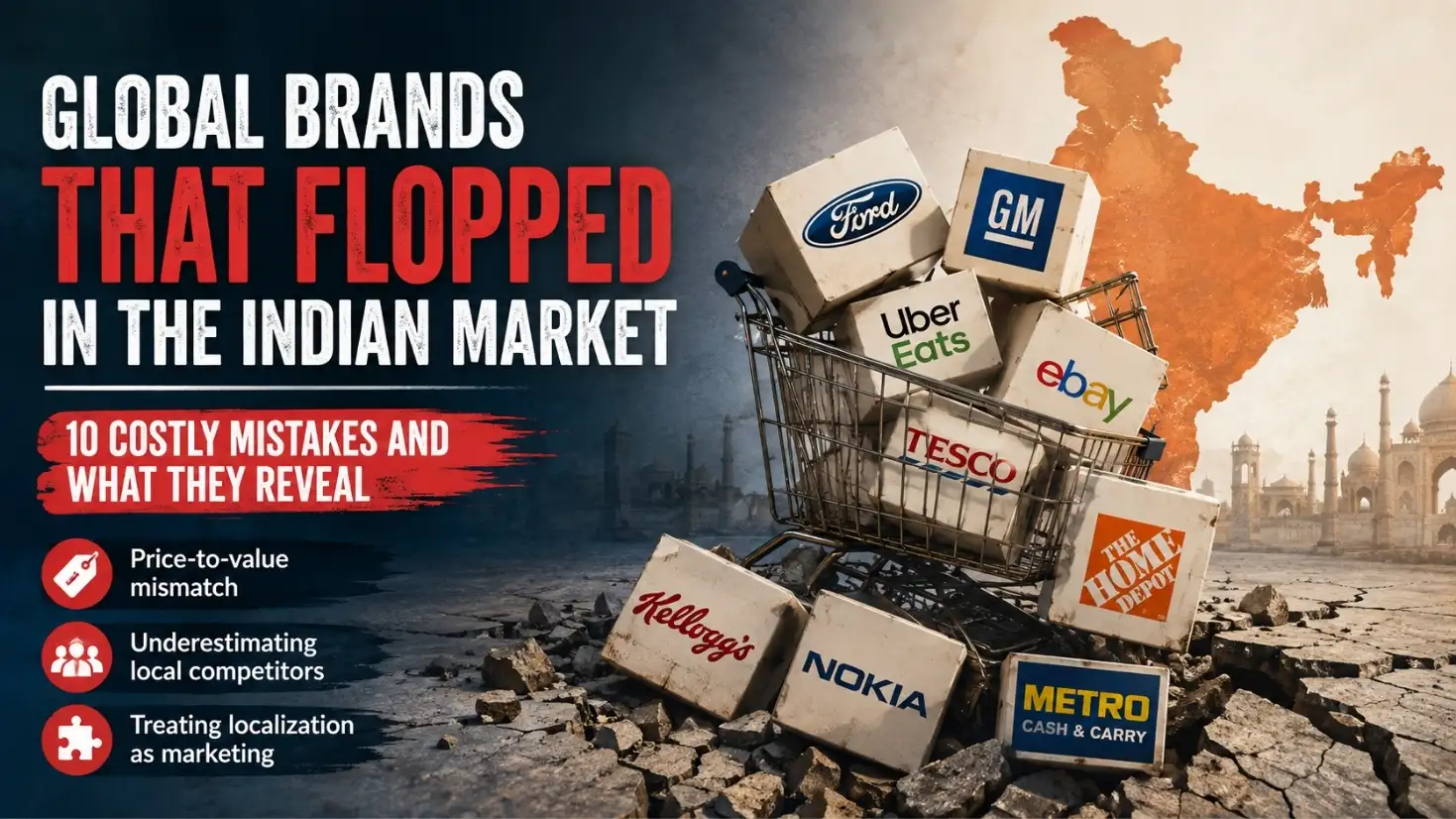
- Price-to-value mismatch: Nearly every brand on this list priced for a market that didn’t exist at the scale they needed, or misjudged what Indian consumers considered “worth it.”
- Underestimating local competitors: Indian and other Asian companies consistently out-executed on distribution, pricing, and speed of adaptation.
- Treating localization as marketing, not product strategy: Translating an ad campaign is not the same as rebuilding a product or format around local habits, regulations, and infrastructure.
For any brand – global or domestic – eyeing the Indian market, the takeaway isn’t “avoid India.” It’s: enter with a product and pricing strategy built for India, not one borrowed from somewhere else and hoped to translate.
FAQs: Global Brands and the Indian Market
Why do so many international brands fail in India?
Most failures trace back to underestimating Indian consumers’ price sensitivity, entering without localizing the product or business model, and underestimating how fast and well local competitors respond.
Which global brands exited the Indian market?
Notable exits include Harley-Davidson, Ford, General Motors, Uber Eats, eBay (as an independent entity), Home Depot, Metro Cash & Carry, and Tesco (as a standalone retail ambition).
Is India a difficult market for foreign companies?
It’s a market with high potential but real complexity – regulatory restrictions, intense price competition, and diverse regional preferences make it demanding for brands that don’t adapt their model specifically for it.
What can new brands learn from these failures?
Localize the product and pricing before scaling, study the local competitive landscape closely, and plan for regulatory realities like FDI rules rather than assuming a global playbook will transfer directly.
What do you feel about this post?

Like

Love

Happy

Haha

Sad