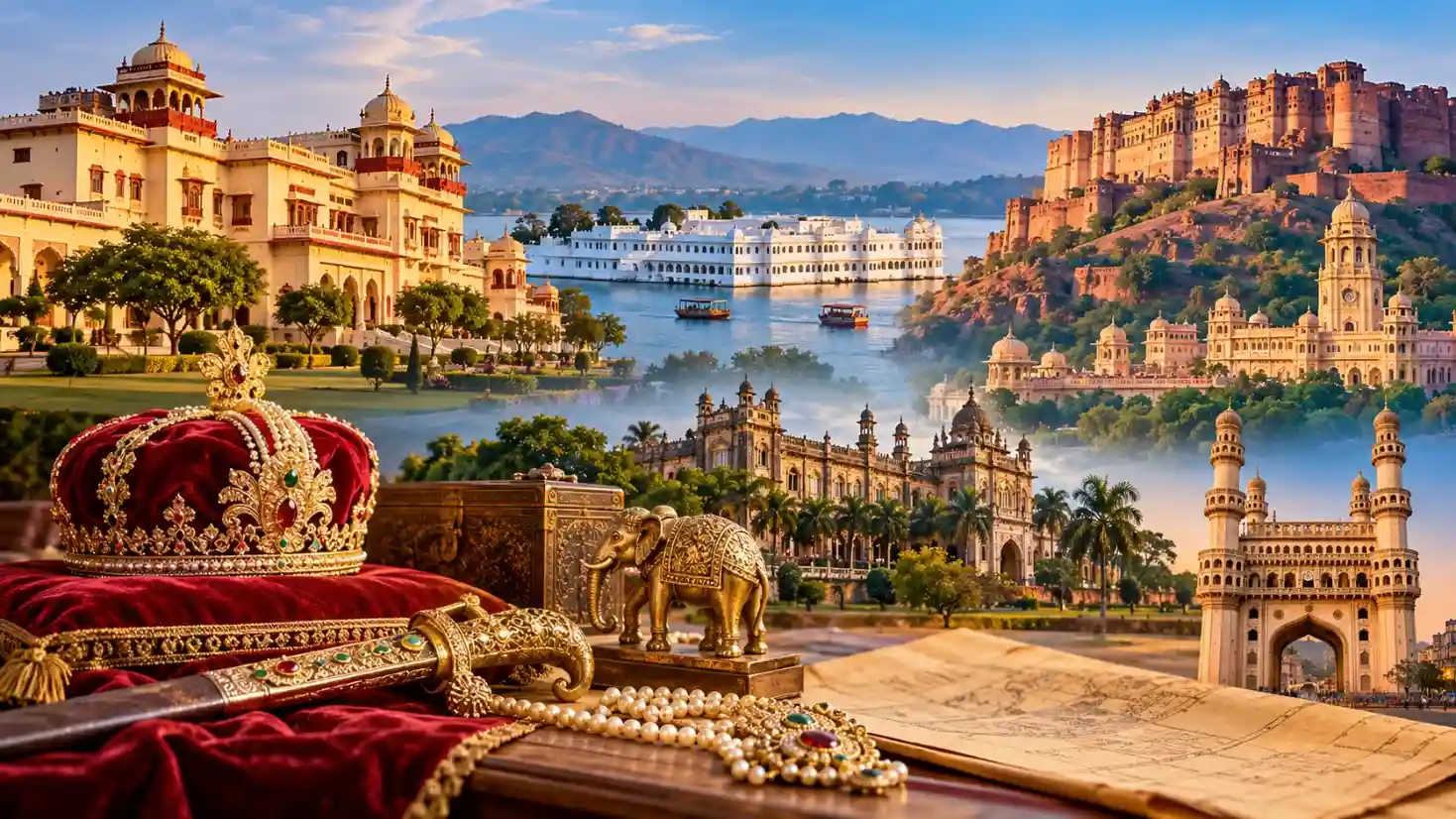
Most royal families in India earn money today through heritage hotels, palace tourism, museums, real estate, event hosting and, for some, politics. Their government allowances ended in 1971. The families that survived turned palaces into businesses.
Here are the top 10 royal families in India and how each one makes its money.
How Do Royal Families in India Make Money Today?
Before 1971, the Indian state paid royal families regular allowances called privy purses. Then the Constitution was amended, royal privileges were cancelled, and those payments stopped. Many families were left with huge assets and almost no cash. As one observer put it, they were high on assets but low on liquidity.
The ones who adapted usually followed the same playbook:
- Lease a palace to a hotel chain such as Taj
- Run a palace hotel or museum themselves
- Rent out grounds for weddings and film shoots
- Hold land, and sometimes fight over it in court
Families that did none of this mostly slid into the middle class.
Quick Summary Table
| # | Royal family | Seat | Main sources of income |
| 1 | Jaipur | Rajasthan | Palace leases to Taj, City Palace museum, stays and events |
| 2 | Mewar | Udaipur | HRH Group hotels, City Palace museum, Taj lease |
| 3 | Jodhpur | Rajasthan | Umaid Bhawan hotel, Mehrangarh Fort museum, weddings |
| 4 | Mysore | Karnataka | Bangalore Palace, private property, land compensation |
| 5 | Baroda | Gujarat | Laxmi Vilas Palace, banquets, golf club, museum |
| 6 | Gwalior | Madhya Pradesh | Inherited real estate, museum wing, politics |
| 7 | Hyderabad | Telangana | Taj Falaknuma lease, Chowmahalla museum, properties |
| 8 | Travancore | Kerala | Family trusts, temple role, private estates |
| 9 | Bikaner | Rajasthan | Palace hotel, Junagarh Fort museum, politics |
| 10 | Pataudi | Haryana | Palace leased to Neemrana, film career, land |
1. Royal Family of Jaipur
The Kachwaha family of Jaipur is probably India’s most visible royal household today. The family leased Rambagh Palace to Taj Hotels, which runs it as a luxury hotel. Part of the City Palace works as a museum, and in a headline-grabbing move, the family listed a City Palace stay on Airbnb.
Source of income: Palace leases, museum tickets, stays and events, and polo sponsorships. Diya Kumari, a family member, also holds public office in Rajasthan, so politics sits alongside the business.
2. Royal Family of Mewar (Udaipur)
Mewar is often called the oldest surviving dynasty on this list. The family runs the HRH Group of Hotels, which has roughly ten properties, and manages the City Palace of Udaipur as both a museum and a hotel. Lake Palace, the white marble hotel in the middle of Lake Pichola, is run by Taj.
Source of income: HRH hotels, City Palace museum entry, the Taj lease, and cultural events. If you want a model of a royal family run like a hospitality company, this is it.
3. Royal Family of Jodhpur
Umaid Bhawan Palace opened in 1944 with 347 rooms. It’s now split three ways: a home for Gaj Singh’s family, a luxury hotel of 64 rooms and suites run by Taj since 2005, and a museum. The family opened part of the palace as a hotel back in 1978, and turned Mehrangarh Fort into a museum, with profits going to restoration.
Source of income: The Taj arrangement, museum tickets, and destination weddings. Umaid Bhawan is one of the most sought-after wedding venues in the country.
4. Royal Family of Mysore (Wadiyar)
Here’s a twist. Mysore Palace draws around six million visitors a year, but the palace itself isn’t the family’s cash machine. The money story sits in Bengaluru. The Wadiyar heirs have spent decades in court over Bangalore Palace land that the state acquired under a 1996 law. In 2025, the Supreme Court told Karnataka to issue Transferable Development Rights worth over Rs 3,000 crore for about 15 acres, and the dispute continued after that.
Source of income: Private property, the Bangalore Palace estate, and land compensation claims. Yaduveer Wadiyar is also a Member of Parliament.
5. Royal Family of Baroda (Gaekwad)
Laxmi Vilas Palace in Vadodara was completed in 1890 and is often described as the largest private residence in India. The palace complex covers hundreds of acres and includes a museum, the Gaekwad Baroda Golf Club and cricket grounds. After a decades-long inheritance battle, the family settled in 2013 over property reported to be worth more than Rs 20,000 crore.
Source of income: Banquets and events at the palace, the golf club, the museum, and a real estate business in Mumbai run by Samarjitsinh Gaekwad.
6. Royal Family of Gwalior (Scindia)
The Scindias hold some of the biggest land assets on this list. The Jai Vilas Palace compound and other Gwalior properties are reported to be worth over Rs 10,000 crore, though a long family feud over them has been heading toward a settlement. Part of Jai Vilas is the Jivajirao Scindia Museum, open to the public since 1964.
Source of income: Mostly inherited real estate and investments, plus political careers. Jyotiraditya Scindia is a Union Minister. Notice the gap between paper wealth and cash: in an earlier election affidavit, he reported only Rs 4.67 lakh in annual income from ancestral property.
7. Royal Family of Hyderabad (Nizam)
The last Nizam was once among the richest people in the world. His grandson Mukarram Jah, crowned in 1967, watched the fortune shrink after privy purses ended in the 1970s. The recovery came from leasing Falaknuma Palace to Taj, which reopened it as a hotel in 2010. Chowmahalla Palace was restored and now works as a museum. Mukarram Jah died in January 2023, and heirs have since argued over the properties.
Source of income: The Taj lease, museum operations, and remaining palace properties.
8. Royal Family of Travancore
People assume the Travancore royals own the vast treasure in Padmanabhaswamy Temple. They don’t own it. The Supreme Court’s 2020 verdict recognised the royal family’s role in managing the temple through a trust, which is a different thing from owning what’s in the vaults.
Source of income: Private estates and family trusts. Public numbers are thin here, so treat any “net worth” figure for this family with suspicion.
9. Royal Family of Bikaner
The Bikaner royals work much like their Rajasthan neighbours: a palace hotel at Lalgarh Palace, Junagarh Fort as a museum, and real estate. Siddhi Kumari has also served as an elected representative.
Source of income: Hotel operations, museum entry, and property. Documented figures are limited, so I’ve kept this one short.
10. Royal Family of Pataudi
The Pataudis are smaller than the others but well known. Ibrahim Kothi, the family’s Pataudi Palace, is run as a hotel by Neemrana Hotels. The Nawab, Saif Ali Khan, adds income from his acting career. The family has also faced legal challenges over inherited Bhopal properties.
Source of income: The Neemrana arrangement, a film career, and land.
What Entrepreneurs Can Learn From These Families
The winners all did the same thing: they stopped treating palaces as homes and started treating them as products. Leasing to a pro operator like Taj gave Jodhpur and Hyderabad steady income without running a hotel. Mewar built its own brand instead. Both worked. The families that sat on assets and waited didn’t.
FAQs About Royal Families in India
Which is the richest royal family in India?
There’s no official ranking. Baroda (Gaekwad) and Gwalior (Scindia) are linked to the largest reported property values, and Jaipur, Mewar and Jodhpur are the most active commercially.
How do royal families in India earn money?
Mainly through heritage hotels, palace museums, event hosting, real estate and, for some, political office.
Do Indian royal families still get government money?
No. Privy purses were abolished in 1971.
Do royal families in India still exist?
Yes, as private citizens. Many still carry ceremonial titles, but they hold no legal royal status.
Do the Travancore royals own Padmanabhaswamy Temple’s treasure?
No. A trust manages the temple, and the royal family has a role in that trust. The treasure isn’t family property.
Conclusion
The royal families in India that still thrive didn’t survive on titles. They survived on hotels, museums, land and smart partnerships. If you’re researching the topic, check each family’s current arrangements, because leases, disputes and succession details change.
What do you feel about this post?

Like

Love

Happy

Haha

Sad