

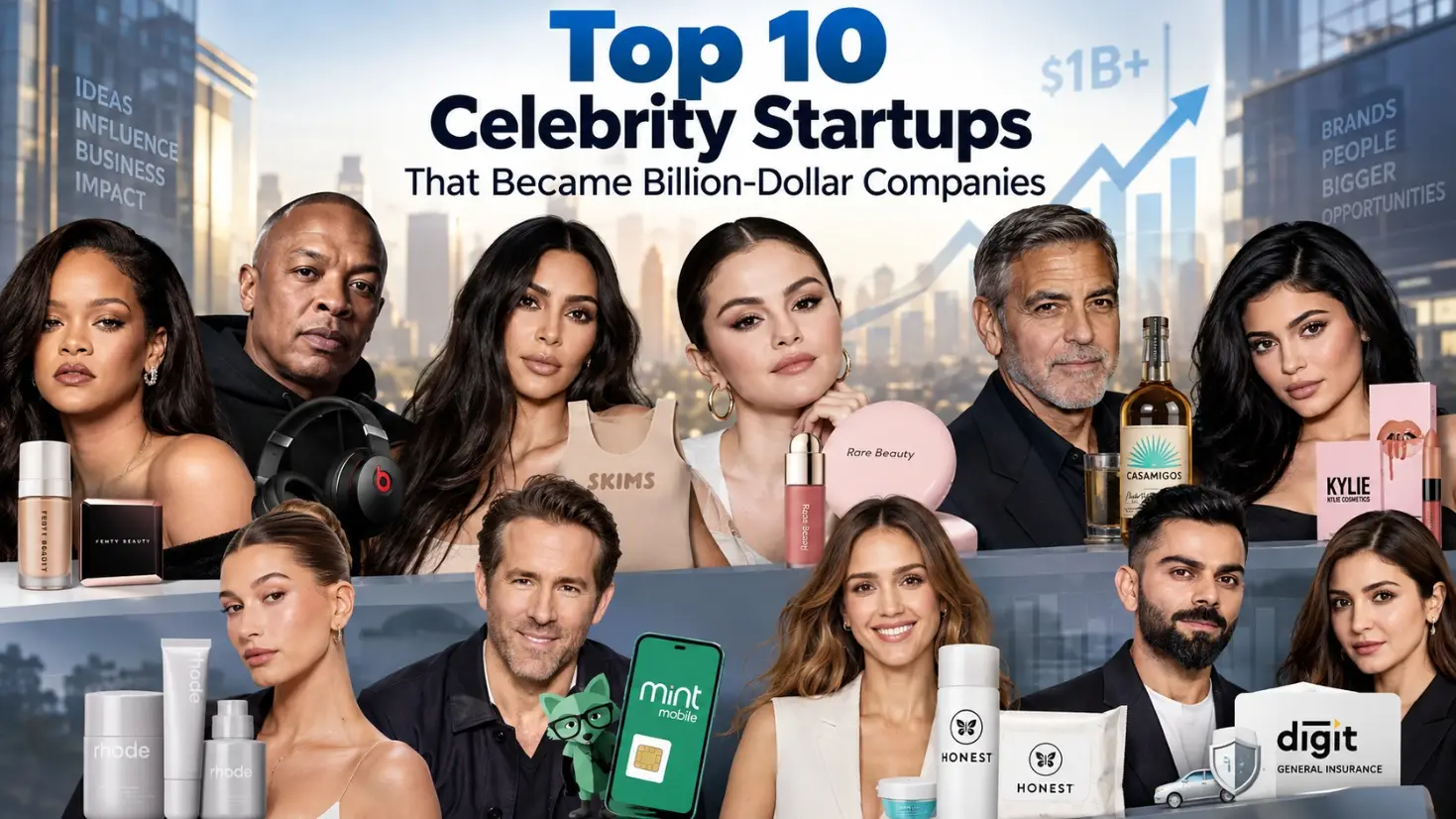
Most celebrity business ventures don’t survive past the launch party. A perfume line here, a tequila brand there, gone in three years once the novelty wears off. The ten below are different – each hit an actual billion-dollar milestone confirmed by a funding round, an acquisition, or an IPO. Eight are companies the celebrity actually founded and built. Two – flagged clearly where they appear – are companies a celebrity backed early as an investor, not the founder. Both stories are worth telling, but they’re not the same thing, and this list doesn’t pretend otherwise.
Quick answer: The ten celebrity startups and ventures confirmed at $1 billion or more are Fenty Beauty (Rihanna), Beats by Dre (Dr. Dre and Jimmy Iovine), Skims (Kim Kardashian), Rare Beauty (Selena Gomez), Casamigos (George Clooney), Kylie Cosmetics (Kylie Jenner), Rhode (Hailey Bieber), Mint Mobile (Ryan Reynolds, early equity partner), The Honest Company (Jessica Alba), and Go Digit General Insurance (Virat Kohli and Anushka Sharma, early investors).
At a glance
| # | Company | Celebrity | Category | Billion-Dollar Event |
| 1 | Fenty Beauty | Rihanna (co-founder) | Cosmetics | Valued at $2.8B (Forbes, 2021) |
| 2 | Beats by Dre | Dr. Dre & Jimmy Iovine (founders) | Audio | Sold to Apple for $3B (2014) |
| 3 | Skims | Kim Kardashian (co-founder) | Shapewear/apparel | Valued at $5B (2025 funding round) |
| 4 | Rare Beauty | Selena Gomez (founder) | Cosmetics | Valued at $2.7B (2025) |
| 5 | Casamigos | George Clooney (co-founder) | Spirits | Sold to Diageo for up to $1B (2017) |
| 6 | Kylie Cosmetics | Kylie Jenner (founder) | Cosmetics | Valued at $1.2B (Coty deal, 2019) |
| 7 | Rhode | Hailey Bieber (founder) | Skincare | Sold to e.l.f. Beauty for up to $1B (2025) |
| 8 | Mint Mobile | Ryan Reynolds (early equity partner) | Telecom | Sold to T-Mobile for up to $1.35B (2023) |
| 9 | The Honest Company | Jessica Alba (co-founder) | Consumer goods | IPO’d at $1.44B (2021) |
| 10 | Go Digit General Insurance | Virat Kohli & Anushka Sharma (early investors) | Insurance | Listed at ~$3.2B market cap (2024) |
1. Fenty Beauty – Rihanna
Rihanna launched Fenty Beauty in 2017 as a 50-50 joint venture with LVMH, and the pitch was simple: a foundation line in 40+ shades at a time when most beauty brands stopped at “light, medium, dark.” It worked immediately – $550 million in sales during its first full year, outpacing Kylie Cosmetics and KKW Beauty, which had launched earlier with bigger starting followings. By 2021, Forbes pegged Fenty Beauty’s value at $2.8 billion, with Rihanna’s 50% stake worth roughly $1.4 billion on its own. The shade-range decision gets treated as a marketing story now, but it was really a manufacturing bet – more shades means more SKUs, more inventory risk, more complexity at launch. LVMH’s backing is what made that bet possible for a first-time founder.
2. Beats by Dre – Dr. Dre & Jimmy Iovine
Dre and music executive Jimmy Iovine started Beats Electronics in 2006, betting that headphones could be a fashion statement instead of just an audio product. It worked well enough that Apple bought the company in 2014 for $3 billion – $2.6 billion in cash plus $400 million in vesting stock, at the time Apple’s largest acquisition ever. Beats had pulled in $1.1 billion in revenue the year before the deal closed, so this wasn’t a hype purchase – the numbers were real. Dre and Iovine joined Apple as part of the deal.
3. Skims – Kim Kardashian
Kim Kardashian co-founded Skims in 2019 with Jens Grede and Emma Grede, and the valuation climb since then has been steep: $1.6 billion (2021), $3.2 billion (early 2022), $4 billion (mid-2023), and $5 billion after a $225 million Goldman Sachs-led round in November 2025. Revenue followed the same curve – from roughly $145 million in 2020 to over $750 million by 2023 – and the brand turned profitable along the way, which is the detail that separates Skims from a lot of celebrity apparel lines that burn cash chasing growth. Skims also picked up official underwear partnerships with the NBA, WNBA, and USA Basketball.
4. Rare Beauty – Selena Gomez
Selena Gomez founded Rare Beauty in 2020 around a specific mission – mental health awareness woven into the marketing, not bolted on as an afterthought – and it turned into one of Sephora’s best-selling brands. She was reportedly offered a sale at a $2 billion valuation in 2024 and turned it down; by October 2025, Fortune had the brand at $2.7 billion. Gomez holds an estimated 51% stake, which is why her personal net worth is now the subject of a genuine dispute between Forbes ($700 million) and Bloomberg ($1.3 billion) – the gap comes entirely from how conservatively each outlet marks Rare Beauty’s private valuation. Several other celebrity beauty lines launched around the same window, including Drew Barrymore’s Flower Beauty and Kate Moss’s Cosmoss, have since shut down or gone into liquidation. Rare Beauty kept climbing.
5. Casamigos – George Clooney
George Clooney, Rande Gerber, and Mike Meldman started Casamigos in 2013 as tequila for their own friend group, not as a company – they only got licensed to sell it because too many people kept asking where to buy it. Four years later, Diageo bought it for up to $1 billion: $700 million up front, $300 million more tied to performance over the following decade. At the time of the sale, Casamigos was selling around 170,000 nine-liter cases a year – a benchmark every celebrity tequila launch since has been measured against.
6. Kylie Cosmetics – Kylie Jenner
Kylie Jenner started what was then Kylie Lip Kits in 2015 as a teenager. By 2019, Coty paid $600 million for a 51% stake – pricing the whole company at $1.2 billion off roughly $177 million in trailing revenue. The brand’s growth slowed after the Coty deal, and some later reporting questioned whether that $1.2 billion mark still held – but the deal itself, and the valuation at the time it closed, are matters of record, confirmed in Coty’s own SEC filings.
7. Rhode – Hailey Bieber
Hailey Bieber launched Rhode in June 2022 with a tight lineup of minimalist skincare – five products, no sprawl. Three years later, e.l.f. Beauty acquired it in a deal worth up to $1 billion: $600 million in cash, $200 million in stock, and a $200 million earnout tied to growth over the next three years. Rhode had pulled in $212 million in net sales the year before the deal closed. Bieber stays on as chief creative officer and head of innovation. Of everything on this list, Rhode is the cleanest zero-to-billion story – three years, one founder, one clear product bet (minimalism, when the rest of the category was launching 20-piece collections), and a buyer willing to pay for it.
8. Mint Mobile – Ryan Reynolds
Worth being precise here: Ryan Reynolds didn’t found Mint Mobile. David Glickman and Rizwan Kassim did. Reynolds bought an equity stake in 2019 and became the company’s creative force – by his own account, he “never dreamt” he’d own a wireless company. T-Mobile bought Mint’s parent company in 2023 for up to $1.35 billion, a cash-and-stock deal weighted toward performance targets. Reynolds’s stake was reported at roughly 25%, putting his personal payout somewhere in the hundreds of millions depending on how the earnout resolves. The lesson isn’t “found something” – it’s that equity plus relentless, self-aware marketing (Reynolds’s ads leaned hard into the joke of a celebrity owning a budget carrier) can build enough brand value to attract a $1.35 billion buyer.
9. The Honest Company – Jessica Alba
Jessica Alba co-founded The Honest Company in 2011 after her first child was born, building it around “clean” baby and household products. It hit unicorn status early – a $1.7 billion valuation in 2015 – then took a hit in 2017 when a lawsuit over ingredient labeling forced a valuation reset below $1 billion. The comeback took four years: Honest IPO’d on Nasdaq in May 2021 at $1.44 billion, raising $412.8 million. It’s a useful case study precisely because it wasn’t a straight line up – the brand had to rebuild trust before Wall Street would price it as a billion-dollar company again.
10. Go Digit General Insurance – Virat Kohli & Anushka Sharma
Kamesh Goyal founded Go Digit in 2016 as a cloud-first general insurance company covering motor, health, travel, and property. In February 2020, cricketer Virat Kohli and actor Anushka Sharma joined its first external funding round – ₹2 crore from Kohli, ₹50 lakh from Sharma, both at ₹75 a share. Go Digit listed on the BSE and NSE in May 2024 at a market cap of ₹26,869 crore, roughly $3.2 billion, with the stock popping over 5% on debut. Neither Kohli nor Sharma sold shares in the IPO – their early stake had grown roughly fourfold by listing day. Same caveat as Mint Mobile above, just more so: this is a celebrity investment story, not a celebrity startup story. Goyal built the company; Kohli and Sharma bet on it early and got paid for the bet.
How celebrities usually get this kind of equity
Two patterns cover this list. Either the celebrity is a genuine co-founder who built the operating business (Alba with Honest, Gomez with Rare Beauty, Bieber with Rhode, Clooney with Casamigos), or the celebrity takes an equity stake in someone else’s venture in exchange for money, marketing pull, or both (Reynolds with Mint Mobile, Kohli and Sharma with Go Digit). Both paths can hit a billion dollars. They’re not the same risk profile, though – a founder puts in years of operating decisions before any exit; an investor’s payoff depends entirely on someone else running the business well.
FAQ
Which celebrity-founded company has the highest valuation right now?
Skims, at $5 billion after its November 2025 funding round, is currently the highest-valued company on this list where the celebrity is a genuine co-founder with an active operating role.
Did all ten celebrities on this list actually found their companies?
No. Eight did – Fenty Beauty, Beats by Dre, Skims, Rare Beauty, Casamigos, Kylie Cosmetics, Rhode, and The Honest Company. Others founded Mint Mobile and Go Digit; Ryan Reynolds, Virat Kohli, and Anushka Sharma bought in as early equity investors.
Is a celebrity brand’s valuation the same as the celebrity’s personal net worth?
No. Valuation reflects what investors or buyers think the whole company is worth; a celebrity’s personal wealth from it depends on their ownership percentage, often 25-51% for founders and much smaller for early investors.
Can a celebrity startup lose its billion-dollar status?
Yes. The Honest Company dropped below $1 billion in 2017 after a lawsuit, then rebuilt to a $1.44 billion IPO valuation in 2021. Valuations move with revenue, lawsuits, and market conditions like any other company.
What’s the fastest a celebrity-founded brand has reached a billion-dollar valuation?
Rhode did it in about three years – June 2022 launch to a $1 billion e.l.f. Beauty acquisition in 2025 – the fastest founder-to-exit timeline on this list.
What do you feel about this post?

Like

Love

Happy

Haha

Sad


3 thoughts on “Top 10 Celebrity Startups That Became Billion-Dollar Companies”