

Every Shark Tank India season closes the same way: a wave of headlines about how many crores got committed on stage. What those headlines don’t tell you is how few of those deals actually turn into real businesses. Some brands take the cheque, get a nice bump in Instagram followers, and quietly fade by the next season. Others use the fifteen minutes of airtime as the launchpad it was meant to be.
This list is about the second group. Ten Shark Tank India startups that didn’t just get funded – they built the revenue, the retail footprint, or the follow-on funding rounds to back it up.
Which Shark Tank India deals turned into the biggest successes?
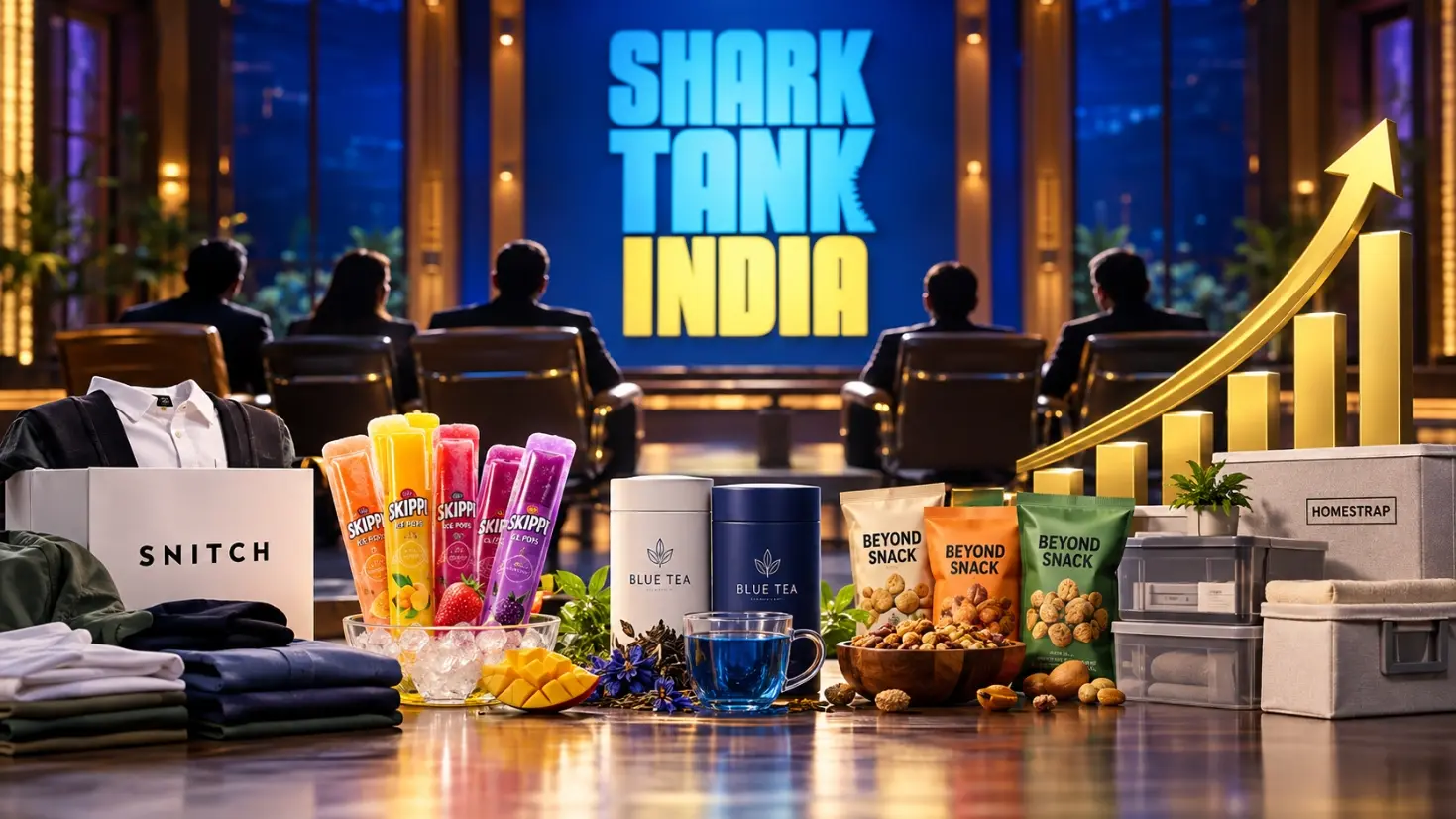
Snitch, Skippi Ice Pops, Blue Tea, Beyond Snack, and Homestrap are widely cited as Shark Tank India’s biggest breakout successes. Snitch went from an all-shark deal to a ₹2,500 crore valuation after a ₹340 crore Series B, while Skippi’s sales grew roughly 40x and Blue Tea crossed ₹100 crore in annual revenue within a few years of its pitch.
Here’s the full list, with what actually happened after the cameras stopped rolling.
Quick Comparison: 10 Shark Tank India Success Stories at a Glance
| Brand | Category | Deal Snapshot | Where They Are Now |
| Snitch | Men’s fashion | All-shark deal, Season 2 | ₹2,500 crore valuation, ₹340 crore Series B |
| Skippi Ice Pops | Frozen desserts | ₹1.2 crore for 15%, Season 1 | Sales up ~40x, chasing ₹100 crore revenue |
| Blue Tea | Herbal tea (D2C) | Funded deal, 2023 | Crossed ₹100 crore revenue, sells in 11+ countries |
| Beyond Snack | Packaged snacks | Funded deal | Monthly sales ₹20 lakh → ₹5 crore |
| Homestrap | Home organization | Funded deal | Monthly revenue ₹50 lakh → ₹50-60 crore annually |
| Hair Originals | Hair extensions | Funded deal | 10x growth in revenue and valuation |
| The Whole Truth | Clean-label nutrition | Funded deal | National retail + D2C scale-up |
| str8bat | Sports tech | Funded deal | Raised a further $3.5M Series B |
| NOOE | Premium lifestyle | ₹5 crore for 51%, largest ST India deal ever | Rapid revenue scale-up post-show |
| Culture Circle | Luxury resale marketplace | Funded deal | AI-authentication platform expanding offline |
1. Snitch – From a Kirana Store Family to a ₹2,500 Crore Fashion Brand
Founder Siddharth Dungarwal built Snitch on a simple bet: young Indian men wanted fast-fashion menswear that updated as often as Instagram trends did. When he pitched on Shark Tank India Season 2, every investor on the panel said yes – an all-shark deal that’s still one of the show’s most talked-about moments.
What happened next is the part most “success story” roundups skip. Snitch didn’t just grow – it raised a ₹340 crore Series B round, pushing its valuation to around ₹2,500 crore, and its revenue is reportedly closing in on ₹500 crore. That’s not a viral spike. That’s a company that built repeatable supply chain and design operations after the TV appearance, not because of it.
Why it worked: fast fashion lives and dies on how quickly you can turn a trend into stock on shelves. Snitch treated the Shark Tank cheque as working capital for exactly that, not as a marketing stunt.
2. Skippi Ice Pops – All Five Sharks, and a 40x Sales Jump
Skippi holds a small piece of Shark Tank India history: it was the first brand to get a commitment from every single shark, walking away with ₹1.2 crore for 15% equity in Season 1.
The founders didn’t sit on that validation. They used it to push into thousands of retail stores and, notably, solved a distribution problem most frozen-food brands never crack in India – cold-chain delivery in tier-2 and tier-3 markets. Their answer was freezer bikes, a low-cost way to keep ice pops frozen on the last mile without needing a full cold-chain truck fleet. Post-show, sales reportedly grew close to 40 times, and the brand is now eyeing ₹100 crore in revenue.
Why it worked: the freezer-bike fix wasn’t cosmetic. It solved the actual operational bottleneck stopping a frozen snack brand from reaching smaller towns.
3. Blue Tea – ₹1 Lakh Start, ₹100 Crore Business
Blue Tea’s founders, Sunil Chandra Saha and Nitesh Singh, started the brand in 2018 with a combined ₹50,000 each – not the kind of number that usually ends in a nine-figure business. Their product, caffeine-free butterfly pea flower tea, was barely known in India when they launched; most of the flower’s supply chain had to be built from scratch, training farmers who’d only grown it for religious use.
By the time Blue Tea appeared on Shark Tank India in 2023, it already had a working export business. Post-show, its monthly revenue reportedly hit ₹5 crore, and the company has since crossed ₹100 crore in annual revenue, now selling across 11-plus countries and stocked among Amazon’s top herbal tea brands in the US and EU.
Why it worked: Blue Tea’s edge wasn’t the pitch – it was seven years of unglamorous farmer training and supply-chain work that had already happened before the sharks ever saw the product.
4. Beyond Snack – Turning a Regional Snack Into a National Brand
Founder Manas Madhu took a snack most Indians associate with Kerala tea stalls – banana chips – and rebuilt it as a modern, better-branded packaged food product. It’s not a flashy pitch (there’s no new invention here), which makes what happened after the show more interesting.
Beyond Snack scaled from around 1,000 retail stores to more than 8,000 outlets nationwide, and monthly sales reportedly grew from ₹20 lakh to over ₹5 crore. The lesson buried in that number: you don’t need a novel product category to build a Shark Tank India success story. You need distribution and a brand that photographs better than the loose packets at the local store.
Why it worked: the product was already trusted. The company just fixed the packaging, the shelf presence, and the story around a snack people already liked.
5. Homestrap – Boring Category, Big Revenue
Home organization products – storage bags, hangers, wardrobe organizers – aren’t a category anyone gets excited pitching. That’s arguably why Homestrap’s growth is worth including here. The brand went from ₹50 lakh in monthly revenue to a business now generating ₹50-60 crore a year.
Why it worked: low-excitement categories often have less competition for shelf space and ad attention. Homestrap leaned into being useful and consistently available rather than chasing a viral moment.
6. Hair Originals – 10x Growth in a Niche Beauty Category
Hair extensions are a category most Indian consumers didn’t associate with a homegrown brand before Hair Originals. After its Shark Tank India appearance, the company reported roughly 10x growth in both revenue and valuation, and now sells across multiple countries.
Why it worked: hair extensions are a repeat-purchase, high-margin category once you build trust in quality – and that trust is exactly what national TV exposure is good for.
7. The Whole Truth – Betting on Ingredient Transparency
Founder Shashank Mehta built The Whole Truth around a specific pitch: no added sugar, no hidden preservatives, no marketing claims you can’t verify on the label. In a protein-bar and snacking category full of “healthy” branding that doesn’t hold up under scrutiny, that positioning became the actual product differentiator.
Post-show, the brand expanded its retail footprint alongside its D2C channel, betting that health-conscious buyers would pay a premium for a label they could actually trust.
Why it worked: in clean-label food, the claim only works if it’s true. The Whole Truth built its brand credibility on being checkable, not just “healthy-sounding.”
8. str8bat – Sports Tech That Raised Again After the Show
str8bat, a sports-tech startup focused on athlete performance tracking, secured a Shark Tank India deal and then went on to raise a further $3.5 million in Series B funding. That’s a meaningfully different signal than most brands on this list: outside investors, not just the sharks, backed the business again after watching it operate.
Why it worked: a funded Series B after a TV deal means the unit economics held up under real due diligence, not just a 15-minute pitch.
9. NOOE – The Largest Deal in Shark Tank India History
NOOE, a premium lifestyle and home products brand, holds the record for the single largest deal the show has ever handed out: ₹5 crore for 51% equity, from Peyush Bansal. A 51% stake is unusually high for the show – most founders fight to keep majority control – which signals how strongly NOOE’s team believed in the growth the capital and mentorship could unlock.
Post-show, the brand’s monthly revenue reportedly moved from lakhs into crores, with international expansion following.
Why it worked: giving up majority ownership is a bet that the shark’s network and capital will grow the pie faster than staying independent would. For NOOE, that bet paid off in scale.
10. Culture Circle – Betting on Trust in the Resale Market
Culture Circle built a marketplace for authentic, limited-edition streetwear and luxury goods – a category where fakes are the single biggest reason buyers hesitate. Its answer was AI-powered authentication plus physical stores, giving resale buyers a reason to trust a listing they can’t inspect in person before buying online.
The company had already built organic traction before its Shark Tank India appearance, which the show’s exposure then accelerated rather than created from scratch.
Why it worked: in resale and luxury categories, trust is the product. Culture Circle solved the authentication problem before it tried to solve the growth problem.
What Separates a Successful Shark Tank India Deal From a Forgotten One
Looking across these ten brands, a few patterns repeat more than any pitch-deck buzzword does:
The hard problem was already half-solved before the show: Blue Tea had years of farmer-supply work done. Culture Circle had already built authentication trust. The sharks amplified existing traction – they rarely created it from zero.
Distribution mattered more than the invention: Beyond Snack and Homestrap didn’t reinvent their categories. They fixed how the product reached shelves and screens.
A handful of brands treated the deal as a first round, not a finish line: Snitch and str8bat both raised again after the show, under real investor scrutiny – a signal that the business, not just the story, held up.
Category boredom isn’t a disqualifier: Home organization and banana chips outperformed flashier pitches on this list. Consistent revenue beats a viral clip.
FAQ: Shark Tank India Success Stories
What is the most successful Shark Tank India deal so far?
Snitch is generally considered the most successful Shark Tank India deal, having grown from an all-shark investment in Season 2 to a reported ₹2,500 crore valuation after a ₹340 crore Series B round.
Which Shark Tank India season produced the most breakout brands?
Season 1 and Season 2 have produced the largest share of well-known breakout brands, including Skippi Ice Pops, Snitch, and Hair Originals, likely because they’ve had the longest time to scale post-show.
Do all Shark Tank India deals actually close?
No. A meaningful share of deals agreed to on camera don’t close after due diligence, or close on revised terms. The companies on this list are ones where funding and growth were confirmed after the show aired.
What’s the largest deal ever given on Shark Tank India?
NOOE holds the record, with Peyush Bansal investing ₹5 crore for a 51% stake – the largest single deal in the show’s history.
Can a Shark Tank India rejection still lead to a successful company?
Yes. Several founders who didn’t get a deal on air have gone on to raise funding independently and scale their businesses – the show’s exposure alone can be valuable even without an on-air investment.
What do you feel about this post?

Like

Love

Happy

Haha

Sad

2 thoughts on “Top 10 Shark Tank India Deals That Became Breakout Successes”