

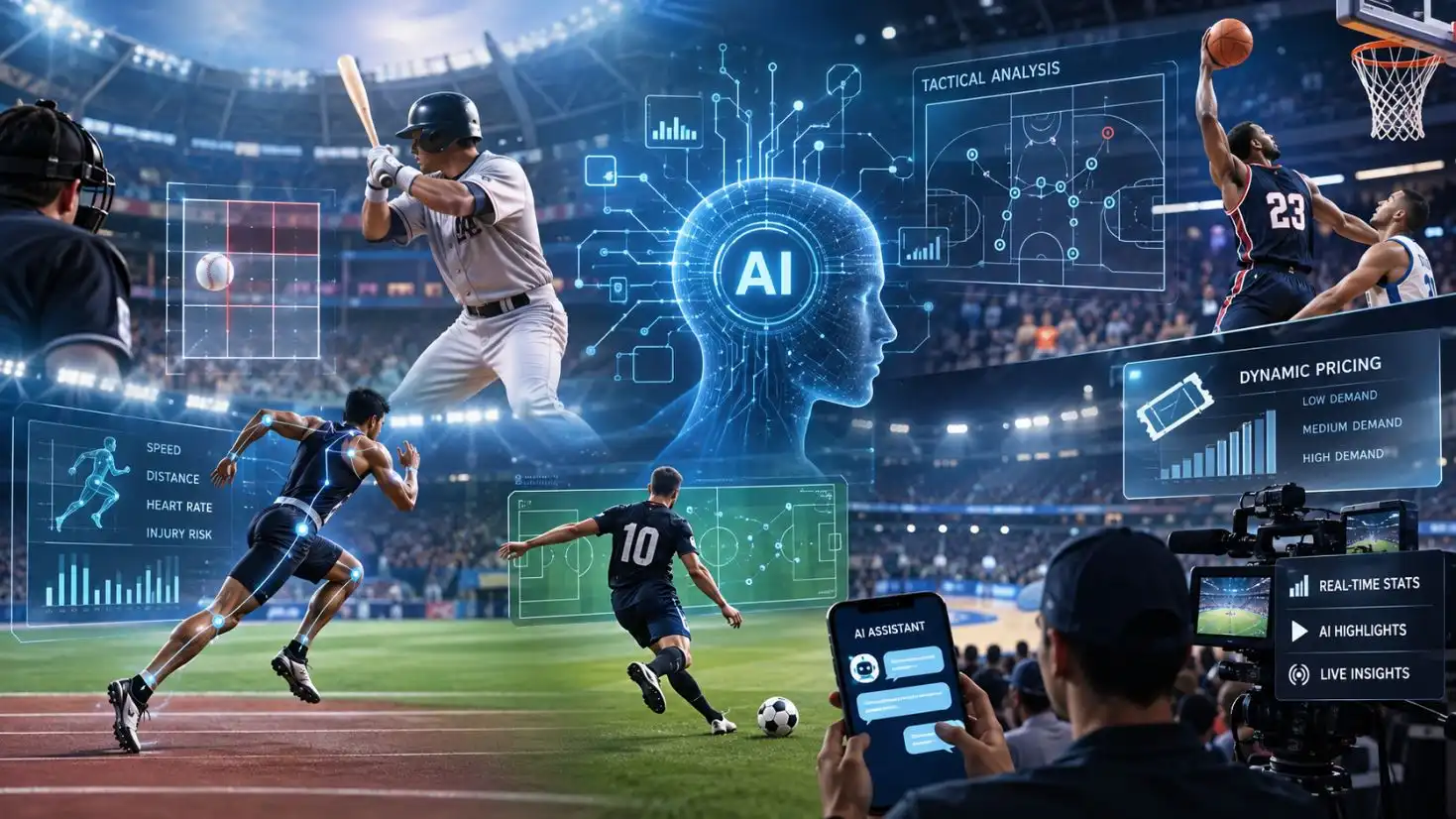
AI in professional sports isn’t a future story anymore. It’s calling balls and strikes, predicting torn ACLs before they happen, and cutting game highlights before the final whistle blows. Here are 10 concrete ways it’s running through pro sports today, with the actual systems and leagues using them.
Quick Answer
Professional sports organizations use AI for automated officiating, real-time player tracking, injury prediction, scouting, tactical simulation, highlight generation, fan chatbots, match predictions, broadcast enhancement, and dynamic ticket pricing. MLB’s robot-umpire challenge system, launching in 2026, is one of the clearest signs the technology has moved from pilot project to rulebook.
| # | Use Case | Example | Sport/League |
| 1 | Automated officiating | MLB’s ABS challenge system | Baseball |
| 2 | Player tracking & tactics | Second Spectrum, Genius Sports | NBA, Premier League |
| 3 | Injury prediction | Zone7, University of Delaware model | Soccer, multi-sport |
| 4 | AI scouting | Remote-league talent identification tools | Global soccer |
| 5 | Tactical simulation | Generative play/matchup simulation | NFL, NBA |
| 6 | Auto highlight generation | WSC Sports | Multi-league |
| 7 | Fan chatbots & personalization | IBM Watson (Grand Slam tennis) | Tennis, tennis broadcasts |
| 8 | Match outcome prediction | GoalAnalytics-style ensemble models | FIFA World Cup 2026 |
| 9 | Broadcast enhancement | Real-time stats overlays, live subtitles | Multi-sport |
| 10 | Dynamic ticket pricing | AI pricing engines | Multi-league |
1. Automated Officiating and Rules Enforcement
Baseball just handed part of the strike zone over to a computer. Major League Baseball’s competition committee approved an automated strike zone challenge system for the 2026 season, after years of testing in the minors. Here’s how it works: the human umpire still makes every call, and players or catchers can appeal it to the computer. The strike zone itself is a two-dimensional rectangle set to the width of home plate, with the top and bottom edges scaled to each player’s certified height.
It’s not a full robot takeover – success rates on challenges have hovered around 50% in the minor leagues, so umpires are still right more often than they’re wrong. But this is the first time a major North American league has put a computer’s ball-strike call directly into live gameplay, and other leagues are watching closely.
2. Real-Time Player Tracking and Tactical Analytics
Every NBA arena and most Premier League stadiums run computer-vision cameras that track every player and the ball, dozens of times per second. Tools like Second Spectrum and Genius Sports feed that data straight into coaching staffs, and AI-driven injury prevention built on the same tracking has become standard across top-tier leagues.
What coaches actually get from it: spacing patterns, shot quality by location, fatigue signals from movement speed, and opponent tendencies broken down possession by possession. None of that required a person with a clipboard and a stopwatch anymore.
3. Injury Prediction Before It Happens
This is the use case with the clearest dollar value attached, because a predicted injury is a game a star player doesn’t miss. Zone7’s platform has predicted injury risk with 72% accuracy across hundreds of cases from professional football clubs, and a University of Delaware model predicted lower-extremity injury risk after concussion with 95% accuracy.
Manchester City monitors players’ heart rate variability, sprint speeds, and movement patterns during practice, watching for the small drop-off in mechanics that shows up before a hamstring gives out – not after. It’s worth flagging plainly: these systems flag elevated risk from load and biometric patterns, they don’t guarantee any individual outcome.
4. AI-Powered Scouting and Recruitment
Traditional scouting has a geography problem – you can only send so many people to so many leagues. AI scouting platforms are now identifying players in remote leagues that traditional scouts would never travel to evaluate, running video and stat analysis on competitions a human scouting department simply doesn’t have the headcount to cover.
For smaller clubs especially, this closes a real gap. A club that can’t afford five scouts abroad can still see a promising 19-year-old in a second-division league nobody’s flying to.
5. Generative AI for Tactical Simulation
Before a game gets played, AI is already playing thousands of versions of it. Football clubs create simulated plays and matchups to find gaps in an opponent’s defense, and in basketball, generative AI can simulate thousands of possessions to find the highest-percentage shot for a given player against a specific matchup.
This is different from tracking past performance – it’s modeling scenarios that haven’t happened yet, so a coaching staff walks into a game with a menu of “if they do X, we run Y” options already tested in simulation.
6. Automated Highlight and Content Generation
Someone has to cut game highlights fast enough to hit social feeds before the next commercial break, and it’s rarely a human editor anymore. Fan-facing content platforms like WSC Sports use AI to detect key moments – a goal, a dunk, a big hit – and auto-generate clips, often personalized to a specific player or team a fan follows.
Same logic applies to written recaps: natural language processing now generates automated commentary and reports for lower-profile games that would otherwise get no coverage at all.
7. Fan Chatbots and Personalized Engagement
IBM’s sports AI deployments span the US Open, Australian Open, Masters Tournament, and Wimbledon, and tennis has become something of a proving ground for AI fan experience. Platforms like IBM Watson are already used at Wimbledon to generate match insights, chatbot Q&A, and real-time stat overlays for viewers.
During live events, AI can also deliver real-time subtitles in a fan’s own language, plus extra stats layered on top of the broadcast – the kind of personalization that used to require a whole second broadcast crew.
8. Match Outcome Prediction
At the FIFA World Cup 2026 – the largest tournament in the event’s history, spanning the US, Canada, and Mexico – one end-to-end prediction pipeline ran three modeling approaches at once: a Poisson baseline, an LSTM sequential model, and an Elo-plus-Monte-Carlo ensemble, forecasting the winner and scoreline for every fixture before the group stage even finished.
These models don’t just feed broadcasters a fun graphic. Front offices use the same kind of modeling for roster decisions, and betting markets lean on it heavily – which is part of why leagues are paying close attention to who has access to it.
9. Broadcast Enhancement
Beyond subtitles and chatbots, AI is changing what viewers see on screen during the actual broadcast. Real-time win probability, expected-goals overlays, and instant replay tagging all run through the same tracking data described in #2 – it’s just being pushed to the broadcast feed instead of the coach’s tablet.
The effect for viewers: a broadcast that used to rely on a color commentator’s gut feel now has a number attached to almost every meaningful moment, updated live.
10. Dynamic Ticket Pricing and Business Operations
AI in sports also touches the business side directly – ticket pricing, alongside player tracking, injury prediction, and scouting, is one of the areas computer vision and machine learning have moved into, replacing manual spreadsheets with models trained on tracking, biometric, and transaction data. A marquee matchup, a star player’s return from injury, or a playoff-race game all shift ticket prices in near real time, based on demand signals a static pricing sheet would never catch.
Frequently Asked Questions
Is AI actually deciding calls in professional games right now?
Partially. MLB’s ABS challenge system, starting in 2026, lets a computer overturn a human umpire’s ball-strike call – but only when a player appeals, and the umpire’s call still stands by default.
Which sport has adopted AI the fastest?
Baseball, tennis, and soccer are furthest along on officiating and broadcast AI. Basketball and soccer lead on tactical and injury-prediction AI, largely because computer-vision tracking cameras are already standard in most top-tier arenas and stadiums.
Can AI actually predict sports injuries reliably?
It can flag elevated risk with strong accuracy in aggregate – one model reported 72% accuracy across hundreds of cases, another 95% for a specific injury type after concussion. It can’t guarantee any single player’s outcome, and teams still make the final call with medical staff.
The Bottom Line
AI in professional sports isn’t one big rollout – it’s ten smaller ones happening in parallel, from the strike zone to the ticket office. The common thread: every use case above replaces a slow, manual process (a scout’s travel schedule, a human editor cutting highlights, a static ticket price) with a faster, data-driven one. Expect the list to be longer a year from now.
What do you feel about this post?

Like

Love

Happy

Haha

Sad

1 thought on “10 Ways AI Is Being Used in Professional Sports Right Now”