

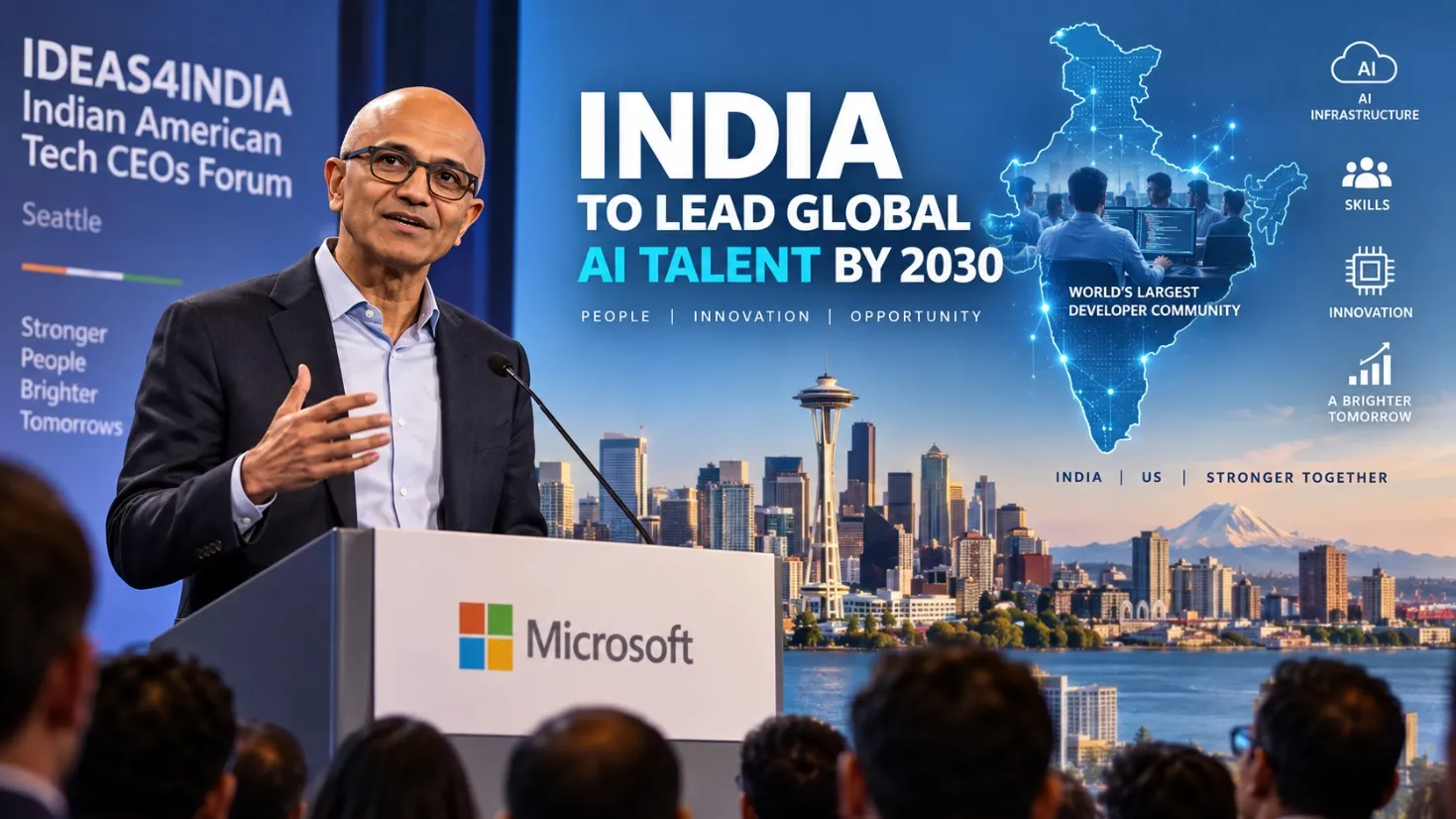
Satya Nadella told a room full of Indian-American tech executives in Seattle this week that India’s edge in AI isn’t infrastructure or capital. It’s people.
Speaking Thursday at the “IDEAS4INDIA: Indian American Tech CEOs Forum,” hosted by the Consulate General of India, the Microsoft chairman and CEO pointed to what he called the “ingenuity of the human capital in India.” He said the country is on pace to have the world’s largest developer community by 2030 – a claim he’s made before, but one that lands differently now that Microsoft has put real money behind it.
What did Nadella say about India’s AI potential?
Nadella said Microsoft remains committed to building the infrastructure, skills, and sovereign capabilities India needs for what he called its “AI-first future.” He credited Indian developer talent directly, and repeated his 2030 projection: India overtaking every other country in developer headcount, driven largely by AI-related work.
That’s not a new talking point for Nadella. He’s floated versions of the largest-developer-community claim since at least 2024. What’s changed is the scale of Microsoft’s financial commitment behind it – a distinction the Seattle audience, many of whom run their own companies, would have clocked immediately.
Who else was in the room
This wasn’t a Microsoft event dressed up as a diplomatic one. More than 40 Indian-origin CEOs and CTOs showed up, pulled from Amazon, Boeing, OpenAI, Anthropic, Intel, and a long list of smaller but well-funded Seattle-area companies – Helion, Rhythms AI, Zenoti, SeekOut, Viome Life Sciences, among others. The forum was billed as a follow-up to the India AI Impact Summit held earlier this year, and it leaned into that framing: less a showcase, more a working session on where the India-US tech relationship goes next.
Discussion topics ran through AI infrastructure, data centers, semiconductor design and manufacturing, quantum research, and aerospace. Ambassador Vinay Kwatra represented the Indian government’s side, reaffirming that India’s AI Mission is meant to stay anchored to “inclusivity, openness, sovereignty, democratized access, safety and trust” – language pulled almost verbatim from India’s official AI policy framing over the past year.
The room also paused for a minute of silence for two Seattle-based Indian-origin tech figures who died recently: Samir Bodas, who co-founded Icertis, and S. Somasegar, formerly a Microsoft corporate VP and more recently at Madrona Venture Group. Padma Shri Ajay Bhatt, the USB co-inventor, was in the audience too.
How much is Microsoft actually investing in India?
The number doing the heavy lifting here is $17.5 billion – Microsoft’s committed spend in India between 2026 and 2029, and its largest-ever investment anywhere in Asia. It goes toward cloud infrastructure, AI capacity, and skilling programs. Microsoft isn’t alone: Amazon has pledged $48 billion through 2030, including AWS data center buildouts in Mumbai and Hyderabad, and Costco is opening its first Global Capability Centre in Hyderabad.
Put those together and you get the real story behind Nadella’s Seattle remarks. This isn’t just talent-pool flattery. It’s three of the largest tech companies on earth backing India’s AI ambitions with capital that has to go somewhere specific – data centers, hiring, and vendor contracts.
What does this mean for Indian entrepreneurs
For founders and operators building in or around India’s tech sector, the practical read is straightforward. Capacity is coming: more Azure and AWS regional infrastructure means lower latency and, eventually, lower compute costs for startups building AI products locally. Hiring demand is coming too – GCCs don’t scale without local engineering and ops talent, and that pulls wages and expectations up across the board, not just inside the big firms opening them.
There’s a sovereignty angle worth watching as well. Ambassador Kwatra’s comments about “sovereignty” and “democratized access” echo a policy direction India has been pushing since the AI Impact Summit – one where global capital funds infrastructure, but India retains more control over how that infrastructure gets governed. How that tension resolves will shape what kind of AI companies get built on Indian soil versus which ones stay dependent on foreign cloud providers.
None of this guarantees India actually hits the “world’s largest developer community” mark by 2030. Projections like that have a way of sliding. But the money moving into the country right now is real, dated, and specific – which is more than can be said for most tech-diplomacy soundbites.
The bigger picture: India-US TRUST Initiative
The Seattle forum ties into a broader framework both governments are calling the India-US TRUST Initiative – “Transforming the Relationship Utilizing Strategic Technology.” The stated goal is joint work across AI, quantum computing, semiconductors, space, telecom, and biotech, including co-development and co-production arrangements. This was the first such Indian-American CEO gathering convened in Seattle, and organizers say it’s meant to become a recurring platform rather than a one-off.
What do you feel about this post?

Like

Love

Happy

Haha

Sad

1 thought on “Satya Nadella: India Set to Lead Global AI Talent by 2030”