

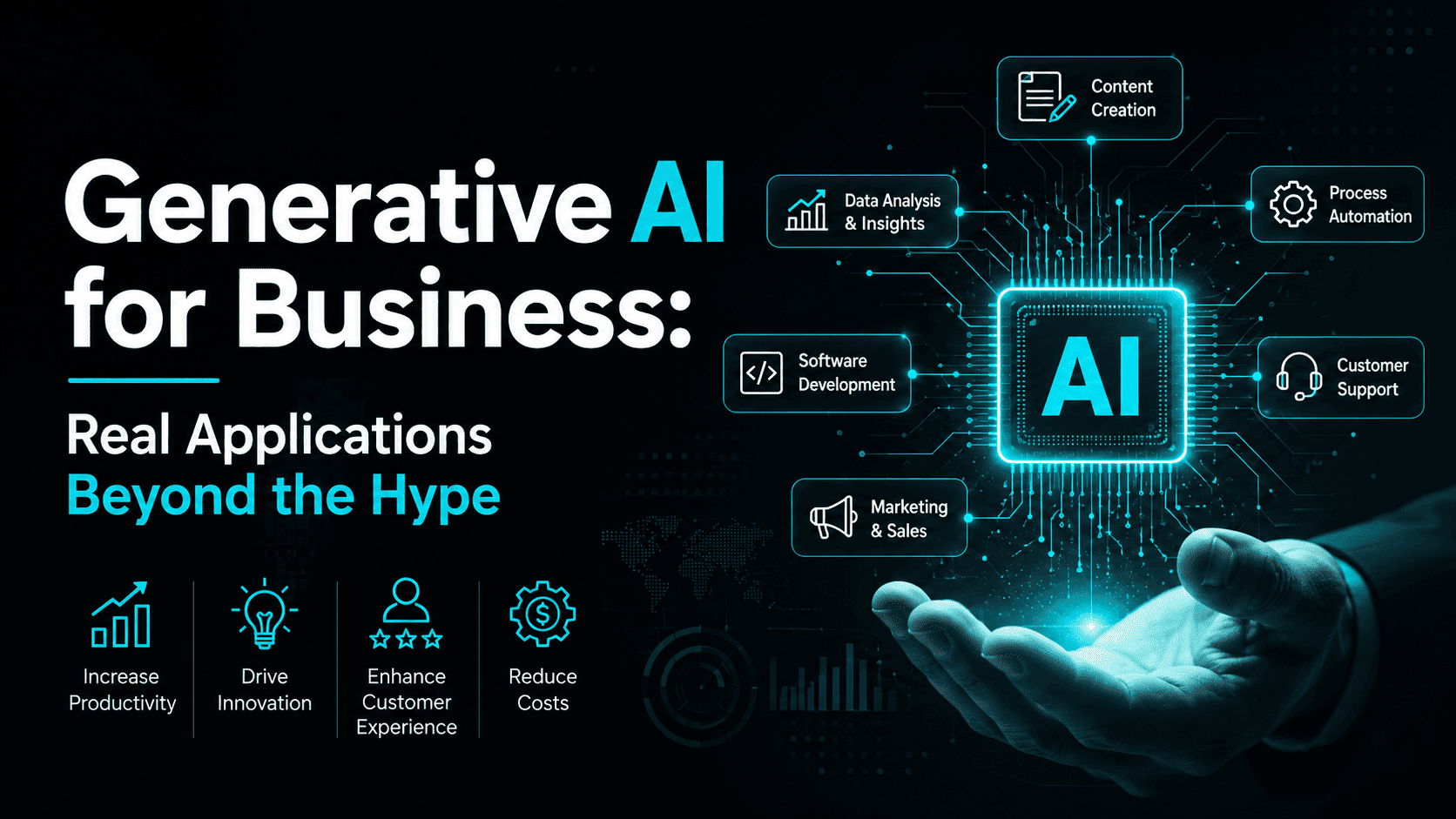
Generative AI for business stopped being a future conversation somewhere around 2024. By now, most companies have either tried it, are actively using it, or are watching competitors pull ahead because they haven’t.
The problem is that most articles on this topic are written for a boardroom audience at a company with a $10 million AI budget. That’s not most of us. This piece is for founders, operators, and team leads who want to know what’s actually working – not what looks good in a press release.
Let’s get into it.
What Generative AI Actually Means for a Business (In Plain Terms)
Forget the academic definition for a second.
Generative AI is software that creates things – text, images, code, audio, data – based on patterns learned from enormous amounts of training material. Unlike older automation tools that follow fixed rules (“if X, then Y”), these systems can handle open-ended inputs and produce something genuinely new.
For a business, that matters because it means you can automate creative and cognitive work, not just repetitive mechanical tasks.
The models doing most of the heavy lifting right now:
- Large language models (LLMs) like GPT-4o, Claude, and Gemini handle text, analysis, and code
- Image generation models like Midjourney, DALL-E, and Stable Diffusion handle visual content
- Multimodal models handle combinations – text + image, document + voice, and so on
You don’t need to understand how these work under the hood. You need to know what they can and can’t do in a business context.
Generative AI for Business: The Use Cases That Are Actually Working
This section is the one that matters. Not theoretical possibilities – real applications, with real outcomes.
1. Marketing and Content Production
This is where generative AI has delivered the clearest wins, and also where it’s most misused.
Companies using it well aren’t just generating blog posts and publishing them raw. They’re using AI to handle the heavy lifting of first drafts, research summaries, ad variations, product descriptions, and email sequences – then having a human edit for accuracy and brand voice.
What that looks like in practice:
- A 4-person marketing team producing content at the volume of a 12-person team
- Running 30 ad variations in a week instead of 3
- Translating product copy into 10 languages in hours rather than outsourcing over weeks
- Repurposing one long-form article into a LinkedIn post, email, YouTube script, and Twitter thread – automatically
The results aren’t magic. A D2C brand I came across reduced their content production cost by 60% while publishing 4x more. Their traffic went up. Their conversion rate stayed flat – which actually tells you something: the AI-assisted content performed the same as the human-only content. That’s the point.
Where people go wrong: Treating AI output as finished work. It isn’t. Generative AI writes like a confident intern – fast, fluent, occasionally wrong, and completely unaware of what makes your brand sound like you.
2. Customer Support and Service
This one surprises people because the early chatbot era was such a disaster. The bots of 2018–2021 were frustrating, rigid, and made customers angrier, not calmer.
Modern AI customer service is different in one key way: it actually understands the question.
What businesses are doing now:
- AI-first support triage – The AI handles Tier 1 queries (order status, return policy, password reset) and routes anything complex to a human agent
- Real-time agent assist – The AI runs in the background during live chats or calls, surfacing relevant knowledge base articles and suggested responses to the human agent
- Post-conversation summaries – Automatically logging what was discussed, what was resolved, and what follow-up is needed
A mid-size SaaS company I read about cut their average resolution time from 18 minutes to 6 minutes by adding an AI layer to their support stack. Their human agents didn’t lose their jobs – they just stopped spending 40% of their time looking up the same answers.
The honest caveat: Customers can tell when they’re talking to a bot. If your AI support isn’t very good, you’ll get more escalations and more frustrated customers than before. The bar is higher than people think.
3. Finance and Operations
This is where the real operational leverage is, and it’s the most underreported category.
Finance teams are using generative AI to:
- Draft financial summaries and reports from raw data – instead of a CFO or analyst spending 6 hours building a narrative, the AI pulls from the numbers and produces a working draft in 20 minutes
- Automate invoice processing – matching POs to invoices, flagging discrepancies, routing for approval
- Fraud detection and anomaly flagging – spotting unusual patterns in transaction data faster than any human review process
- Contract analysis – pulling key clauses, payment terms, and liability language from vendor agreements in seconds
A legal operations team at a mid-size company reportedly cut their contract review time by 70% after training an AI on their standard templates and common risk flags. Their lawyers now review AI-flagged items rather than reading every contract from scratch.
For startups and small businesses, the lower-stakes version of this is just using AI to automate the financial reporting and bookkeeping narrative layer. It’s not glamorous, but it saves real hours.
4. Human Resources and Hiring
HR is one of the more interesting generative AI applications because it’s not just about efficiency – it’s about doing the process better.
Current uses that are working:
- Job description writing – This sounds trivial but it matters. Vague or poorly written JDs get worse applicants. AI trained on role-specific requirements produces cleaner, more accurate descriptions faster.
- Resume screening at scale – Filtering 500 applications down to 40 worth reading is exactly the kind of pattern-matching task AI handles well
- Interview prep materials – Generating role-specific questions, scoring rubrics, and assessment criteria
- Onboarding content – Creating training materials, FAQ documents, and process guides tailored to specific roles
The tricky part here is bias. AI models trained on historical hiring data can replicate historical bias. Companies using AI in hiring need to audit their outputs regularly and have humans making the final calls. This isn’t optional – in some regions, it’s becoming a legal requirement.
5. Product Development and Coding
For any business that builds software – or works with developers – this is probably the highest-leverage application right now.
Developers using AI coding assistants (GitHub Copilot, Cursor, Claude) are consistently reporting that they spend less time on boilerplate, documentation, and repetitive refactoring. The estimates vary wildly, but somewhere between 30–55% productivity gains on certain task types is credible based on current data.
More interesting uses:
- Generating test cases – Writing comprehensive unit tests is time-consuming and often skipped. AI handles the generation; developers review and approve.
- Code review assistance – AI can catch common bugs, security issues, and style inconsistencies before human reviewers see the code
- Documentation – Auto-generating docs from code is one of those tasks developers hate and AI is genuinely good at
- Prototyping – Non-technical founders can describe what they want and get working prototypes faster than ever before
For non-technical entrepreneurs: tools like Lovable, Bolt, and v0 now let you build functional web apps and interfaces without writing code. This isn’t a replacement for engineers on complex systems, but for MVPs and internal tools, it’s genuinely changed the math.
6. Sales and Lead Generation
Sales teams are using generative AI in a few ways that are actually moving numbers:
- Personalized outreach at scale – Writing cold emails that reference specific company news, recent funding, or job postings. AI does the research and draft; the rep reviews and sends.
- Lead scoring – AI analyzing incoming leads against your ideal customer profile (ICP) and prioritizing outreach accordingly
- Call transcription and coaching – Recording sales calls, generating summaries, and flagging coachable moments for managers
- Proposal generation – Drafting custom proposals and pitch decks from templates and deal-specific data
The personalization piece is where this gets interesting. The best-performing cold outreach in most industries right now includes some reference to something specific and recent about the prospect. AI makes that kind of research scalable.
7. Data Analysis and Business Intelligence
This one is probably the most underused by small and mid-size businesses, because it feels like something only data teams can do. It isn’t anymore.
Generative AI can now:
- Answer questions about your own data in plain English – Tools like ChatGPT with data analysis, or Claude connected to your database, can let non-technical team members ask questions like “which product had the highest return rate last quarter?” and get an actual answer
- Generate reports from raw data – Turning spreadsheets into readable narrative summaries
- Surface anomalies – Flagging unusual patterns in sales, operations, or customer behavior data
- Build basic dashboards – Translating business requirements into working data visualizations without a dedicated data analyst
For founders who don’t have a data team, this is one of the more transformative capabilities. The bottleneck used to be technical skill. Now it’s mostly just knowing what questions to ask.
What Generative AI Still Can’t Do Well
Competitors don’t write this section. They should.
Generative AI fails in predictable ways:
- It fabricates – When it doesn’t know something, it often makes something up that sounds plausible. This is especially dangerous in legal, medical, or financial contexts.
- It has no memory of your business context – Unless you explicitly give it that context every time (or build a system that does), it’s working blind.
- It can’t verify its own output – It doesn’t know when it’s wrong.
- It performs poorly on niche or proprietary topics – Anything not well-represented in its training data will produce weaker results.
- It needs good prompts – “Write me a blog post about AI” produces garbage. Specific, structured prompts produce good output. Most people underinvest in learning this skill.
How to Actually Get Started (Without Wasting Money)
Most businesses that fail with AI do so because they tried to boil the ocean. They bought an expensive enterprise tool, had no clear use case, and declared AI “not ready.”
A better approach:
Step 1: Pick one problem: Not “improve our marketing.” Something specific – “we spend 8 hours a week writing product descriptions.”
Step 2: Start with existing tools: ChatGPT, Claude, Gemini – paid tiers of these cost $20–$30/month and can solve a remarkable number of problems without custom development.
Step 3: Run a 2-week test: Don’t evaluate AI on one output. Give it real tasks over two weeks and measure the result honestly.
Step 4: Build a prompt library: Once you find prompts that work, write them down and share them across your team. This is where most of the value gets locked in.
Step 5: Expand from there: Once you have one working use case, you understand the pattern. The second one is faster.
Generative AI ROI: What the Numbers Actually Say
Some real data worth knowing:
- According to Cisco’s research shared at the 2024 Enterprise Technology Leadership Summit, 74% of companies deploying generative AI reported seeing ROI from their investments, and 86% saw revenue growth
- Gartner predicts that by 2026, more than 80% of enterprises will have deployed generative AI in production environments – up from under 5% in 2023
- Companies in content-heavy functions are reporting 60–80% reductions in production time on first drafts
- Developer productivity gains on specific task types (boilerplate, documentation, test generation) range from 30–55% across multiple studies
What these numbers don’t tell you: the median result is not the top-line headline. A lot of companies are still struggling to move from pilot to production. The productivity paradox is real – significant investments are going in, and not everyone is capturing meaningful value back out.
The gap between the companies winning and the ones stuck is usually not budget or technical capability. It’s clarity about the problem they’re trying to solve.
Frequently Asked Questions
Is generative AI only for large enterprises?
No. Some of the fastest adoption is happening at the 10–50 person company level, where a single employee spending 5 hours a week less on repetitive tasks has a big impact. The tools are accessible, the cost is low, and smaller teams often move faster.
Will generative AI replace my team?
Probably not wholesale. The pattern we’re seeing is AI handling specific task types within roles, not roles entirely. Writers are still writing – but they’re editing AI drafts rather than starting from blank pages. The jobs that are most at risk are narrow, repetitive cognitive tasks that don’t require judgment or relationships.
How do I know if an AI tool is right for my business?
Ask: does this tool solve a specific problem I have, at a cost that makes sense for the time it saves? If yes, try it. If you’re buying a tool because it sounds impressive, that’s a red flag.
What’s the biggest mistake businesses make with generative AI?
Trusting the output without reviewing it. AI-generated content, code, legal summaries, and financial analysis all need human review. The mistake isn’t using AI – it’s using it unsupervised.
How much should a small business budget for AI tools?
For most small businesses, $50–$150/month in AI subscriptions covers a meaningful stack. Beyond that, you’re looking at custom development or enterprise contracts, which only make sense once you’ve proven the use case.
Final Thought
The hype was real, but so are the results – for companies that approached this with a specific problem rather than a general ambition.
Generative AI for business isn’t a revolution that happens to you. It’s a set of tools you choose to use or not. The businesses that are pulling ahead right now aren’t necessarily the ones with the most sophisticated tech stacks. They’re the ones who picked a problem, tested something, and actually implemented what worked.
That’s always been the advantage of a founder mindset. This is just the latest version of it.
What do you feel about this post?

Like

Love

Happy

Haha

Sad

1 thought on “Generative AI for Business: Real Applications Beyond the Hype”