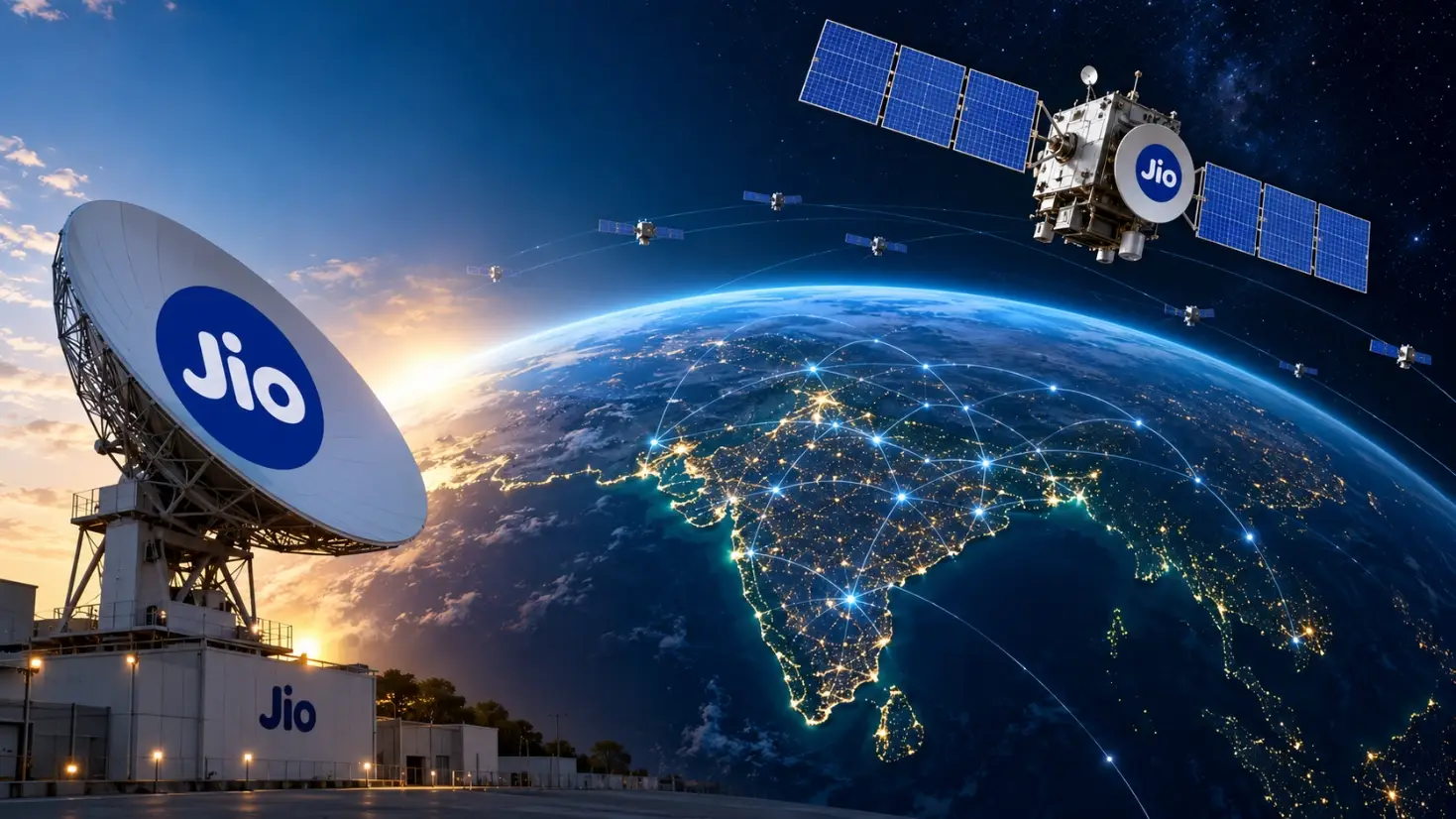
Jio built its empire by wiring up India on the ground. Now it wants the sky too. The company has confirmed it will send its first test satellite into orbit in September 2027, the opening move in a plan to put more than 1,600 satellites over India within the next decade.
If you run a business that depends on connectivity outside India’s big cities, this is worth paying attention to now, not in 2027.
Key Takeaways
- Jio’s first test satellite launches in September 2027, built to check hardware, software, and systems before any large-scale rollout.
- The full network target is 1,600+ satellites, with 400–450 planned by 2030.
- Each satellite is designed for 100–150 Gbps, adding up to 4–4.8 Tbps once the constellation is complete – more than Starlink’s and Amazon Leo’s stated India applications.
- Jio has applied to the ITU for orbital slots and has clearance from IN-SPACe, India’s space regulator.
- Commercial satellite internet in India has already been delayed for years over government concerns about routing Indian traffic through foreign gateways – a problem Jio’s approach is partly designed to sidestep.
What Happened
Jio has applied to the International Telecommunication Union for the orbital slots it needs to start launching satellites, and IN-SPACe – the government body that regulates Indian space activity – has given its approval. The first launch, a small test satellite, is scheduled for September 2027, exactly one year from when this news broke.
That satellite isn’t going up to serve customers. It’s a shakedown flight: Jio needs to confirm its hardware, software, and ground systems actually work in orbit before it commits to a 1,600-satellite build-out. Think of it as the pilot episode before the full season gets greenlit.
One detail stands out. Jio’s satellites will orbit farther from Earth than competitors like Starlink typically do. A company spokesperson told the Economic Times that no other operator is targeting that particular distance. Most low-Earth-orbit players stay as close to the ground as they can, since proximity cuts latency. Jio going the other way suggests a different set of trade-offs – likely fewer satellites needed for the same coverage, at the cost of some latency.
Why It Matters
Roughly a fifth of India still doesn’t have reliable broadband. Fiber and 5G towers make economic sense in dense areas; they don’t in island communities, mountain villages, or scattered border outposts. That’s the gap satellite internet is built to close, and it’s the gap every major operator – Jio, Starlink, Amazon, Eutelsat – is racing to fill first.
For a founder running a logistics, agritech, or fintech operation with customers in tier-3 towns or rural districts, this isn’t an abstract infrastructure story. It’s the difference between a delivery app that works in 400 districts and one that works in 700. Reliable satellite backhaul could also cut the cost of setting up connectivity for remote warehouses, farms, or field teams that currently depend on patchy cellular coverage or expensive VSAT contracts.
Jio vs. Starlink vs. Amazon Leo: How the Numbers Compare
| Jio | Starlink (India application) | Amazon Leo (India application) | |
| Planned satellites | 1,600+ | Not disclosed for India | Not disclosed for India |
| Per-satellite throughput | 100–150 Gbps | – | – |
| Total constellation throughput | 4–4.8 Tbps | 600 Gbps | 3+ Tbps |
| First test launch | September 2027 | Already operational elsewhere | Not yet launched in India |
On paper, Jio’s throughput numbers beat both rivals by a wide margin. Numbers on paper and satellites actually in orbit are two different things, though, and Jio hasn’t launched anything yet.
What to Expect Next
The next twelve months are about paperwork and hardware, not customers. Jio still needs its ITU slots finalized, its test satellite built and integrated, and a launch vehicle booked – likely through ISRO or a commercial provider, though the company hasn’t named one yet. Assuming the September 2027 test goes as planned, expect Jio to talk timelines for its first commercial batch shortly after.
Watch two things in parallel. First, Jio Platforms’ IPO, which Reuters has reported could raise to $3.8 billion – a listing that gives Jio fresh capital right as it needs to fund a satellite build estimated at $10–15 billion. Second, the Department of Telecom’s stance on satcom licensing has already slowed Starlink and OneWeb’s India entry over concerns about operators routing Indian data through foreign infrastructure. Jio’s “sovereign constellation” framing looks like a direct answer to that objection – a domestically built and owned network sidesteps the foreign-gateway argument entirely.
What This Means for Your Business Right Now
You don’t need to change any plans today. But if connectivity in underserved regions affects your unit economics, it’s worth building a 2027–2028 satellite internet option into your infrastructure roadmap rather than treating it as a someday idea.
A few practical moves:
- If you’re evaluating VSAT or long-term connectivity contracts for remote sites, negotiate shorter terms where possible so you’re not locked in past 2027.
- If your customer base skews toward tier-2/tier-3 India, start tracking Jio’s commercial rollout announcements – pricing and coverage maps will matter more to you than the launch date itself.
- If you’re in logistics, agritech, or field services, satellite-backed connectivity could eventually replace costly private networks in remote operations. Worth a line item in next year’s budget planning, even a small one.
Background: How Jio Got Here
This didn’t come out of nowhere. Jio has held a satellite joint venture with SES, called Jio Space Technology, since 2022. In June 2026, Jio Platforms chairman Akash Ambani used Reliance’s 49th Annual General Meeting to lay out a “dual-track” satellite strategy: build a sovereign LEO constellation over time, while leasing capacity from global partners to get services running faster in the interim. Jio has also been quietly building its own ground station infrastructure in India to support both its future satellites and partner networks.
That AGM announcement was the intent. The ITU filing and IN-SPACe clearance reported in September 2026 are the first concrete steps toward acting on it, with a real date attached – September 2027 – for the first time.
FAQs
When is Jio launching its first satellite?
Jio’s first satellite is scheduled to launch in September 2027. It’s a small test satellite meant to validate hardware and software before Jio commits to its full constellation.
How many satellites does Jio plan to launch?
Jio is targeting a constellation of more than 1,600 satellites, with 400–450 expected to be in orbit by 2030 and the full network taking roughly a decade to complete.
Will Jio’s satellite internet compete with Starlink in India?
Yes. Jio’s projected total throughput of 4–4.8 Tbps is well above Starlink’s disclosed 600 Gbps application for India, and Jio’s satellites are planned to orbit farther from Earth than Starlink’s typical altitude.
Is satellite internet available in India yet?
Not commercially. Starlink, OneWeb, and Jio have all faced delays tied to government concerns over satellite operators routing Indian internet traffic through foreign infrastructure, and the Department of Telecom has not finalized spectrum or licensing terms.
How much is Jio investing in its satellite network?
Industry estimates put Jio’s satellite investment between $10 billion and $15 billion, funded in part by the upcoming Jio Platforms IPO, which could raise to $3.8 billion.
What do you feel about this post?

Like

Love

Happy

Haha

Sad