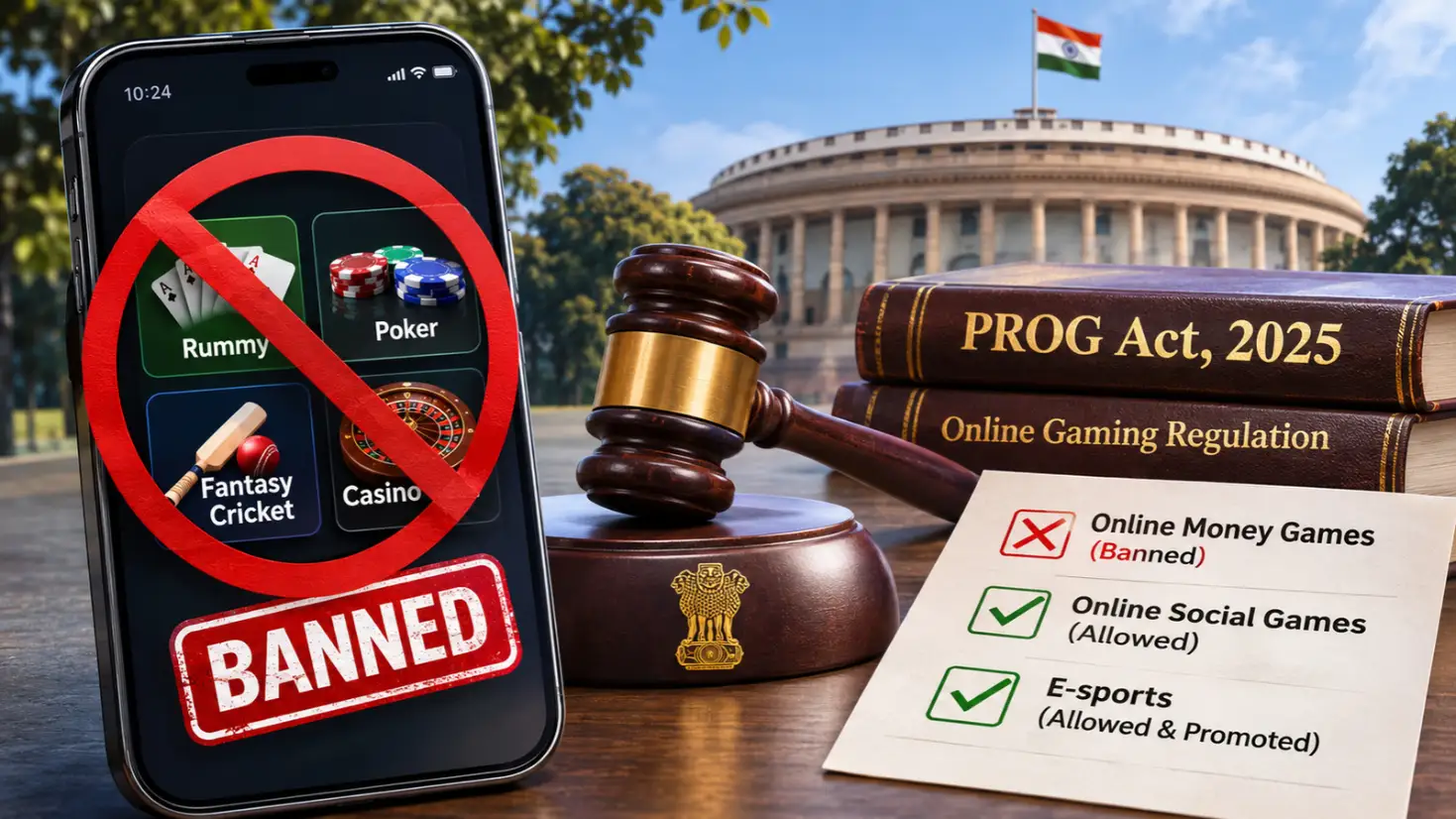
The online gaming ban in India is live. Since 1 May 2026, an app that takes a user’s money and pays out cash based on a game’s result is illegal to offer, advertise or process payments for. Rummy, poker, fantasy cricket and casino slots all fall under it. If your startup has a wallet, a leaderboard and a prize pool, this guide shows where the line sits and what happens if you cross it.
What Is the Online Gaming Ban in India?
India bans all online money games under the Promotion and Regulation of Online Gaming (PROG) Act, 2025, in force since 1 May 2026. A money game is any online game where users put in a stake and expect cash or similar returns, whether it depends on skill, chance or a mix of both. Offering, advertising and processing payments for these games are offences.
The ban is narrower than the headlines suggest. E-sports and online social games are recognised under the same law. Officials have also said enforcement targets operators, advertisers, promoters and financial backers, not players.
How the Betting and Gaming App Crackdown Unfolded
- 20–22 August 2025: Parliament passed the PROG Bill within days. The President gave assent on 22 August.
- 22 April 2026: The government notified the PROG Rules, 2026 and set up the Online Gaming Authority of India (OGAI) under MeitY.
- 1 May 2026: The Act and Rules came into force. Legal analysts noted there was effectively no grace period for the core ban and penalties.
- 27 May 2026: The Supreme Court upheld the Tamil Nadu and Karnataka state bans on stake-based games, skill games included. It set aside the High Court rulings that had struck them down.
- 29 July 2026: OGAI told app stores, cloud providers, telecom firms, banks, social media platforms, streaming services and ad agencies to cut off online money games, their payments and their ads.
- 15 October 2026: The Supreme Court dismissed ten review petitions against the state-ban judgment, including one led by Junglee Games India.
Blocking runs alongside all this. Ministry figures given to Parliament put blocked betting and gambling URLs at close to 8,400 by March 2026, and more than 4,800 of those came after the Act passed. It doesn’t fully work. Operators hop to mirror domains, and CUTS International surveys reported in Indian media suggest offshore platform use went up after the law arrived.
What the PROG Act Bans and What It Still Allows
| Category | Status | What it means for you |
| Online money games (cash rummy, poker, paid fantasy contests, casino games, betting) | Banned | No offering, advertising or payment processing |
| Online social games | Allowed | Can earn through subscriptions or similar models, but can’t pay users out |
| E-sports | Allowed and promoted | Prize money is fine only for recognised, legitimate sporting events |
So who decides which bucket your product lands in? OGAI. Under the Rules it can classify a game on its own initiative or when a provider applies. It looks at four things: whether users pay stakes, whether they expect money winnings, how the game earns revenue, and whether in-game assets can be turned into value outside the game.
Penalties for Betting and Gaming Apps
| Offence | Penalty |
| Offering or facilitating an online money game | Up to 3 years in prison, a fine up to ₹1 crore, or both |
| Repeat offence | Minimum 3 years, extendable to 5, plus ₹1 crore to ₹2 crore in fines |
| Advertising an online money game | Up to 2 years in prison, a fine up to ₹50 lakh, or both |
| Banks and payment firms processing the transactions | Reported at up to 3 years, up to ₹1 crore, or both |
Cyber cell officers at state and Union Territory level handle enforcement. Platforms can also be blocked under the IT Act, 2000. Civil inquiries under the Rules run mostly in digital mode and are meant to wrap up within 90 days of a complaint.
Why This Isn’t Only a Betting App Problem
Picture a payments startup that onboarded a gaming merchant last year. Nothing about the product changed. The law did. Now every rupee that merchant routes through the gateway is a liability for the gateway.
That is the real shift. The Act reaches the whole chain: the app, the payment rail, the ad network, the influencer who promotes it, the cloud host and the app store that distributes it. OGAI’s July advisory named all of them.
If you sell software, payments, analytics, ad tech or creator tools to gaming clients, your customer list is now part of your compliance work. Check merchants at onboarding. Add contract clauses that let you terminate for money-gaming activity. Don’t wait for a notice.
Grey Zones That Catch Founders
None of these is automatically illegal. Each one gets measured against the test above, and you need a lawyer’s view before you ship.
- Cash-out of in-game currency or items: The test asks whether in-game assets are monetised outside the game. A withdrawal button is the loudest signal you can send.
- Entry fees on skill contests: Quizzes, trivia leagues, prediction games and fantasy-style formats all look different on the surface. If users pay to enter and win money, regulators will see a stake and a payout.
- Gamified rewards in fintech, shopping or edtech apps: Spin wheels and scratch cards are fine when users put nothing in. They get risky when payment unlocks the chance to win.
- Creator platforms with paid gifts: If viewers buy virtual gifts and creators convert them to cash, the structure needs a close look.
A Five-Step Compliance Check for Your App
- Map every point where user money comes in: Deposits, entry fees, in-app purchases, subscriptions.
- Map every point where money or cash-like value goes out: Withdrawals, vouchers, redeemable credits.
- Check whether the two connect through a game outcome: If they do, treat the product as a money game and stop. Waiting for OGAI to say so is a bad plan.
- Audit your advertising and partners: Affiliates, influencers, sponsorships and ad networks all carry liability under the ad ban.
- Get a determination or registration, and set up the basics: A provider can apply to OGAI for classification. The Rules also expect a working grievance system and safety features such as time limits, parental controls and fair-play monitoring.
Where Founders Can Still Build
Social games that earn from subscriptions or in-game purchases without cash payouts are allowed. So are e-sports platforms and tournaments that qualify as legitimate sporting events.
My honest view: the better opportunity sits next to the ban, not inside it. Game studios, anti-cheat tools, analytics, KYC, merchant-risk screening and payment compliance all have new demand. Every bank, app store and ad agency that received that July advisory now needs a way to prove it isn’t touching money games.
What Is Still Unsettled
The challenge to the central Act is still pending before the Supreme Court. It questions Parliament’s power to legislate on this subject. Reports on hearing dates have shifted between October 2026 and January 2027, so check the latest court listing before you quote a date to anyone.
Don’t build a business model on the ban being struck down. The court has already upheld two state bans, the review petitions failed, and the government is adding enforcement instead of loosening it.
Frequently Asked Questions
Is online gaming banned in India?
Online money gaming is. Since 1 May 2026 the PROG Act bans offering, advertising and processing payments for any online game played with a stake for monetary returns. E-sports and online social games are not banned.
Are players punished under the online gaming ban?
Officials have said enforcement targets operators, advertisers, promoters and financial backers, not players. The penalties in the Act are written for those who offer, advertise or facilitate the games.
Is fantasy sports banned in India?
Paid fantasy contests that involve stakes and money winnings fall under the ban on online money games. Free-to-play formats with no stake and no payout sit outside it, but classification rests with OGAI.
Can I run a skill-based game with cash prizes?
Not as an online money game. The ban covers games of skill, games of chance and mixes of both. Cash prizes are allowed only inside recognised e-sports events.
What is the Online Gaming Authority of India?
OGAI is the regulator set up under MeitY. It classifies online games, publishes the list of online money games, handles complaints and works with banks, platforms and law enforcement.
What can I do if OGAI acts against my game?
The Rules include an appeals route. A second appeal goes to the Secretary, MeitY, who is expected to decide it within 30 days. Take legal advice before you file anything.
The Bottom Line for Founders
If users pay in and cash comes out based on a game result, the product is a money game, and India has made it a criminal matter. Audit your money flows, your ad partners and your merchants now. Then look at the parts of the gaming economy that the law actively wants to grow.
This article was last checked against public sources on 2 November 2026. The law and court cases are moving, so confirm the latest position with a qualified lawyer before you decide anything.
Related reading on Entrepreneur Bus: Startup Stories and Technology.
What do you feel about this post?

Like

Love

Happy

Haha

Sad