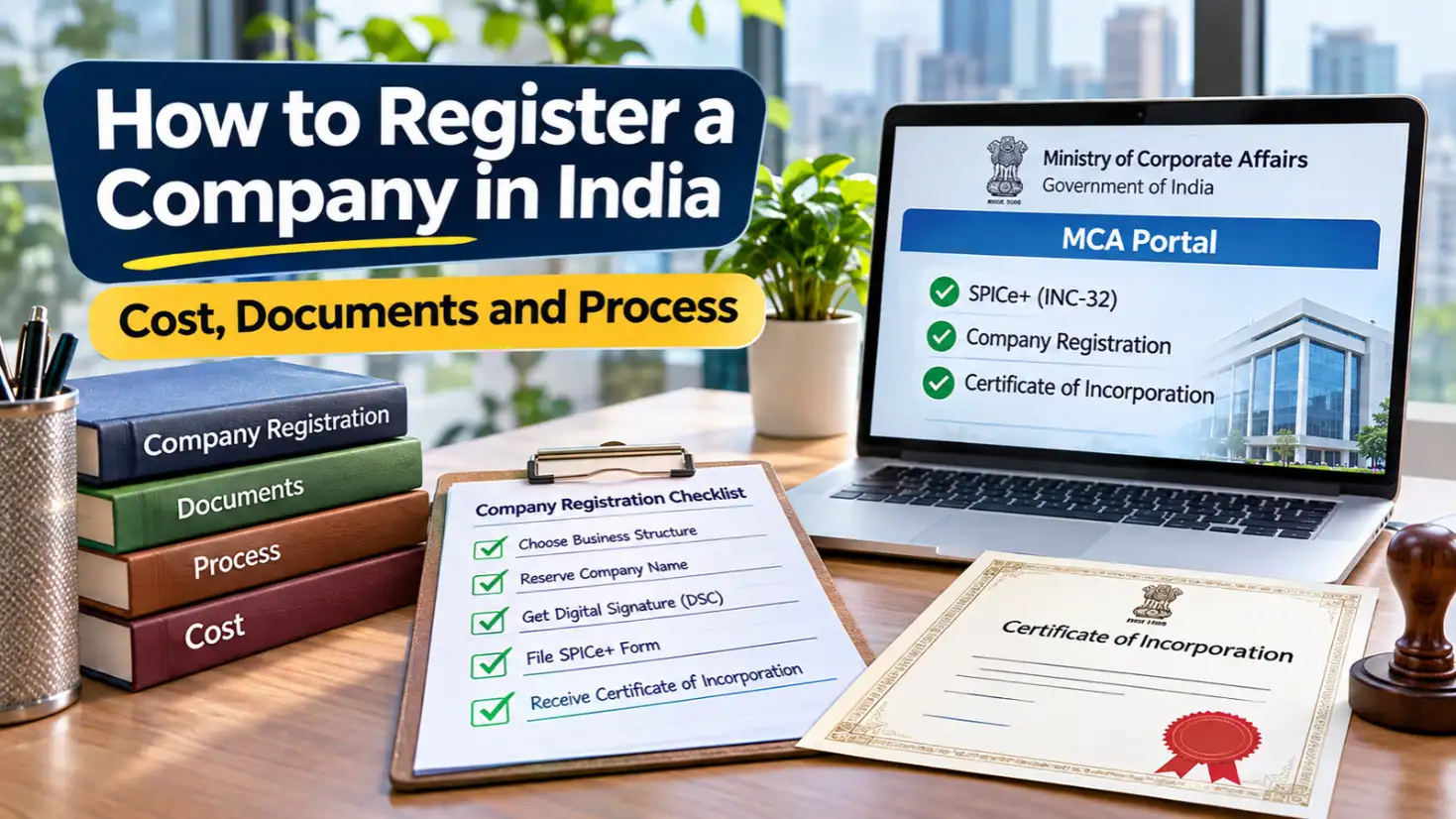
To register a company in India, pick a structure, reserve a name, get a Class 3 digital signature for each director, and file the SPICe+ form on the MCA portal. A Private Limited Company usually costs ₹7,500 to ₹25,000 all-in, and the Certificate of Incorporation arrives in about 7 to 15 working days.
That’s the short version. The rest of this guide covers what the paperwork looks like, where the money goes, and the deadlines that catch founders out after incorporation.
Company Registration in India at a Glance
| Item | Private Limited Company |
| Where you file | MCA portal (mca.gov.in), SPICe+ form (INC-32) |
| Minimum people | 2 directors and 2 shareholders; one director must be an Indian resident |
| Minimum capital | None |
| Government fee | ₹0 for authorised capital up to ₹15 lakh |
| Typical all-in cost | ₹7,500 to ₹25,000 |
| Time | 7 to 10 working days with clean documents; up to 15 if there are queries |
| What you get | Certificate of Incorporation with CIN, PAN and TAN |
As of 31 January 2026, the MCA register showed about 20.4 lakh active companies, and roughly 23,000 new ones were added in that single month. So the process is well worn. It just punishes small mistakes.
What Does It Mean to Register a Company in India?
Registering a company in India means incorporating it with the Registrar of Companies under the Companies Act, 2013, through the Ministry of Corporate Affairs (MCA). Once registered, the company is a separate legal entity. It can own property, sign contracts and sue in its own name, and the owners’ personal assets stay outside the company’s debts unless they’ve signed a personal guarantee.
Everything happens online. You don’t visit an office, and you don’t courier documents.
Which Type of Company Should You Register?
Choose the structure before you touch any form, because it decides your liability, your funding options and your compliance load.
| Structure | Best for | Minimum people | Can raise equity? |
| Private Limited Company | Startups and growing businesses | 2 directors, 2 shareholders | Yes |
| One Person Company (OPC) | Solo founders | 1 director plus a nominee | Not until converted to Pvt Ltd |
| LLP | Partner-run service businesses | 2 partners | Limited |
| Section 8 Company | Non-profits | 2 directors | Donations only |
Sole proprietorships and ordinary partnerships need no MCA registration, but owners carry unlimited personal liability. A proprietorship also can’t get Startup India (DPIIT) recognition.
My view: if you plan to hire, take outside money or sell on big marketplaces, register a Private Limited Company from day one. Founders who start as proprietors to save ₹10,000 often convert within a year when an investor or marketplace asks, and conversion costs more than starting right.
Documents Required to Register a Company in India
Gather everything before you file. Mismatched or unclear documents are the most common reason a SPICe+ application gets sent back.
For every director and shareholder
- PAN card (mandatory for Indian nationals, and it must be linked to Aadhaar on the Income Tax portal)
- Aadhaar card or passport as identity proof
- Address proof such as a bank statement or utility bill, not older than 2 months
- Recent passport-size photograph
- Email ID and an Indian mobile number for OTP verification
Foreign nationals need apostilled identity and address proof and a valid business visa.
For the registered office
- Rent agreement or lease deed, if the premises are rented
- No Objection Certificate (NOC) from the property owner
- Latest electricity, water, gas or internet bill, not older than 2 months
Yes, you can use your home address as the registered office. You still need the bill and the NOC (which you write yourself if you own the place).
For the company itself
- Memorandum of Association (MoA) and Articles of Association (AoA)
- Subscriber declarations (INC-9) from directors and shareholders
- For an OPC, the nominee’s consent (INC-3), built into the SPICe+ form
- A Class 3 Digital Signature Certificate (DSC) for every proposed director
How Much Does It Cost to Register a Company in India?
Registering a Private Limited Company in India typically costs ₹7,500 to ₹25,000 in total for a two-director company with ₹1 lakh of authorised capital. The SPICe+ government fee is ₹0 up to ₹15 lakh of authorised capital. Your real spend is the DSC, state stamp duty and professional fees.
| Cost component | Amount (₹) |
| Digital Signature Certificates (2 directors) | 2,000 to 5,000 |
| Standalone name reservation (RUN), if you use it | 1,000 |
| SPICe+ government filing fee (capital up to ₹15 lakh) | 0 |
| State stamp duty on MoA, AoA and INC-32 | 0 to about 15,000, depending on state |
| Drafting, certification and professional fees | 3,000 to 10,000 |
| Typical total | 7,500 to 25,000 |
Stamp duty depends on your state
This is the line item that surprises people. For ₹1 lakh of authorised capital, one 2026 state-wise compilation shows roughly:
| State | Stamp duty (₹) |
| Sikkim | 0 |
| Delhi | 360 |
| Tamil Nadu | 720 |
| Maharashtra | 1,300 |
| Karnataka | 10,020 |
| Punjab | 10,025 |
State rates change, so check your state’s current schedule before you budget.
Keep authorised capital at ₹1 lakh
Authorised capital is the maximum share capital the company can issue. In many states, stamp duty climbs as it rises. Gujarat goes from about ₹820 at ₹1 lakh to ₹7,820 at ₹15 lakh. Later MCA forms that scale with capital cost more too. You can raise it later with Form SH-7 when an investor shows up, so there’s no gain in setting it high “just in case.”
There is no minimum paid-up capital for a Private Limited Company, LLP or OPC.
How to Register a Company in India (Step by Step)
- Choose your structure: Private Limited, OPC, LLP or Section 8.
- Get a Class 3 DSC for each proposed director from a licensed certifying authority.
- Reserve your company name through RUN or in SPICe+ Part A.
- Prepare the MoA, AoA and KYC documents.
- File SPICe+ (INC-32) on the MCA portal, with AGILE-PRO-S if you want GST, EPFO, ESIC and a bank account in the same application.
- Receive the Certificate of Incorporation with your CIN, PAN and TAN.
- Open a current account and deposit the subscribed share capital.
Step 1: Choose your structure
Cover the decision in the table above. The only real trap is picking for today’s needs when you’ll need something else in 24 months.
Step 2: Get a Class 3 digital signature
Every director signs the incorporation forms digitally. Apply through a licensed certifying authority such as eMudhra, Sify or Capricorn. You’ll submit PAN and Aadhaar or passport and complete a short video verification. Expect ₹1,000 to ₹2,500 per DSC, issued in one or two working days, usually valid for two years.
Step 3: Reserve a unique company name
The name must be unique and can’t closely match an existing company or a registered trademark. Words like Bank, Insurance, National or Federal need special approval. You can propose up to two names. A standalone RUN application costs ₹1,000, and an approved name stays reserved for 20 days, so file SPICe+ Part B inside that window.
What goes wrong: names that sound like an existing brand. Search the MCA name database and the IP India trademark register before you apply. An MCA-approved name can still be challenged later on trademark grounds, and each RUN rejection costs ₹1,000.
Step 4: Prepare the MoA and AoA
The MoA states what the company does (the object clause). The AoA sets how it’s run. A vague or wrongly worded object clause is a common cause of rejection, so have it drafted by someone who files these regularly.
Step 5: File SPICe+ on the MCA portal
SPICe+ (Form INC-32) is one integrated form. It handles incorporation, DIN allotment for up to three first directors, PAN and TAN. The linked AGILE-PRO-S form can add GST, EPFO, ESIC and bank account opening. A practising Chartered Accountant, Company Secretary or Cost Accountant must certify the form before it goes in, and each director signs with their DSC. Then you pay stamp duty and submit.
One practical note: if you need GST fast, say to sell on Amazon or Flipkart, it’s often quicker to apply separately on gst.gov.in after you receive the Certificate of Incorporation.
What goes wrong: director details that don’t match across PAN, Aadhaar and the form. This is the top reason for resubmission.
Step 6: Receive the Certificate of Incorporation
Once the Registrar approves the application, you download the Certificate of Incorporation from the MCA portal. It carries your 21-character Corporate Identity Number (CIN), and your PAN and TAN come with it. From this date the company exists in law.
Step 7: Open a current account
Take the certificate, MoA, AoA, company PAN, a board resolution and every director’s KYC to the bank. Then deposit the share capital the subscribers committed to. You’ll need that deposit for the next filing.
How Long Does Company Registration Take in India?
Company registration in India takes about 7 to 10 working days when your documents are clean, and up to 15 if the Registrar raises queries. DSC issue takes 1 to 2 days, name approval 1 to 3 days, and SPICe+ approval usually 3 to 7 days.
Three things stretch that: name rejections, mismatched KYC and unclear registered office proof. Fix those up front and the timeline holds.
What to Do After You Get the Certificate of Incorporation
This is where founders default without noticing. Two deadlines start the day you incorporate.
- Form ADT-1: appoint the first statutory auditor within 30 days of incorporation.
- Form INC-20A: file the declaration of commencement of business within 180 days, confirming subscribers have paid in their share capital. Missing it can lead to strike-off proceedings, a ₹50,000 penalty on the company and ₹1,000 per day for each officer in default.
Set your reminder for day 60, not day 175.
Then sort out GST. Registration is mandatory once annual turnover crosses ₹40 lakh for goods or ₹20 lakh for services (lower in special category states), and in certain cases such as e-commerce selling and inter-state services regardless of turnover. If you’re building something with funding in mind, also look at DPIIT recognition on startupindia.gov.in. Private Limited Companies and LLPs under 10 years old with turnover below ₹100 crore can apply.
Annual Compliance for a Private Limited Company
The yearly list, in brief:
- Board meetings (small companies and DPIIT-recognised startups need two a year; others need four)
- Annual General Meeting within 6 months of the financial year end
- Form AOC-4 (financial statements) within 30 days of the AGM
- Form MGT-7 (annual return) within 60 days of the AGM
- Income tax return ITR-6, due 31 October for companies that need an audit
- Statutory audit of the accounts
- GST and TDS returns, if you’re registered or deduct tax
One rule changed recently. Under the Companies (Appointment and Qualification of Directors) Amendment Rules, 2025, effective 31 March 2026, directors file DIR-3 KYC once every three financial years, on or before 30 June, instead of every year by 30 September. Miss it and the DIN gets deactivated, which blocks that director from signing any MCA form.
Can a Foreigner or NRI Register a Company in India?
Yes. Foreign nationals and NRIs can own up to 100% of an Indian company under the FDI automatic route in most sectors. The company still needs at least one director who is an Indian resident, meaning someone who stayed in India for 182 days or more in the previous calendar year. Foreign directors submit apostilled identity and address proof and hold a valid business visa.
Common Mistakes to Avoid
- Setting authorised capital far above what you need, which raises stamp duty and later form fees.
- Skipping the trademark search before name reservation.
- A loose object clause in the MoA.
- Director details that differ between PAN, Aadhaar and the form.
- Forgetting ADT-1 and INC-20A.
- Missing the DIR-3 KYC cycle and finding your DIN deactivated.
Frequently Asked Questions
How do I register a company in India?
Choose a structure, get a Class 3 DSC for each director, reserve a name, prepare the MoA and AoA, and file SPICe+ (INC-32) on the MCA portal. After approval, you receive the Certificate of Incorporation with CIN, PAN and TAN. The process is fully online.
How much does it cost to register a company in India?
A Private Limited Company typically costs ₹7,500 to ₹25,000 all-in. The SPICe+ government fee is ₹0 up to ₹15 lakh of authorised capital. The variable parts are DSC charges, state stamp duty and professional fees.
How long does company registration take in India?
About 7 to 10 working days with correct documents, and up to 15 working days if the Registrar raises queries. Name rejections and mismatched KYC are the usual causes of delay.
What documents are required to register a company in India?
Each director and shareholder needs PAN, Aadhaar or passport, address proof under 2 months old, a photograph, and an email and mobile number. The registered office needs a utility bill and an owner’s NOC, plus a rent agreement if rented. The company files the MoA and AoA.
What is the minimum capital to register a company in India?
There is no minimum paid-up capital for a Private Limited Company, LLP or OPC. Most founders set authorised capital at ₹1 lakh because stamp duty rises with it and the amount can be increased later.
Can I register a company in India without a CA?
You can prepare the details yourself, but SPICe+ must be certified by a practising Chartered Accountant, Company Secretary or Cost Accountant before submission. In practice you’ll need a professional for that step.
Can I use my home address as the registered office?
Yes. You need a recent utility bill, an NOC from the property owner (which can be you), and a rent agreement if the property is rented.
What is SPICe+?
SPICe+ (Form INC-32) is the integrated web form on the MCA portal for incorporating a company. It covers incorporation, DIN, PAN and TAN, and links to AGILE-PRO-S for GST, EPFO, ESIC and bank account opening.
The Bottom Line
Registering a company in India is quick and cheap compared with how it used to be. The hard part isn’t the filing. It’s choosing the right structure, getting the documents to match, and putting ADT-1, INC-20A and DIR-3 KYC dates in your calendar before you need them.
This guide is general information, not legal, tax or financial advice. Fees, stamp duty and compliance rules change. Check mca.gov.in and your state’s current schedule, or speak to a qualified professional, before you file.
What do you feel about this post?

Like

Love

Happy

Haha

Sad