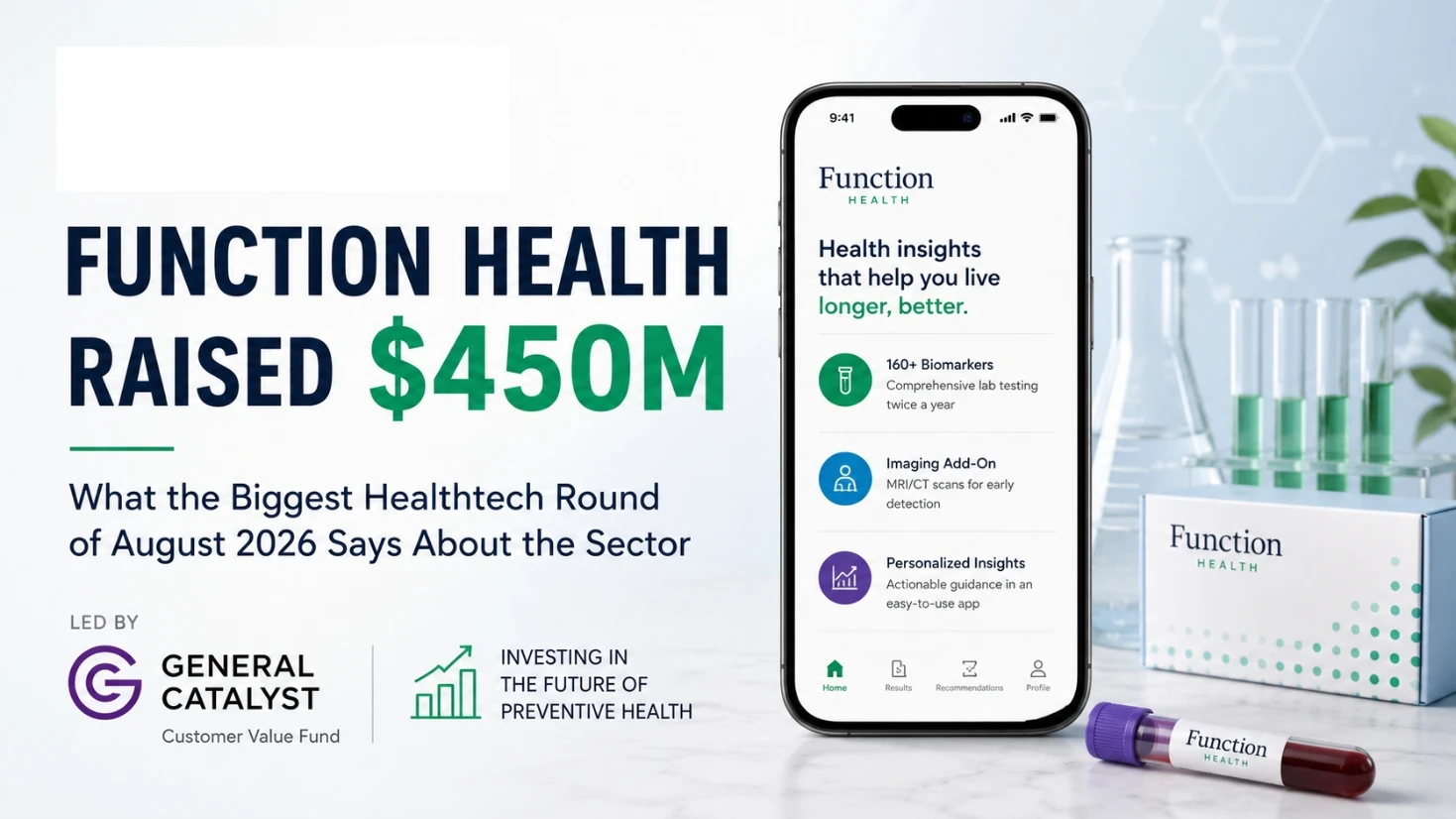
Function Health raised $450 million in growth financing on July 31, 2026, from General Catalyst’s Customer Value Fund (CVF). The round is not a traditional equity raise – it is a revenue-share structure that finances Function’s sales and marketing spend and pays back General Catalyst out of the customer revenue that spend generates. The deal comes eight months after Function’s $298 million Series B (November 2025, $2.5 billion valuation) and follows three acquisitions in 15 months: Ezra, Getlabs, and SuppCo. It stands out as one of the largest healthtech rounds of the year and a signal that investors are betting big on consumer-paid preventive health.
What Actually Happened
Function Health, the Texas-based preventive health company known for its membership-based lab testing platform, announced $450 million in growth financing on July 31, 2026. The capital came from General Catalyst’s Customer Value Fund, a financing vehicle structured differently from a standard venture round.
Function co-founder and CEO Jonathan Swerdlin framed the raise around the company’s long-stated mission: “Our mission is simple: enable you to live 100 healthy years.” General Catalyst’s Pranav Singhvi, who co-heads CVF, said the firm sees Function as “one of the defining companies of our generation” and believes it’s positioned to reach millions more members.
Neither company disclosed a new valuation tied to this round, which is itself a clue about the structure – more on that below.
Why This Isn’t a Normal “Round”
Most healthtech funding stories treat every raise as an equity round with a headline valuation. This one isn’t, and that’s the part worth understanding if you’re trying to actually learn something from the deal rather than just report the number.
General Catalyst’s Customer Value Fund is built to finance a company’s customer acquisition spend directly – the sales and marketing dollars that turn ad spend and outreach into paying members. Instead of buying equity, CVF takes a capped share of the value generated by the customers acquired with that capital, and it only gets paid once Function gets paid. The intent is growth capital that doesn’t dilute existing shareholders the way a traditional Series C would.
For founders, this matters more than the $450 million headline. It tells you General Catalyst is underwriting Function’s unit economics – the belief that a dollar spent acquiring a member reliably returns more than a dollar in membership revenue – rather than underwriting a story about future potential. That’s a different bet than a typical growth-equity check, and it’s a financing model more founders are likely to see pitched to them as this structure gets tested at scale.
Function Health’s Business, in Brief
| Detail | Figure |
| Founded | 2023 |
| Headquarters | Texas |
| Membership price | Starts at $365/year |
| Lab tests included | 160+ biomarkers, twice-yearly testing |
| Imaging add-on | MRI/CT scans, under $1,000 |
| Physical footprint | 200+ locations nationwide |
| Total funding to date | ~$800M+ (Seed, Series A, Series B, CVF growth financing) |
| Estimated valuation (as of Nov 2025 Series B) | $2.5 billion |
Function’s model combines three things under one membership: lab testing across biomarkers tied to heart, hormone, thyroid, liver, and kidney health; imaging for early detection of cancer, aneurysms, and strokes; and an app-based layer – its “Medical Intelligence Lab” – meant to turn results into ongoing, personalized guidance rather than a one-time report.
The Funding Timeline
| Round | Date | Amount | Lead Investor |
| Series A | 2024 | $53M | Andreessen Horowitz Bio + Health |
| Series B | November 2025 | $298M | – ($2.5B valuation) |
| Growth financing | July 31, 2026 | $450M | General Catalyst (Customer Value Fund) |
That’s roughly $800 million raised in under two years for a company launched in 2023 – a pace that puts Function among the fastest-scaling consumer health brands in the current cycle, alongside wearable maker Whoop and AI clinical-documentation companies.
The Acquisition Trail Behind the Raise
The $450 million doesn’t exist in isolation – it follows a deliberate roll-up strategy. In 15 months, Function made three acquisitions that each closed a specific gap in its platform:
- Ezra (May 2025) – added AI-powered full-body MRI scanning, letting Function combine lab testing with imaging under one roof.
- Getlabs (April 2026) – added a nationwide network for at-home and in-office blood draws, removing the need for members to visit a lab in person.
- SuppCo (May 2026) – added a supplement-management layer, extending Function from diagnostics into ongoing intervention.
Read together, the acquisitions show Function building toward a closed loop: test, scan, interpret, and then act on the results – all inside its own platform, rather than sending members elsewhere for the next step. That’s the strategic logic General Catalyst is financing, not just customer growth in isolation.
How the $450M Round Compares to 2026’s Other Mega-Deals
Function’s raise lands inside a broader surge in “mega-rounds” – deals of $100 million or more – that defined digital health funding through 2026.
| Company | Round | Amount | Segment |
| Function Health | Growth financing | $450M | Preventive health/diagnostics |
| Whoop | Series G | $575M | Wearables |
| Verily | Late-stage | $300M | Precision health |
| OpenEvidence | Series D | $250M | AI clinical search |
| Talkiatry | Series D | $210M | Psychiatry/telehealth |
| Oura (2025) | Series E | $900M | Wearables |
| Neko Health (2025) | – | $260M | In-person preventive scanning |
According to Rock Health, U.S. digital health companies raised $7.4 billion across 244 deals in the first half of 2026 alone – ahead of the $6.4 billion raised over the same period in 2025 – with mega-deals accounting for 45% of all capital deployed. Function’s round fits a clear pattern: capital is concentrating in fewer, larger, later-stage bets on companies that have already proven people will pay out of pocket for preventive care. Oura’s $900 million round and Neko Health’s $260 million raise in 2025 told the same story a year earlier – consumers are paying to know more about their own health before something goes wrong, and investors are backing the platforms capturing that demand at scale.
What It Signals About the Preventive Health Sector
Three things stand out for anyone tracking where healthtech capital is heading:
- Consumer-paid preventive care is now investable at mega-round scale: Function charges members directly – no insurance billing required – and investors are treating that direct-pay model as durable rather than niche.
- Roll-ups are replacing single-product bets: Function’s value isn’t one test or one scan; it’s the acquisitions stitched into a single membership. Expect more preventive-health platforms to grow by acquiring adjacent capabilities rather than building everything internally.
- Financing structures are diversifying: A revenue-share growth fund financing customer acquisition, instead of a straight equity round, is a structure other growth-stage health platforms are likely to explore as an alternative to dilutive late-stage rounds.
FAQ
How much did Function Health raise in total?
Function Health has raised roughly $800 million across four rounds: a Series A ($53M, 2024), a Series B ($298M, November 2025), and the $450M growth financing announced July 31, 2026.
Who led Function Health’s $450 million round?
General Catalyst’s Customer Value Fund led the round. Terms were not disclosed as a traditional equity valuation.
Is Function Health’s $450M round equity or debt?
Neither in the traditional sense. It’s structured as a revenue-share financing vehicle: General Catalyst funds Function’s customer acquisition spend and receives a capped share of the resulting customer revenue, paid only as Function is paid.
What is Function Health’s valuation?
Function was valued at $2.5 billion following its Series B round in November 2025. No new valuation was disclosed alongside the July 2026 growth financing.
What companies has Function Health acquired?
Ezra (AI-powered imaging, May 2025), Getlabs (at-home blood draws, April 2026), and SuppCo (supplement management, May 2026).
Was this the largest healthtech round of August 2026?
It was among the largest healthtech deals announced around that period and the largest in the consumer preventive-health category, based on publicly disclosed rounds tracked by Rock Health and industry trackers as of this writing.
What do you feel about this post?

Like

Love

Happy

Haha

Sad