A celebrity’s name on a pitch deck gets a startup covered in every entertainment blog within a week. It doesn’t get the unit economics right. That gap – between headline buzz and boring operational discipline – is why so many Indian celebrity-backed ventures raise money, generate a flurry of press, and quietly disappear two or three years later.
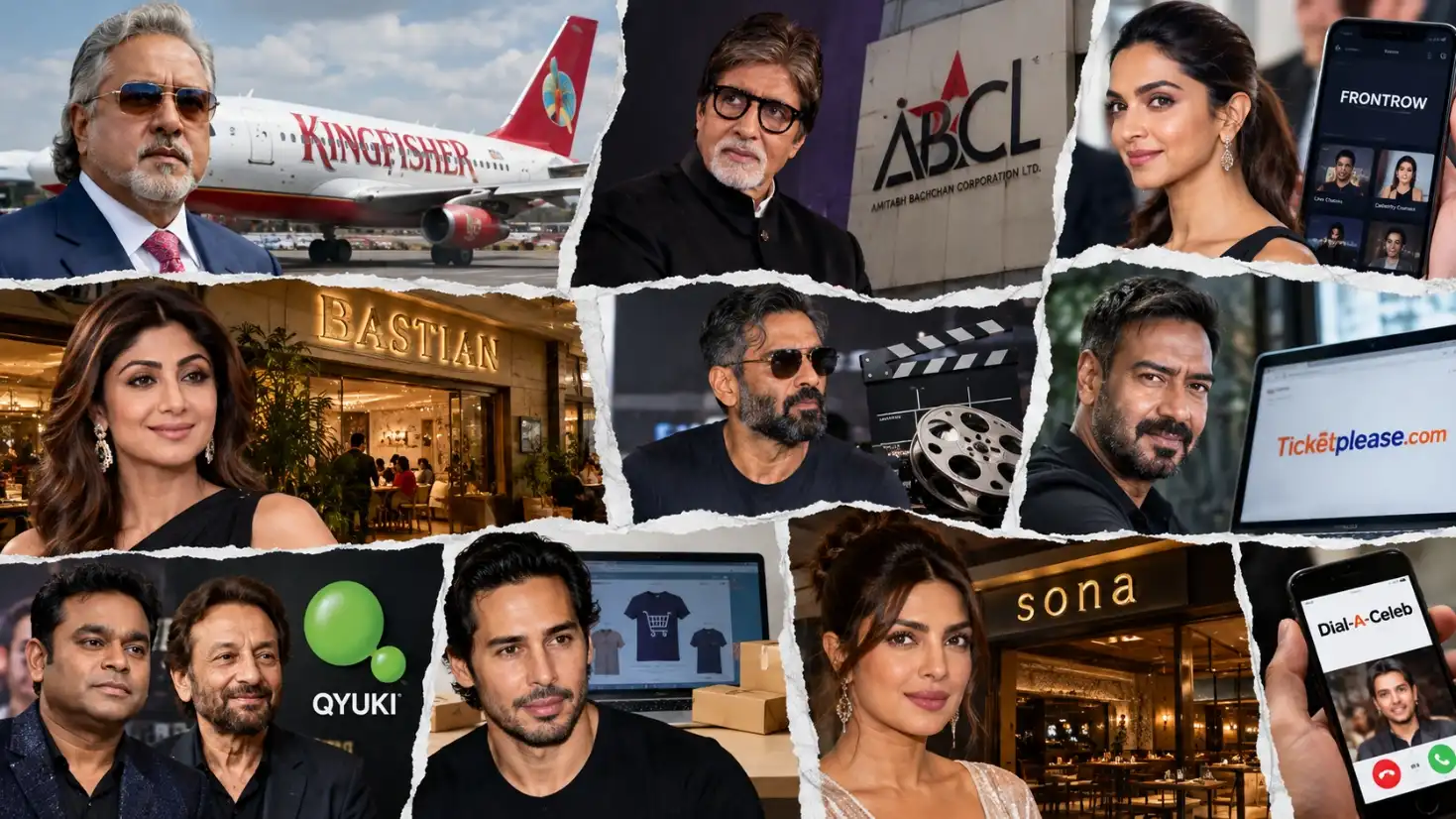
Ten Indian celebrity startups that shut down include Kingfisher Airlines (Vijay Mallya), Amitabh Bachchan Corporation Ltd, FrontRow (Deepika Padukone-backed), Bastian Bandra (Shilpa Shetty), Popcorn Motion Pictures (Suniel Shetty), Ticketplease (Ajay Devgn), Qyuki Digital Media (A.R. Rahman & Shekhar Kapur), Coolmaal.com (Dino Morea), Sona restaurant (Priyanka Chopra), and Dial-A-Celeb.
At a glance
| # | Startup | Celebrity | What it was | Fate |
| 1 | Kingfisher Airlines | Vijay Mallya | Full-service airline | Grounded 2012, ~$1.4B debt |
| 2 | ABCL | Amitabh Bachchan | Entertainment conglomerate | Bankrupt 1999 |
| 3 | FrontRow | Deepika Padukone (investor) | Celebrity-led skill app | Shut 2023, $17M+ raised |
| 4 | Bastian Bandra | Shilpa Shetty & Raj Kundra | Restaurant | Flagship outlet closed 2025 |
| 5 | Popcorn Motion Pictures | Suniel Shetty | Film production/F&B | Losses, restaurants shut |
| 6 | Ticketplease | Ajay Devgn | Ticket booking portal | Folded quietly |
| 7 | Qyuki Digital Media | A.R. Rahman & Shekhar Kapur | Youth media platform | Faded, major revamp |
| 8 | Coolmaal.com | Dino Morea | Merchandise e-commerce | Went dark |
| 9 | Sona | Priyanka Chopra | NYC restaurant | Closed 2025 |
| 10 | Dial-A-Celeb | Gaurav Chopra & Ranjan Agarwal | Celebrity video-chat app | Shut within a year |
1. Kingfisher Airlines – Vijay Mallya
This is the one everyone thinks of first, and for good reason. Mallya launched Kingfisher in 2005 as India’s answer to a “good times” full-service carrier – mood lighting, in-flight entertainment, the works. It never turned a profit in a single year of operation. By early 2012 the airline had racked up accumulated losses of over ₹70 billion, half its fleet was grounded, and staff were striking over unpaid salaries. The licence was suspended that October. Banks were left chasing close to $1.4–1.5 billion in dues, and Mallya was later declared a wilful defaulter before leaving the country. Not a startup in the venture-funded sense, but it’s the reference point every other entry on this list gets measured against.
2. Amitabh Bachchan Corporation Ltd (ABCL)
In 1995, at the height of his fame, Amitabh Bachchan launched ABCL with the ambition of building a Hollywood-style studio system in India – film production, distribution, and celebrity event management under one roof. The company’s biggest public bet, hosting the Miss World pageant in 1996, turned into a financial and controversy-laden fiasco. Successive film flops followed. By 1999 ABCL had collapsed into bankruptcy, and Bachchan personally carried roughly ₹90 crore in debt and 55 legal cases, with creditors moving to attach his Juhu bungalow. He rebuilt his fortunes years later, largely on the back of hosting Kaun Banega Crorepati – but ABCL itself stands as one of Bollywood’s most-cited cautionary business tales.
3. FrontRow
FrontRow is the closest thing on this list to a “proper” venture-backed startup gone wrong. Founded in 2019 by Mikhil Raj, Shubhadit Sharma, and Ishaan Preet Singh, it let people learn cricket from Suresh Raina, singing from Neha Kakkar, rap from DIVINE, and comedy from Biswa Kalyan Rath. Actress Deepika Padukone backed it as an early investor alongside Lightspeed and Elevation Capital, and the company raised more than $17 million across two rounds. It never found product-market fit. Nearly 90% of the workforce was laid off in 2022, acquisition talks with other edtech players fell through, and FrontRow shut down in mid-2023, returning around $2.5 million to investors. The core problem: celebrity-fronted learning is a great marketing hook, but it doesn’t automatically translate into retention or willingness to pay.
4. Bastian Bandra
Worth a note here on accuracy: Bastian itself isn’t dead – the flagship Bandra outlet is. Shilpa Shetty and co-owner Ranjit Bindra opened Bastian in 2016, and it became one of Mumbai’s most Instagrammed celebrity hangouts. In September 2025, Shetty announced the Bandra branch was closing “for good,” weeks after she and husband Raj Kundra were accused of defrauding a Mumbai businessman of ₹60 crore in a decade-long loan deal. The brand says it lives on through Bastian at the Top on Kohinoor Square’s 48th floor, but the timing – a flagship celebrity venue shutting right alongside a fraud allegation – is exactly why this one made headlines.
5. Popcorn Motion Pictures & Suniel Shetty’s restaurant ventures
Suniel Shetty turned producer with his banner Popcorn Motion Pictures and took losses on productions including Khel and Rakht. Speaking at the Moneycontrol Creator Economy Summit in 2023, he was candid about it: every restaurant he’s opened in the F&B business has shut down, because he couldn’t give them his full attention while acting. It’s a useful data point precisely because it isn’t dramatic – no scandal, no fraud case, just a well-known pattern of celebrities spreading themselves across too many ventures without operational focus.
6. Ticketplease – Ajay Devgn
Ajay Devgn launched Ticketplease as one of India’s earlier attempts at a one-stop entertainment ticketing portal, for movies, concerts, and plays. He promised to stay close to customers through a company blog. That blog got four posts before it stopped. The venture folded quietly, well before ticketing platforms like BookMyShow made the category work at scale – a reminder that being early isn’t the same as being right.
7. Qyuki Digital Media – A.R. Rahman & Shekhar Kapur
Two genuinely heavyweight creative names – composer A.R. Rahman and director Shekhar Kapur – teamed up to launch Qyuki as a platform spotlighting youth-focused content, built on Cisco’s cloud infrastructure with early investment from Cisco itself. On paper it had everything: talent, backing, and infrastructure. In practice, the platform never became the youth-media force it was pitched as, and by the late 2010s it was reportedly headed for a major overhaul rather than growth. It’s the least dramatic failure on this list – no bankruptcy, no fraud case – just a slow fade that’s easy to miss if you’re not looking for it.
8. Coolmaal.com – Dino Morea
Actor Dino Morea put money into Coolmaal.com, an e-commerce site selling promotional merchandise. It’s a small, low-visibility case compared to the others here, but it fits a pattern common across this list: a celebrity name attached to a commerce site with no clear differentiation from every other merchandise seller online. The site eventually went dark.
9. Sona – Priyanka Chopra
Priyanka Chopra co-founded Sona, an Indian restaurant in New York City, with restaurateur Maneesh Goyal in 2021, opened with a traditional puja ceremony. It ran for just over three years. Chopra withdrew her partnership, and months later, in mid-2025, Sona served its final brunch and closed for good. Unlike most entries here, this wasn’t framed as a financial collapse – more a partnership ending and a business not continuing without its original backers. Still, “celebrity restaurant closes a few years after a splashy launch” is close to the most common failure shape on this entire list.
10. Dial-A-Celeb
A quick honesty check on this one: Dial-A-Celeb wasn’t founded by a celebrity – it was built by entrepreneurs Gaurav Chopra and Ranjan Agarwal in 2016, selling access to celebrities through video chats and autographed merchandise. It’s included here because it’s the purest example of a startup betting its entire model on celebrity culture rather than a product. Within a year, celebrities started building their own direct-to-fan apps, wiping out Dial-A-Celeb’s reason to exist, and it shut down in 2017.
Why celebrity startups fail more often than they should
Look across these ten and the same three problems keep showing up:
The name substitutes for the plan: Investors write checks faster when a famous face is attached, which means less pressure on the founding team to prove product-market fit before spending. FrontRow raised $17M+ before it had a retention story that worked.
Divided attention: Suniel Shetty said it plainly – you can’t run a restaurant chain while you’re also shooting films. Most celebrities backing these ventures have a full-time job that isn’t the startup.
The buzz has an expiry date: Coolmaal, Ticketplease, and Dial-A-Celeb all rode an initial wave of press that a famous founder generates automatically. None of them built a reason for people to come back once the novelty wore off.
None of this means celebrity involvement is a red flag by default – Alia Bhatt’s early bet on Nykaa and MS Dhoni’s stake in Garuda Aerospace are the counter-examples. The difference is usually whether the celebrity is a genuine operator or advisor, or just a name on the press release.
FAQs
Do celebrity-backed startups fail more than regular startups in India?
No reliable data proves a higher failure rate specifically for celebrity ventures – most Indian startups fail regardless of who’s involved. What’s different is visibility: a celebrity failure gets covered by entertainment media as well as business media, so it feels more common than it may actually be.
Why did Kingfisher Airlines really shut down?
Kingfisher never posted a profit in any year of operation, and an aggressive, poorly integrated acquisition of Air Deccan added to the debt load. By 2012 accumulated losses crossed ₹70 billion and the aviation regulator suspended its licence after unpaid salaries triggered staff strikes.
Is Bastian restaurant completely shut down?
No. Only the Bandra flagship closed, in September 2025. The brand continues to operate as Bastian at the Top in Dadar West.
What’s the biggest lesson from these failures for new founders?
A celebrity co-founder or investor buys attention, not product-market fit. Every venture on this list that survived early buzz still had to solve retention, unit economics, and focused execution – the same problems every startup faces.
What do you feel about this post?

Like

Love

Happy

Haha

Sad